


In IB Business Management, leadership styles can feel like personality quizzes until you hit a case study and realize they are really about trade-offs. Picture a team that is behind schedule, under pressure, and quietly panicking. The leader has three paths: take control, share control, or change approach depending on what is happening. That single choice can lift motivation, improve decision-making, or sink morale.
The quick exam checklist (what to compare)
When you compare leadership styles in IB Business Management, keep your analysis tight:
-
Speed of decision-making (fast vs slow)
-
Employee motivation and morale (voice vs control)
-
Creativity and innovation (ideas flow vs compliance)
-
Quality of decisions (expert input vs leader judgment)
-
Best-fit context (crisis, routine, change, skilled teams)
For syllabus-aligned definitions, the IB Business Management glossary is a quick way to get precise wording before you write.
Autocratic leadership: control that buys speed
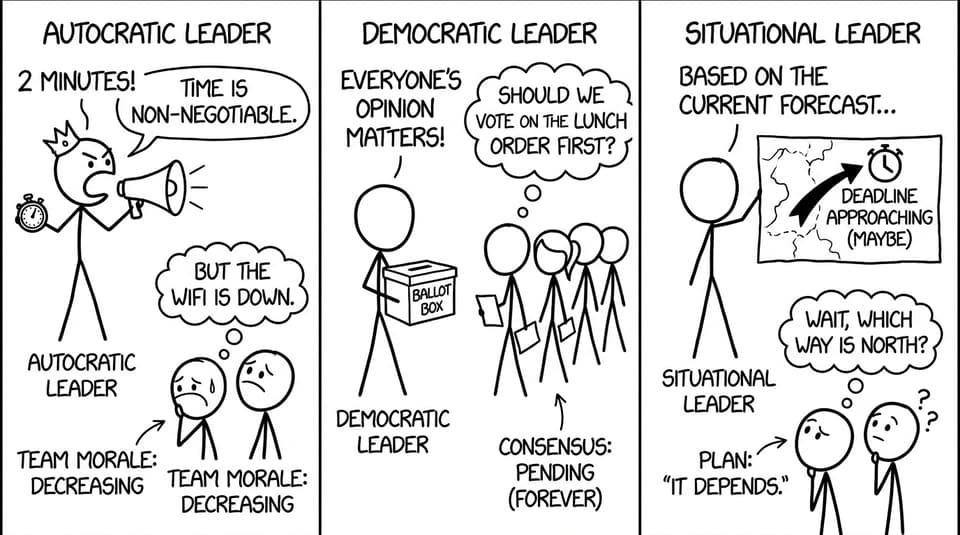
Autocratic leadership is simple: the leader decides, the team executes. In IB Business Management, it is most persuasive when the case study signals urgency, high risk, or inexperienced employees. You can argue it reduces ambiguity and keeps everyone aligned with a clear process.
The cost is usually human. Autocratic leadership can restrict two-way communication, reduce creativity, and lower motivation if employees feel ignored. In exam answers, link this to performance outcomes: short-term efficiency may rise, but long-term engagement can fall.
If you want a clean set of characteristics and language, use 2.3.3 Leadership Styles to anchor your definitions.
Democratic leadership: trust, ideas, and slower decisions
Democratic leadership pulls employees into the decision. In IB Business Management, that usually means higher commitment, stronger relationships, and better ideas because information flows upward instead of getting trapped at the bottom.
But participation takes time. If the business needs immediate action, democratic leadership can delay outcomes or create conflict when opinions split. A strong answer shows balance: democratic leadership is powerful for planning, creativity, and change initiatives, but risky when the clock is loud.
To connect leadership to the bigger HR unit, browse Unit 2: HR Management and borrow terminology about motivation, communication, and culture.
Situational leadership: the flexible option examiners love
Situational leadership is the most adaptable: the leader changes style depending on the team and the task. In IB Business Management, this is often the most realistic approach because businesses face mixed conditions. A situational leader might be autocratic during a crisis, democratic during strategic planning, and more hands-off with a highly skilled team.
The strength is fit. The weakness is judgment. Situational leadership demands emotional intelligence and accurate diagnosis: skill level, urgency, and stakes. In evaluation, show how a misread situation can backfire (for example, going democratic when safety requires strict control).
For practice applying leadership to mini case studies, the Leadership and management Questionbank helps you train the “choose and justify” muscle.

How to write this comparison in an IB answer
In IB Business Management, you score well when you make the comparison feel inevitable:
-
Start with the trigger in the case (crisis, change, conflict, low skills, high skills).
-
Choose a style and explain the mechanism (how it affects motivation, communication, and decision quality).
-
Evaluate the trade-off (what improves, what worsens).
-
Conclude with a context-dependent judgment (often situational, or a shift from autocratic to democratic as stability returns).
For leadership vs management framing (useful in longer responses), see 2.3.2 Management and Leadership notes.
Bringing it back to RevisionDojo
If leadership styles still blur together, treat them like tools, not labels. RevisionDojo helps you practice IB Business Management the way the exams demand it: applying concepts to messy situations. Use the Study Notes for clear definitions, Flashcards for fast recall, AI Chat to test your reasoning, and the Questionbank to practice exam-style responses with mark-friendly structure. When you are ready to level up, add Mock Exams, Predicted Papers, Grading tools, the Coursework Library, and Tutors to turn understanding into confident performance.
For a broader hub of support, start with IB Business Management Resources and build from there.


