


If you have ever looked at a company’s profit figure and thought, “Okay… but is that good?” you already understand why IB Business Management cares so much about profitability ratios.
Profitability ratios turn a single number into a story you can actually judge. They help managers, investors, and even examiners see whether a business is genuinely strong, quietly struggling, or just having a lucky month.
In IB Business Management, these ratios are not just calculations. They are interpretation tools. They help you explain financial success with evidence, not vibes.

The quick checklist (what to do in an exam)
When you see profitability data in IB Business Management, run this mental checklist:
-
Identify the ratio (gross profit margin, profit margin, ROCE)
-
State what it measures (what “success” means here)
-
Compare it (over time or against competitors)
-
Explain reasons (costs, pricing, efficiency, demand)
-
Judge implications for stakeholders
If you need the syllabus home base for this, start with 3.5 Profitability and liquidity ratio analysis.
Gross profit margin: pricing power and core efficiency
Gross profit margin asks a simple question: after paying the direct costs of making/buying the product, how much revenue is left?
That matters because it isolates the core trading performance. A high gross profit margin can suggest strong pricing power, efficient sourcing, or cost control. A falling gross profit margin might hint at rising input costs, discounting, or tougher competition.
For formula practice and clearer definitions, use 3.5.1 Profitability ratios notes and the IB Business Management data booklet.
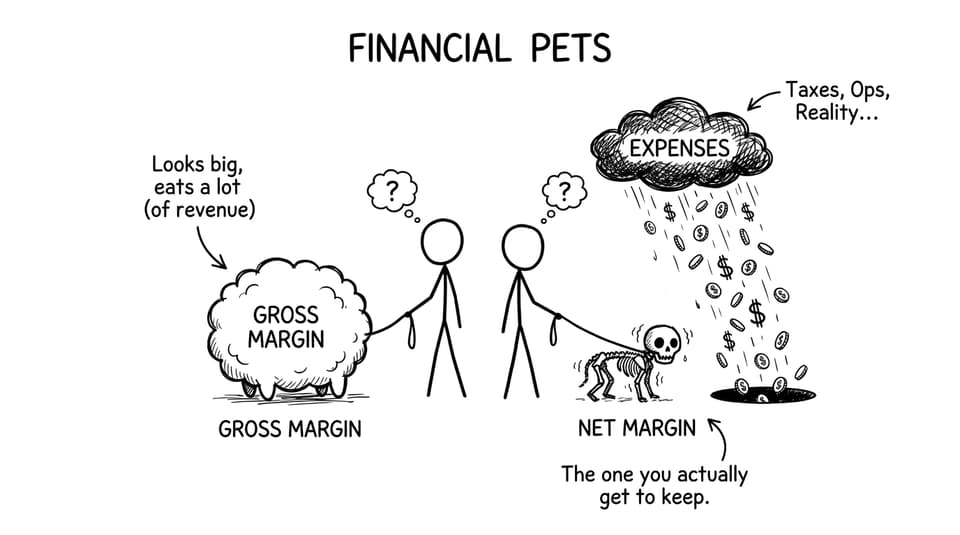
Net profit margin (profit margin): the “real life” version of profit
Profit margin (often taught as net profit margin in everyday language) widens the lens. It includes operating expenses, and in many contexts will use profit before interest and tax.
This is why it is so valuable in IB Business Management: it captures how well the whole business is run, not just the product.
If profit margin declines, you can discuss overheads rising, inefficient operations, higher wage costs, or weak cost control. If it increases, you can connect it to economies of scale, better productivity, or a stronger market position.
To revise improvement methods, see 3.5.2 Strategies to improve profitability ratios and connect the story back to 3.3 Costs and revenues.
ROCE: is the business using its long-term money wisely?
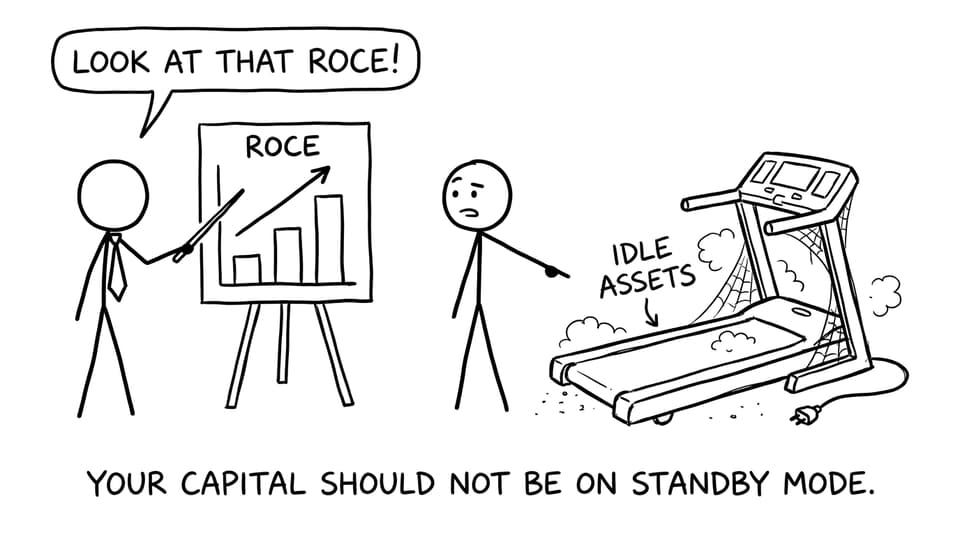
ROCE (Return on Capital Employed) is where IB Business Management becomes quietly philosophical.
A business can look “profitable” and still be wasteful. ROCE tells you whether the company is generating strong returns relative to the capital invested. High ROCE suggests capital is being used efficiently. Low ROCE may indicate overinvestment, idle assets, or poor strategic choices.
This is also where you can link to operational efficiency and capacity decisions. If you want extra context, browse Efficiency ratios notes.
Why ratios matter: trends and benchmarking
A ratio alone is a snapshot. What makes it powerful is comparison.
In IB Business Management, you can score evaluation marks by comparing profitability ratios over time (trend analysis) and against competitors (benchmarking). Improving ratios suggest better decisions or stronger demand. Falling ratios are early warnings, giving managers time to respond.
To strengthen your terminology for explanations, use the IB Business Management glossary.
Final takeaway (and your next revision move)
Profitability ratios help businesses understand financial success because they translate raw numbers into judgment: efficiency, pricing power, cost control, and capital effectiveness. That is why IB Business Management exam questions love them; they let you calculate, explain, compare, and evaluate.
To practice the exact style of questions you will face, use the 3.5 topic Questionbank and reinforce formulas with 3.5 flashcards. If you want everything in one place: Questionbank, Study Notes, Flashcards, AI Chat, Grading tools, Predicted Papers, Mock Exams, Coursework Library, and Tutors, RevisionDojo is built to make IB Business Management feel structured again.