

Sometimes a business doesn’t fail because the product is bad. It fails because the money arrives at the wrong time.
That’s the quiet lesson inside IB Business Management finance: choosing a source of finance isn’t just “getting funds.” It’s choosing a set of consequences: for cash flow, ownership, risk, and even how much sleep the manager gets.

IB Business Management checklist: how businesses choose finance
Use this fast checklist in case studies:
-
Time frame: short-term vs long-term need
-
Cost: interest, fees, opportunity cost, dividend expectations
-
Risk: repayment pressure and probability of cash flow problems
-
Control: dilution of ownership vs keeping decision-making power
-
Flexibility: can terms change, can it be repaid early, how strict are conditions?
-
Availability: size, reputation, collateral, track record
-
Purpose: working capital, inventory, expansion, equipment, emergency buffer
For the syllabus core, revise 3.2 Sources of finance alongside 3.1 Introduction to finance.
Match the time frame to the source of finance
In IB Business Management, one of the cleanest evaluation points is alignment: finance should match the life of the asset or need.
If the problem is short-term (a seasonal dip, delayed customer payments, a one-off inventory order), businesses often prefer short-term finance such as overdrafts and trade credit. If the need is long-term (new machinery, new premises, expansion), long-term sources like loans, share capital, or retained profit make more sense.
The trick for exams: link time frame to cash flow forecasts. A short-term gap is often visible in the forecast, which you can revise in 3.7 Cash flow notes.
Cost, risk, and control: the triangle you keep reusing
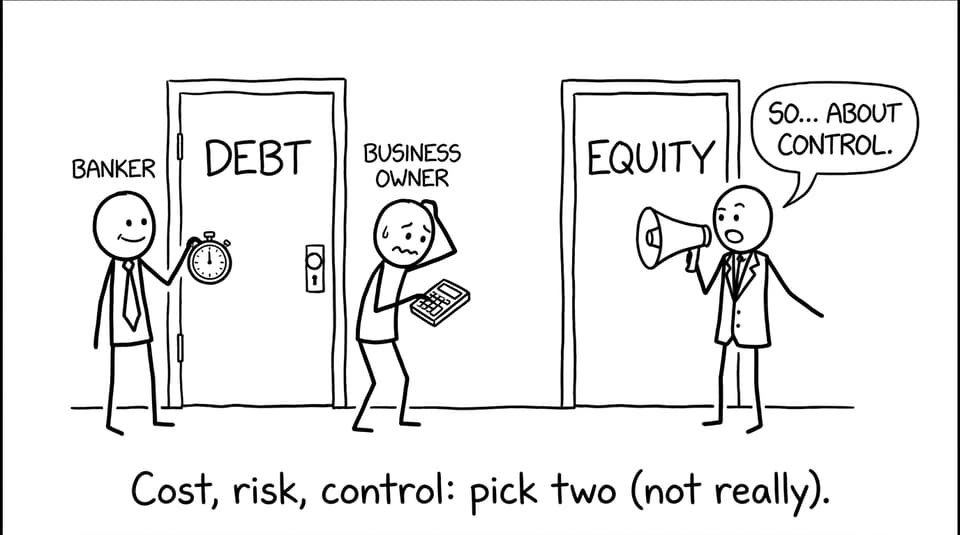
Businesses rarely get “cheap, low-risk, no-loss-of-control” all at once.
Debt finance (like loans) adds interest and creates a fixed obligation. It can be efficient when profits are stable, but dangerous when sales are uncertain. Equity finance reduces repayment pressure, but can dilute ownership and shift control.
A strong IB Business Management answer compares at least two sources and evaluates them using cost, risk, and control, notnot just definitions.
To tighten your evaluation language, use key terms from the IB Business Management glossary and consider the firm’s gearing position (HL extension).
Flexibility and availability: what the business can actually access
A new business can want a big loan and still not qualify. Availability depends on credibility, collateral, existing cash flow, and reputation.
Flexibility matters too. Some sources lock a business into terms that don’t fit a changing market. Others allow renegotiation or early repayment. In case studies, this becomes a powerful point: fast-moving industries often value flexibility more than the lowest theoretical cost.
When you practice this skill, use the 3.2 Sources of finance Questionbank to rehearse exam-style evaluation, not just recall.

Purpose matters: finance should fit the job
A business financing machinery should think differently than a business financing advertising or a cash emergency.
For big long-term decisions, managers may use investment appraisal (payback, ARR, NPV HL) to judge whether the project is worth funding in the first place. That links directly to Investment appraisal techniques and the broader investment appraisal section.
Conclusion: turn “it depends” into an exam-ready method
Choosing a source of finance is really choosing what kind of pressure a business can live withrepayment pressure, ownership pressure, or cash flow pressure. In IB Business Management, you score highest when you match the finance to the time frame and purpose, then evaluate cost, risk, control, flexibility, and availability.
To lock this in before exams, use RevisionDojo as your full system: learn the core ideas in the notes, drill decisions in the Questionbank, cement definitions with Flashcards, and refine evaluation with AI Chat and grading tools. Start here: IB Business Management resources hub and build your confidence one scenario at a time.