
Batteries feel like magic until the moment your calculator dies mid-paper and you realize the “magic” had rules all along. In IB Chemistry, batteries are one of those topics that rewards you for thinking calmly: two half-reactions, one wire, one ionic pathway, and a voltage that comes from tendency, not effort. Once you see the pattern, every battery question starts looking like the same story with different characters.
In this guide, we’ll explain how batteries work simply, in the exact language IB Chemistry exam questions expect.
Battery basics (the IB Chemistry checklist)
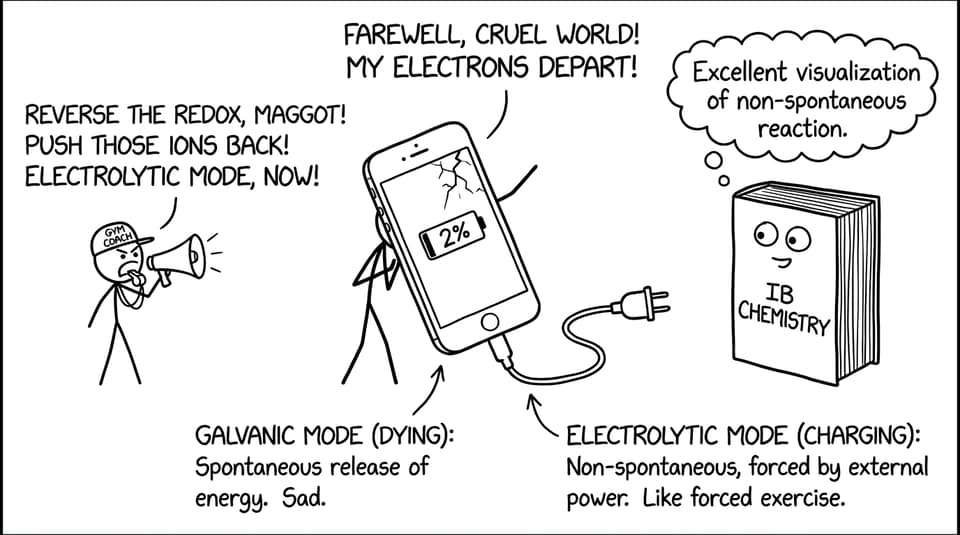
A battery is a device that converts chemical energy into electrical energy using a spontaneous redox reaction in a galvanic (voltaic) cell.
To work, a battery needs:
-
Two electrodes (different materials or different chemical environments)
-
An electrolyte (lets ions move)
-
A separator (stops the electrodes touching directly)
-
An external circuit (a path for electrons)
If you want the syllabus framing, it helps to pair this article with RevisionDojo’s IB Chemistry electrochemistry pages and practice: Electrochemical cells (HL) and the matching Electrochemical cells (HL) Questionbank.
The simple idea behind batteries: split the redox
A battery works because it separates oxidation and reduction so electrons are forced to travel through a wire.
Here’s the whole mechanism in slow motion:
-
At one electrode, a substance loses electrons (oxidation).
-
At the other electrode, a substance gains electrons (reduction).
-
Electrons move through the external circuit (that’s the current you use).
-
Ions move inside the electrolyte to keep charge balanced.
That separation is the heart of electrochemistry in IB Chemistry. If redox is still fuzzy, revise the core definitions first: Oxidation and reduction explained for IB Chemistry and What’s a redox reaction? (IB Chemistry).
Anode vs cathode (the rule that never changes)
In IB Chemistry, students lose marks here because they memorize signs instead of meanings.
Anode
-
Oxidation happens at the anode
-
Electrons are produced here
-
In a galvanic battery (discharging), the anode is negative
Example oxidation half-equation:
Zn(s) → Zn²⁺(aq) + 2e⁻
Cathode
-
Reduction happens at the cathode
-
Electrons are used here
-
In a galvanic battery (discharging), the cathode is positive
If you want a clean, exam-aligned explanation with half-equations and electrode labels, use: Electrochemical cells: oxidation and reduction (Notes).
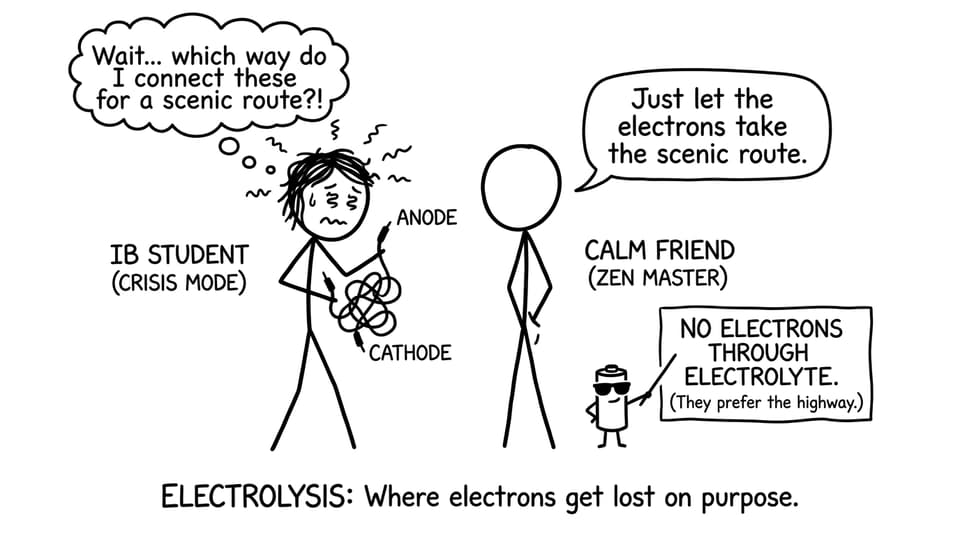
Why electrons go through the wire (and not the electrolyte)
A battery doesn’t “create electricity” out of nowhere. It creates a push (potential difference) that makes electrons travel along the only available electron pathway: the metal wire.
Inside the battery, the electrolyte conducts via ions, not electrons. That’s why the internal ionic movement matters:
-
Cations move toward the cathode
-
Anions move toward the anode
Without ion migration, charge would build up, and electron flow would stop almost immediately.
This is also why electrolyte concepts show up across IB Chemistry papers: conductivity, ionic solutions, and electrochemical cells overlap. For a quick refresher, see Electrolyte solutions explained.
Battery “types” you should recognize in IB Chemistry
You don’t need to memorize every commercial design, but you should recognize the chemistry patterns.
Alkaline cells
Common household batteries often use a zinc-based anode, manganese dioxide at the cathode, and an alkaline electrolyte. In questions, focus on identifying oxidation vs reduction and tracing electron flow.
Lead-acid batteries
Car batteries are built from multiple cells in series. They’re rechargeable because the overall redox can be driven in reverse with an external power supply.
Lithium-ion batteries
These rely on ions shuttling between electrodes (often graphite and a lithium metal oxide). In IB Chemistry terms, the key idea is still controlled redox plus internal ion movement.
Why batteries run out (the unromantic answer)
A battery stops delivering usable electrical energy when the reaction can’t keep going effectively. Typical reasons include:
-
Reactants are used up
-
Products build up and slow down reactions
-
Internal resistance increases (ion movement becomes harder)
-
The voltage drops below what the device needs
In exam wording: the cell potential decreases as conditions move away from the ideal assumptions, and the driving force for electron flow weakens.
Where voltage comes from: standard electrode potentials
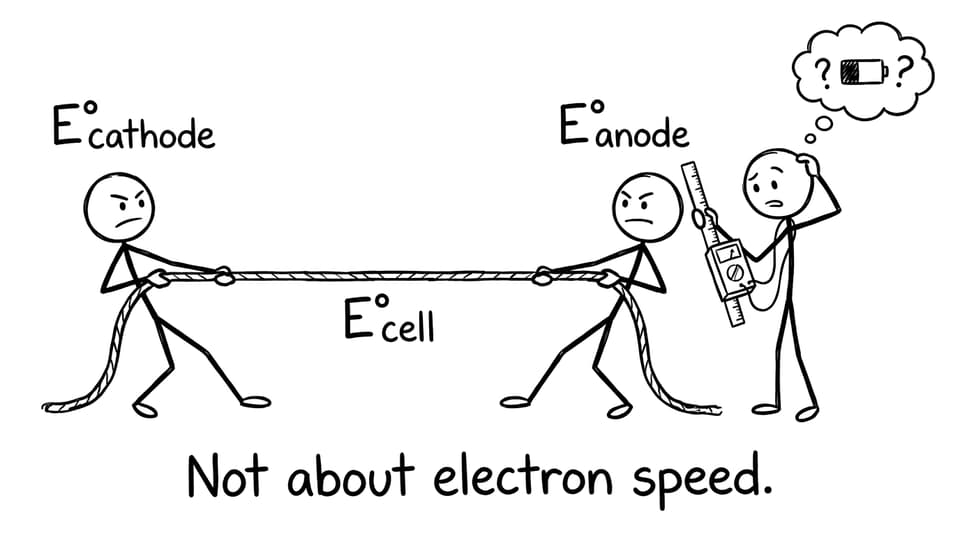
In IB Chemistry, voltage is tied to reduction potentials (E° values), not “how fast electrons move.”
Key relationship:
E°cell = E°cathode − E°anode
-
A more positive E° means a stronger tendency to be reduced.
-
Pairing two half-cells with a bigger difference in E° gives a bigger E°cell.
-
If E°cell is positive under standard conditions, the overall reaction is spontaneous.
To make this feel intuitive, read: Standard electrode potential explained.
Quick exam traps (and how to dodge them)
-
“The anode is always positive.” Not in a galvanic battery. In IB Chemistry, oxidation defines the anode, then the sign depends on cell type.
-
“Electrons travel through solution.” In electrochemistry, electrons travel through the wire, ions through the electrolyte.
-
“Voltage is about electron speed.” Voltage is about potential difference based on reduction tendencies.
To practice these exact traps in context, RevisionDojo’s Questionbank feature is useful because it forces the correct label-use under time pressure.
Conclusion: batteries are just IB Chemistry in disguise
A battery is what happens when IB Chemistry redox stops being a diagram and starts powering your life: oxidation at the anode, reduction at the cathode, electrons through the wire, ions through the electrolyte, and voltage from electrode potentials. If you can tell that story clearly, you can handle cell diagrams, half-equations, E° questions, and common misconceptions.
When you’re ready to turn understanding into marks, use RevisionDojo’s IB Chemistry ecosystem: targeted IB Chemistry resources, electrochemistry Study Notes, Flashcards for definitions, AI Chat for “why” questions, Grading tools for written explanations, and the Questionbank plus Mock Exams and Predicted Papers to rehearse under exam conditions. (And if your coursework touches electrochemistry, the Coursework Library and Tutors can keep your reasoning tight.)