
Standard electrode potential can feel like the kind of table you only understand after the exam. You stare at rows of half-equations, a few plus and minus signs, and suddenly your brain tries to negotiate: “What if I just remember zinc is reactive and hope for the best?”
But in IB Chemistry, standard electrode potential (E°) is one of those quiet ideas that turns confusion into certainty. Once you can read E° properly, you can rank oxidizing and reducing agents, predict whether a redox reaction is spontaneous, and calculate the voltage of a cell with confidence.
The exam checklist (the 30-second version)
Use this IB Chemistry checklist whenever E° appears:
-
E° values are measured under standard conditions and written as reduction half-equations.
-
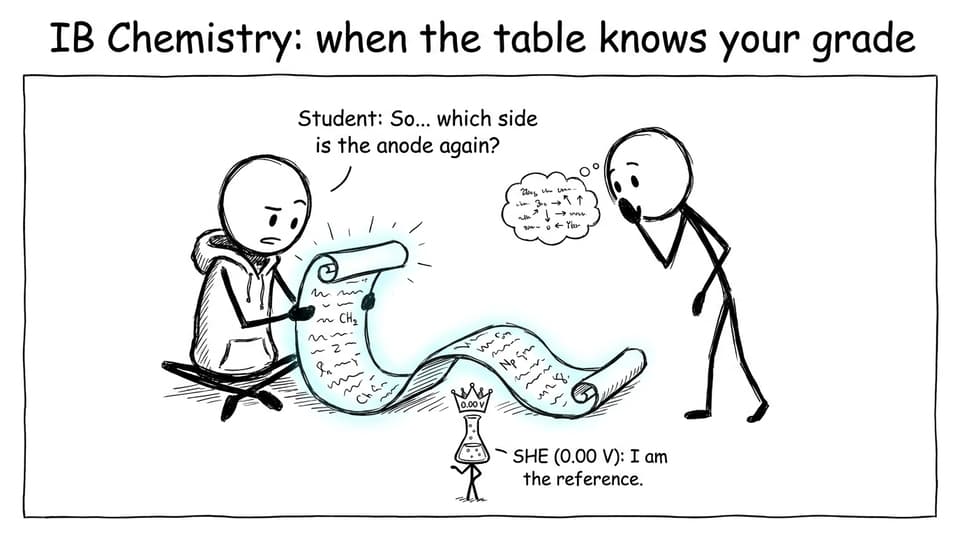
The reference is the standard hydrogen electrode (SHE), defined as 0.00 V.
-
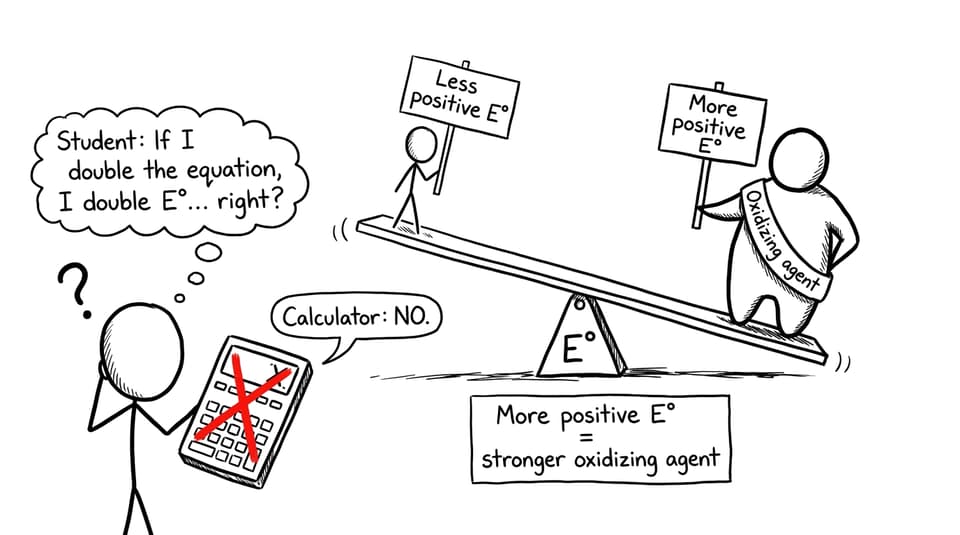
More positive E° means the species is more easily reduced (stronger oxidizing agent).
-
More negative E° means the species is more easily oxidized in reverse (stronger reducing agent).
-
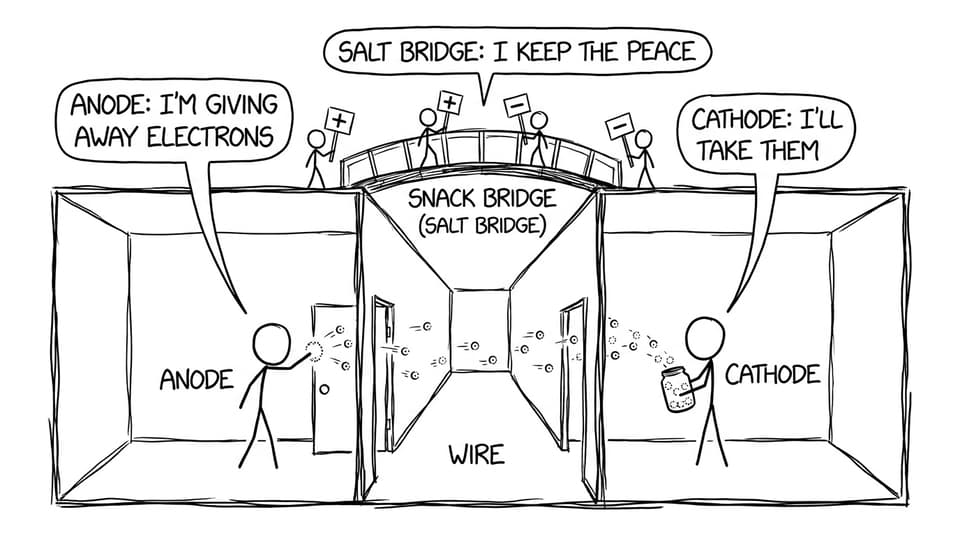
For galvanic cells: (E^\circ_{\text{cell}} = E^\circ_{\text{cathode}} - E^\circ_{\text{anode}}) and spontaneity needs (E^\circ_{\text{cell}} > 0).
If you want structured practice after this, the IB Chemistry Redox Processes hub is the cleanest place to connect the definitions to exam-style questions.
What standard electrode potential (E°) actually means
In IB Chemistry, standard electrode potential (E°) is the potential difference (voltage) of a half-cell measured relative to the standard hydrogen electrode under standard conditions.
It’s not “how reactive a metal feels.” It’s a measurement of a tendency: how strongly a species wants to gain electrons (be reduced) when compared to hydrogen.
The standard conditions you must quote
E° values assume:
-
298 K (25°C)
-
100 kPa (for gases)
-
1.0 mol dm⁻³ (for aqueous ions)
-
pure substances for solids and liquids
These are the conditions behind the data table in the IB Chemistry Data Booklet and they matter because changing concentration or pressure changes the potential (that becomes a non-standard cell potential).
Why everything is compared to the SHE
A class can’t compare test scores unless everyone took the same test. E° values are similar: we need a shared reference.
The standard hydrogen electrode is defined using:
-
(\text{H}_2(g)) at 100 kPa
-
(\text{H}^+(aq)) at 1.0 mol dm⁻³
-
an inert platinum electrode surface
Its potential is set to 0.00 V by definition. That’s why every other E° value can be positive or negative, but the SHE stays perfectly calm in the middle of the scale.
How to interpret E° values (the meaning of plus and minus)
Here’s the core translation into IB Chemistry language:
More positive E°
-
reduction is more favorable
-
species gains electrons more readily
-
species is a stronger oxidizing agent
More negative E°
-
reduction is less favorable
-
the reverse reaction (oxidation) is more favorable
-
species (in reduced form) is a stronger reducing agent
To strengthen this foundation, pair this with Oxidation and Reduction Explained for IB Chemistry so the “agent” language becomes automatic.
Reading the reduction table like the IB expects
The IB data booklet lists reduction half-equations only. For example:
-
(\text{Cu}^{2+} + 2e^- \rightarrow \text{Cu}(s)) (E^\circ = +0.34,V)
-
(\text{Mg}^{2+} + 2e^- \rightarrow \text{Mg}(s)) (E^\circ = -2.37,V)
Copper(II) has a positive E°, meaning it’s relatively happy to be reduced. Magnesium(II) has a very negative E°, meaning magnesium metal is usually the one that gets oxidized (so Mg is a strong reducing agent).
If your half-equations are shaky under pressure, revise the method in Half-Equations Explained Simply.
Predicting spontaneity and calculating E°cell
A redox reaction in a galvanic (voltaic) cell is spontaneous when the overall cell potential is positive:
E^\\circ\_{\\text{cell}} = E^\\circ\_{\\text{cathode}} - E^\\circ\_{\\text{anode}}How to decide which is which in IB Chemistry:
-
The half-equation with the more positive E° stays as reduction at the cathode.
-
The other half-equation is reversed to become oxidation at the anode.
Quick example
Given:
-
(\text{Ag}^+ + e^- \rightarrow \text{Ag}) (E^\circ = +0.80,V)
-
(\text{Zn}^{2+} + 2e^- \rightarrow \text{Zn}) (E^\circ = -0.76,V)
Silver is reduced (more positive E°). Zinc is oxidized (reverse the zinc equation). Then:
E^\\circ\_{\\text{cell}} = 0.80 - (-0.76) = +1.56,VPositive means spontaneous.
To see how IB labels anodes/cathodes in full cell context, read IB Chemistry: Galvanic Cells Explained Simply and then drill questions in the Electrochemical cells (HL) Questionbank.
Common IB Chemistry mistakes to avoid
-
Mixing up agents: more positive E° means stronger oxidizing agent, not reducing agent.
-
Thinking E° scales with coefficients: multiplying a half-equation does not multiply E°.
-
Using “bigger minus smaller” blindly: always use (E^\circ_{\text{cathode}} - E^\circ_{\text{anode}}), not a guessing rule.
For a bigger picture of how electrochemistry shows up in real contexts (and exams), IB Chemistry: How Batteries Work (Explained Simply) is a helpful bridge.
Closing: make E° a scoring topic, not a guessing topic
Standard electrode potential is one of the most reliable mark sources in IB Chemistry because it rewards calm procedure: read the table as reductions, choose cathode vs anode, compute (E^\circ_{\text{cell}}), and interpret the sign.
When you want that procedure to stick, RevisionDojo is built for repetition without burnout: use the Study Notes to anchor the definitions, the Flashcards to automate the language, and the Questionbank with AI Chat to correct your reasoning step-by-step. Add Grading tools, Mock Exams, Predicted Papers, the Coursework Library, and Tutors when you want the full exam push. Start with the IB Chemistry resources hub and turn E° into an easy win.