

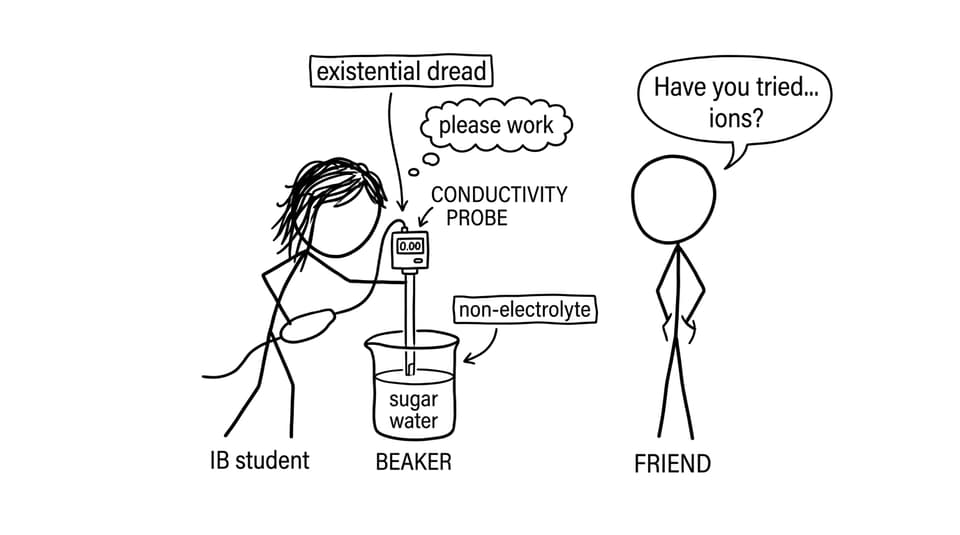
You dip the conductivity probe into a beaker and wait for that satisfying beep. Nothing. The screen stares back: 0.00. In IB Chemistry, that tiny moment can feel like a judgement on your whole revision plan.
But it’s rarely the probe. It’s the particles.
Electrolyte solutions sit quietly underneath huge parts of IB Chemistry: conductivity tests, acid-base theory, equilibrium, electrochemical cells, and even those questions that look like they’re about “simple lab observations” but are really about ions and movement.
Electrolyte solutions: the exam definition you can actually use
In IB Chemistry, an electrolyte solution is a solution that contains mobile ions and therefore conducts electricity.
That word mobile matters. A solid ionic compound has ions, but they’re locked in a lattice, so it won’t conduct. Dissolve it (or melt it) and the ions can move, so current can flow.
Common IB Chemistry examples:
-
NaCl(aq), KBr(aq), MgSO₄(aq)
-
Strong acids like HCl(aq)
-
Strong bases like NaOH(aq)
-
Weak acids like CH₃COOH(aq) (still an electrolyte, just weaker)
If you want a quick refresher on where electrolytes show up in redox and cells, pair this with IB Chemistry 9.2 Electrochemical Cells Notes.
Quick checklist: how to spot an electrolyte in seconds
When you’re moving fast through IB Chemistry multiple choice or data-based questions, use this:
-
Ionic compound dissolved in water (and soluble) -> electrolyte
-
Strong acid/strong base in water -> strong electrolyte
-
Weak acid/weak base -> weak electrolyte (equilibrium present)
-
Covalent molecule that stays as molecules (e.g., sugar, ethanol, urea) -> non-electrolyte
To build speed with exam-style identification, the IB Chemistry Topic Acids and Bases Questionbank (SL/HL) is a reliable way to drill the patterns.
Why electrolyte solutions conduct (and metals don’t help you here)
Metals conduct because electrons move. Electrolyte solutions conduct because ions move.
In IB Chemistry terms:
-
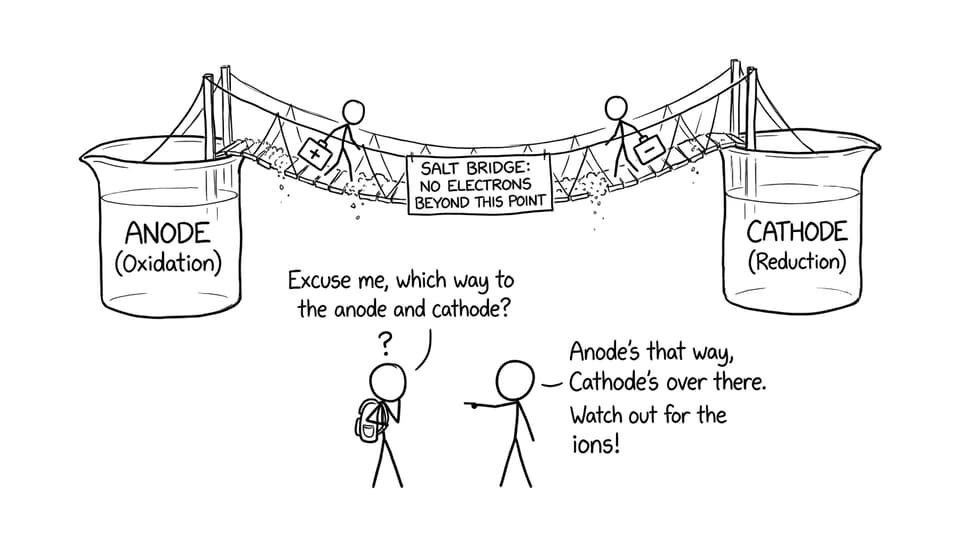
Cations (positive ions) migrate toward the cathode
-
Anions (negative ions) migrate toward the anode
Their opposite motion carries charge through the solution, completing the circuit.
This becomes especially testable once you reach electrolysis and cell diagrams. A good companion read is Electrolysis Explained for IB Chemistry.
Strong vs weak electrolytes in IB Chemistry (the story is dissociation)
A surprising number of IB Chemistry mistakes come from confusing strength with concentration. Strength is about degree of dissociation/ionization, not how much you poured.
Strong electrolyte solutions
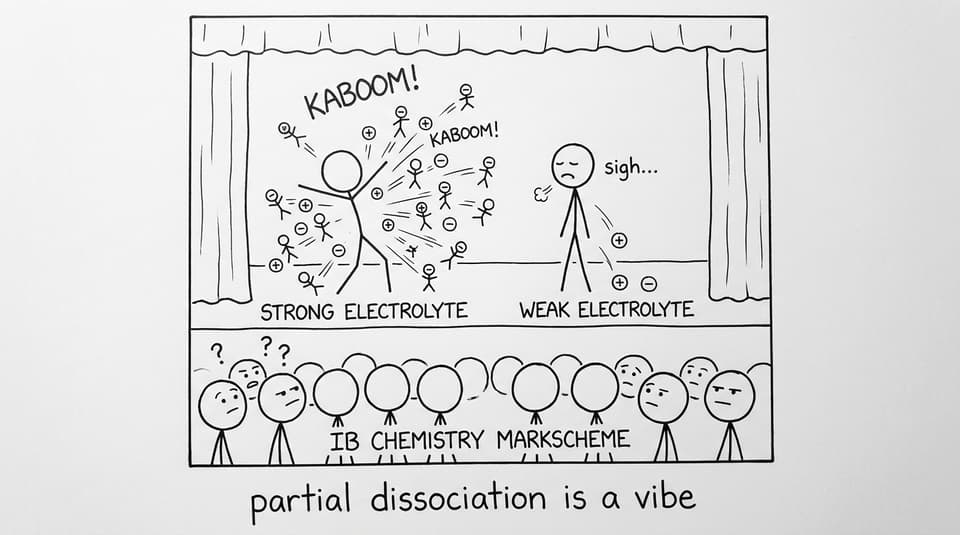
Strong electrolytes dissociate completely (or essentially completely) in water.
Typical IB Chemistry strong electrolytes:
-
Strong acids (HCl, HNO₃, H₂SO₄)
-
Strong bases (NaOH, KOH)
-
Soluble salts (NaCl, KBr)
What the examiner expects you to say:
-
Many ions in solution
-
High conductivity
-
No meaningful equilibrium between ions and undissociated particles
Weak electrolyte solutions
Weak electrolytes partially ionize in water and establish an equilibrium.
Typical IB Chemistry weak electrolytes:
-
CH₃COOH(aq)
-
NH₃(aq)
Exam consequences:
-
Fewer ions in solution
-
Lower conductivity (but not zero)
-
Equilibrium language is required (use a reversible arrow)
If this is a recurring weak spot, revise alongside R3.1.6 Strong and weak acids and bases Notes.
How electrolyte solutions form: dissociation vs ionization
IB Chemistry often wants the process name as much as the final ions.
Dissociation (ionic compounds)
Example: NaCl(s) dissolving
Water’s polarity stabilizes separated ions via ion-dipole attractions:
- NaCl(s) -> Na⁺(aq) + Cl⁻(aq)
Ionization (molecular acids and bases)
Example: HCl in water (strong acid)
- HCl(aq) -> H⁺(aq) + Cl⁻(aq)
Example: ammonia (weak base)
- NH₃(aq) + H₂O(l) ⇌ NH₄⁺(aq) + OH⁻(aq)
To link this to proton transfer language, see IB Chemistry R3.1 Proton Transfer Reactions Notes.
Properties examiners love: beyond “it conducts”
In IB Chemistry, electrolyte solutions connect to multiple marks:
-
Conductivity trends: more ions (and higher charge) generally increases conductivity
-
pH and acidity/basicity: more H⁺ or OH⁻ produced means stronger acid/base behavior
-
Electrochemical necessity: cells require ionic movement; without ions, circuits stall
-
Colligative properties: electrolytes create more particles, strengthening boiling point elevation/freezing point depression compared to non-electrolytes
For the cell-specific story of ion flow, Purpose of a Salt Bridge in Electrochemical Cells is a clean, markscheme-friendly explanation.
A calm way to revise electrolyte solutions (and actually remember them)
If IB Chemistry revision has taught most students anything, it’s that understanding beats memorizing when pressure hits. Electrolyte solutions are a perfect example: once you picture mobile ions as the reason behind conductivity, acid strength, equilibrium, and cells, the topic stops being a list and starts becoming a system.
When you’re ready to make that system automatic, RevisionDojo is built for it: use the Study Notes to lock in definitions, the Flashcards for fast retrieval, the Questionbank to spot patterns, and AI Chat when a markscheme phrase won’t stick. Then tighten exam timing with Mock Exams, Predicted Papers, and Grading tools that show you exactly where the marks are slipping. If you want human support, the Tutors and Coursework Library keep you moving when motivation dips.
For a structured starting point, visit IB Chemistry - RevisionDojo and build a short daily loop around electrolyte solutions in IB Chemistry: concept, question, correction, repeat.