
Redox shows up in IB Chemistry the way a chorus shows up in a song: once you notice it, you hear it everywhere. Batteries. Rust. Combustion. Even those exam questions that look innocent until you realise they’re secretly asking, “Where did the electrons go?” If you can track electron transfer calmly, redox stops feeling like a trick and starts feeling like a map.
Redox in IB Chemistry: the quick checklist
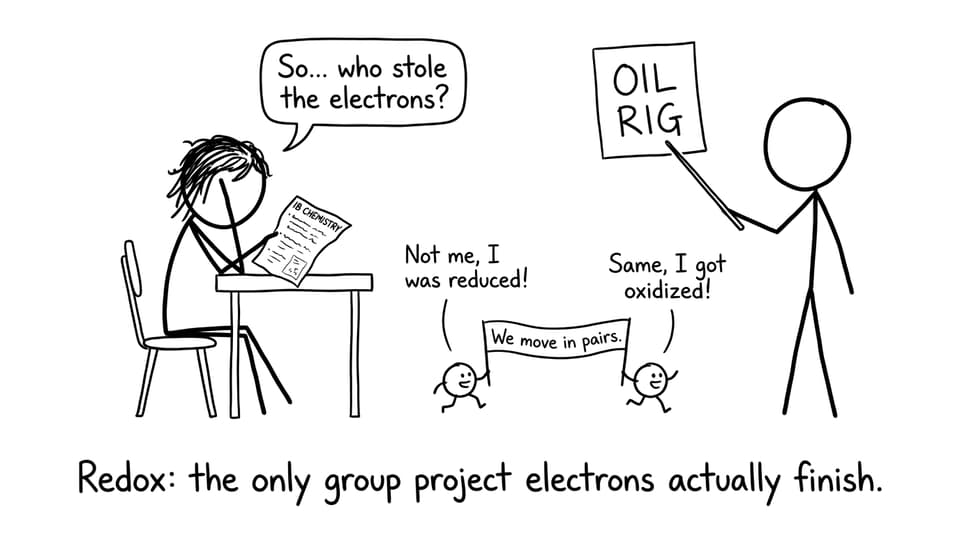
A redox reaction (reduction-oxidation) is any reaction where:
-
Oxidation and reduction happen together
-
Electrons are transferred between species
-
One species loses electrons (oxidation)
-
One species gains electrons (reduction)
If you want your redox answers to sound like an examiner wrote them, build practical confidence too: Tips to Improve Your Lab Skills for IB Chemistry.
The two definitions you must know for IB Chemistry
In IB Chemistry, examiners expect you to recognise redox using both electrons and oxidation states.
Oxidation
-
Loss of electrons
-
Increase in oxidation state
Reduction
-
Gain of electrons
-
Decrease in oxidation state
The mnemonic OIL RIG helps, but don’t stop there. You also need to apply it in equations and unfamiliar contexts. A clean refresher is: Oxidation and Reduction Explained for IB Chemistry.
What makes a reaction “redox” in IB Chemistry?
A reaction is redox if at least one element changes oxidation state. That’s the fastest test when electrons aren’t shown.
Classic example (often used to introduce electrochemistry):
-
Oxidation: Zn(s) → Zn²⁺(aq) + 2e⁻
-
Reduction: Cu²⁺(aq) + 2e⁻ → Cu(s)
Together, they form the overall redox process. This same logic later becomes the backbone of cells, electrode potentials, and electrolysis.
To practise this in a syllabus-aligned way, use the topic hub: IB Chemistry Redox Processes.
Electron transfer: why half-equations matter in IB Chemistry
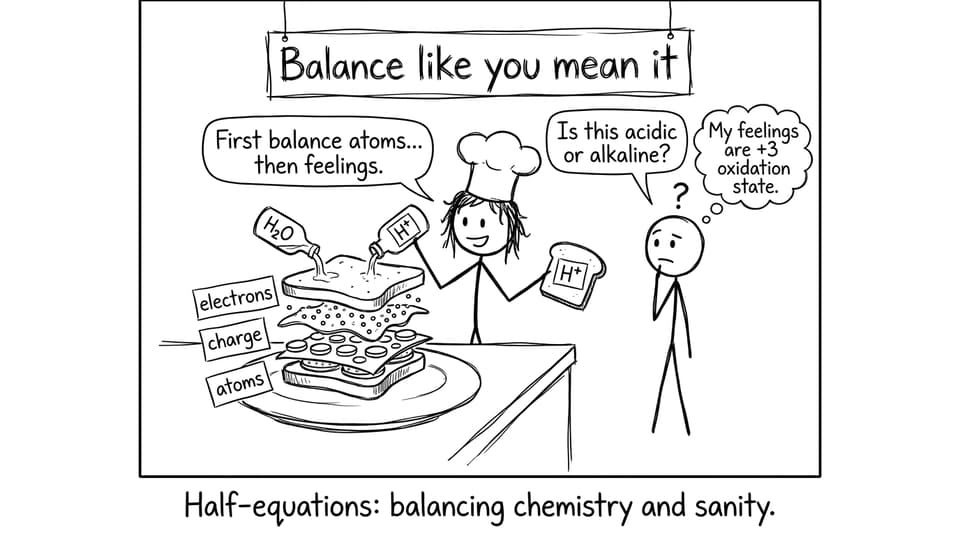
Every IB Chemistry redox question is really testing one idea: electrons lost = electrons gained. Half-equations are your tool to prove that you understand this conservation.
A reliable exam workflow:
-
Separate into oxidation and reduction half-equations
-
Balance atoms (then O with H₂O, then H with H⁺ if acidic)
-
Balance charge with electrons
-
Multiply to cancel electrons
-
Add the halves to get the full equation
If half-equations feel slippery under time pressure, read: IB Chemistry: Half-Equations Explained Simply. Then drill with RevisionDojo Flashcards and the Questionbank so the steps become automatic.
Oxidizing vs reducing agents (the “opposite rule”)
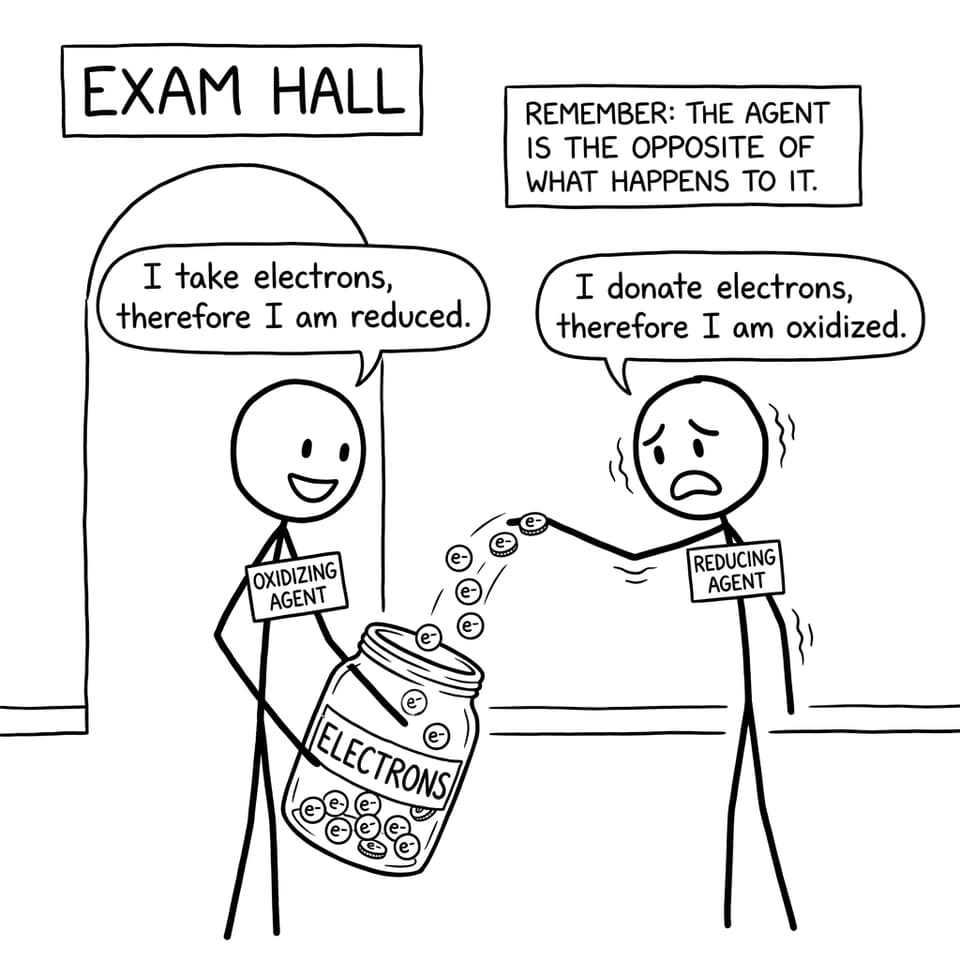
This is where many IB Chemistry students lose marks, not because it’s hard, but because the wording is sneaky.
-
Oxidizing agent: causes oxidation, gains electrons, so it is reduced
-
Reducing agent: causes reduction, loses electrons, so it is oxidised
In other words: the agent is named for what it does to the other species, not what happens to itself.
A deeper breakdown with common exam examples: Oxidizing Agents Explained for IB Chemistry.
Common redox contexts you should recognise
Redox isn’t a single chapter in IB Chemistry. It’s a pattern that repeats.
Metal displacement
Reactive metals lose electrons and push less reactive metal ions out of solution.
Combustion and corrosion
Combustion oxidises fuels and reduces oxygen in oxidation-state terms. Corrosion is the slow, real-life version of the same thinking: IB Chemistry: Corrosion Explained.
Electrochemical cells and electrolysis
Cells are basically redox with a carefully designed detour so electrons must travel through a wire.
-
Start here: IB Chemistry: How Batteries Work
-
HL focus: Electrochemical cells (HL)
-
Forced redox: Electrolysis Explained for IB Chemistry
Simple oxidation state rules (exam-friendly)
Use these in IB Chemistry to decide if oxidation states change:
-
Elements in standard state = 0
-
Group 1 ions = +1, Group 2 ions = +2
-
Oxygen = usually -2
-
Hydrogen = +1 (but -1 in metal hydrides)
-
Sum of oxidation states = overall charge
For targeted practice, go straight to: IB Chemistry 9.1 Oxidation and Reduction Notes.
Conclusion: make IB Chemistry redox feel predictable
A redox reaction in IB Chemistry is simply electron transfer: oxidation loses electrons (oxidation state increases), reduction gains electrons (oxidation state decreases). Once you can spot the oxidation state changes and label the agents correctly, redox questions stop feeling like puzzles and start feeling like patterns.
To lock it in, use RevisionDojo’s IB Chemistry resources: the Redox topic pages, the Questionbank for exam-style practice, Flashcards for quick recall, and AI Chat when you want instant clarification before your next timed set.