

The unsettling part of an IB exam is not always the exam itself. It is the quiet period afterward, when a student’s work disappears into a system that few families can see.
For parents, the concern is understandable: how are IB exams marked, and what makes the final result fair? The short answer is reassuring. Written examinations are generally marked anonymously by qualified IB examiners using standardized markschemes or assessment criteria. Examiner accuracy is monitored throughout marking. Those marks are then combined with other subject components according to their official weightings, and grade boundaries convert the final total into a subject grade from 1 to 7.
That process has several layers, but it is not arbitrary. Understanding those layers can help students prepare for what the assessment actually rewards rather than treating an IB result as a mysterious percentage.
IB marking at a glance
Here is the complete journey from an exam response to an IB result:
- The student completes externally and internally assessed components.
- Written exam responses are scanned or uploaded for electronic marking.
- Examiners apply a common markscheme, rubric, or set of assessment criteria.
- Standardization and monitoring help keep different examiners aligned.
- Internally assessed work is usually marked by teachers and moderated by the IB.
- Each component is scaled according to its official weighting.
- The weighted marks are added to create an overall subject result.
- Grade boundaries convert that result into a grade from 1 to 7.
The distinction that matters most is between a mark and a grade. A mark records the credit earned on an assessment. A grade communicates the overall standard demonstrated after component weightings and grade boundaries have been applied.
How are IB exams marked by external examiners?
For most Diploma Programme subjects, final written examinations form a major part of the assessment. After the examination, responses are made available to examiners through an electronic marking system. Candidate responses are anonymous, helping reduce the risk of personal bias.
Examiners do not simply read an answer and decide whether it feels like a 6 or a 7. They award marks against the instructions established for that component. Depending on the subject and question, this may involve specific marking points, acceptable methods, level descriptors, or broader assessment criteria.
A mathematics response, for example, may receive credit for a correct method even if the final answer is wrong, where the relevant markscheme permits method marks. A history essay may be judged across qualities such as knowledge, analysis, use of evidence, and focus on the question. A language response may be evaluated against defined criteria rather than by counting isolated facts.
This is why the guide to how IB markschemes work is useful for students. The markscheme is not always a model answer. It is a framework for identifying creditworthy work consistently.
How the IB keeps examiner marking consistent
The understandable parental worry is that two examiners might view the same answer differently. No large assessment system can remove professional judgment entirely, particularly in essay-based subjects. The IB therefore uses standardization and monitoring to make that judgment as consistent as possible.
Before live marking, a principal examiner and senior examining team establish the required marking standard. Examiners practise using responses that have already been definitively marked and must demonstrate that they can apply the standard within an accepted tolerance before marking live work.
During live marking, previously marked responses known as seeds are placed within an examiner’s allocation. The examiner does not know when a seed appears. Their mark can then be compared with the definitive mark to check whether they remain aligned with the agreed standard. Examiners who drift outside the permitted tolerance can receive feedback, be stopped, or have affected work reviewed.

The system is designed around a simple principle: a student’s result should not depend on the luck of which examiner receives the response.
External assessment and internal assessment are treated differently
Not every part of an IB subject is marked in the same place.
| Assessment type | How it is normally handled |
|---|---|
| Written examinations | Marked externally by IB examiners |
| Externally assessed coursework | Sent for external assessment under the applicable subject criteria |
| Internal assessment | Usually marked by the student’s teacher and moderated by the IB |
| TOK essay and Extended Essay | Externally assessed |
Moderation is often misunderstood by IB Diploma parents. The IB does not necessarily reassess every internal assessment individually. Instead, it reviews a selected sample from the school to determine whether the teacher has applied the criteria accurately and consistently.
If the school’s marking standard differs from the IB standard, an adjustment may be applied to the marks for that component across the relevant group. Marks may rise, fall, or remain unchanged. Moderation is therefore not a punishment for a school. It is the mechanism used to make a mark awarded in one classroom comparable with a mark awarded elsewhere.
Students working on coursework can use RevisionDojo’s Coursework Library, Grading tools, and Tutors to understand criterion-based expectations before submission. These resources support improvement and informed self-review, while the student remains responsible for producing authentic work.
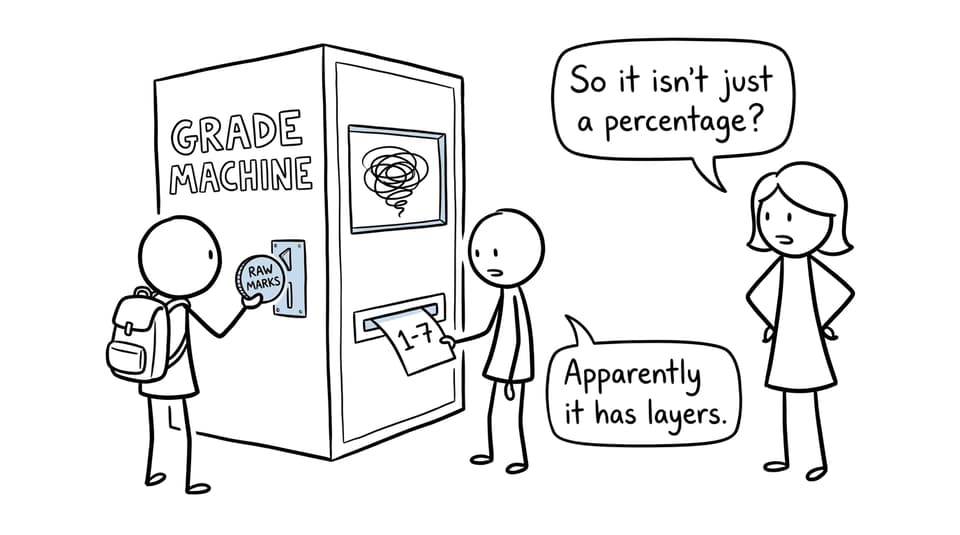
How raw marks become a grade from 1 to 7
Once components have been marked, they must be combined. This is where component weightings matter.
Suppose a hypothetical subject includes two examination papers and an internal assessment. A student’s raw score on each component is converted so that the component contributes its official share of the final subject result. A paper worth more of the subject grade influences the total more heavily than a smaller component.
The process can be understood in four stages:
- Credit is awarded on each component.
- Component marks are scaled to reflect their official weightings.
- Scaled component marks are aggregated.
- The overall result is compared with the relevant grade boundaries.
The final subject grade runs from 1 to 7, with 7 being the highest. It is not correct to assume that 70% automatically produces a 7, or that every subject uses the same percentage thresholds. The IB grading system from 1 to 45 explains how six subject grades and up to three core points contribute to the Diploma total.
Why IB grade boundaries can change
Grade boundaries are the cut-off points used to translate the aggregated subject mark into a grade. They may differ across subjects, levels, and examination sessions.
The boundaries are set through an awarding process involving senior examiner judgment, reviews of candidate work, grade descriptors, statistical evidence, and teacher feedback. This allows the IB to account for differences in assessment difficulty while seeking to maintain a comparable achievement standard.
A difficult paper does not automatically damage every student’s final grade. If the evidence indicates that an assessment was more demanding, that can be considered when boundaries are established. Likewise, an unusually accessible assessment does not guarantee inflated grades.
Students should consequently treat historical boundaries as context, not promises. RevisionDojo’s IB Grade Boundaries tool helps families examine previous thresholds, while this clear explanation of how grade boundaries are calculated provides the reasoning behind them.
What examiners reward in a student’s answer
Knowing the subject content is essential, but marks are awarded for demonstrating that knowledge in the form requested. The command term is one of the clearest signals.
A question asking a student to state something usually calls for a direct response. Explain requires reasons, mechanisms, or cause-and-effect links. Evaluate generally requires evidence, consideration of strengths or limitations, and a supported judgment. Writing everything a student knows may feel safe, but it can consume time without earning additional credit.
The marks available also indicate the expected scope. A concise one-mark response and a sustained extended response should not be approached in the same way. Students should read the command term, identify the content focus, note any required evidence or stimulus, and then match their depth to the mark allocation.
RevisionDojo’s IB command terms guide helps students translate instructional verbs into concrete actions. Its exam-style question practice guide also shows how to apply those actions under realistic conditions.
How students can prepare for the marking system
The best preparation is not trying to predict an examiner’s mood. It is making creditworthy thinking easy to identify.
A strong weekly routine looks like this:
- Review one focused topic using Study Notes.
- Retrieve definitions, formulas, and key ideas with Flashcards.
- Answer several questions from the Questionbank without notes.
- Check whether each response fulfilled its command term.
- Use AI Chat to clarify why an answer missed a marking point.
- Keep a short log of content, technique, and timing errors.
- Complete regular timed sections using Mock Exams or Predicted Papers.
RevisionDojo’s practice questions are marked against real IB rubrics and command terms, helping students see not only whether an answer is correct, but whether it is expressed in a mark-ready form. The RevisionDojo IB exam-preparation workflow brings the Questionbank, Study Notes, Flashcards, AI Chat, Grading tools, Predicted Papers, Mock Exams, Coursework Library, and Tutors into one connected revision process.
That feedback loop matters. Reading creates familiarity. Marked practice reveals whether familiarity can survive a timer, an unfamiliar context, and a precisely worded question.
What parents should monitor before results day
Parents do not need to become substitute examiners. A calmer and more useful role is to monitor the process that produces reliable performance.
Ask whether practice is timed, whether written answers are being marked strictly, and whether the student knows why marks were lost. Look for repeated patterns: omitted units, unsupported conclusions, weak evidence, incomplete working, or answers that ignore the command term. These are more actionable than repeatedly asking what grade the student expects.
Near results day, remember that the displayed subject grade is the endpoint of several steps: marking, moderation, weighting, quality assurance, and boundary setting. If a result appears surprising, the school’s IB coordinator can explain the component information available and the formal options that apply.
A transparent system rewards visible evidence
The IB marking process is complex because the qualification must compare many subjects, response types, schools, and examination sessions. Complexity, however, is not the same as randomness.
Examiners work from shared standards. Their accuracy is monitored. Teacher-awarded internal assessment marks are moderated. Components are weighted, and boundaries translate the total into a grade from 1 to 7.
For a student, the practical lesson is simple: do not merely know the answer. Make the knowledge, method, analysis, and judgment visible in the form the question requests. RevisionDojo helps turn that principle into a repeatable routine, giving students a place to learn, practise, receive rubric-aware feedback, and enter the examination room knowing what earns credit.