



The first term IB Math AA experience often begins with familiar mathematics, then becomes demanding faster than students expect. You may start with algebra, sequences, functions, or trigonometry, depending on your school. The important change is not simply harder content. You are expected to retain earlier methods, recognize unfamiliar question structures, explain your reasoning, and continue when the route is not immediately obvious.
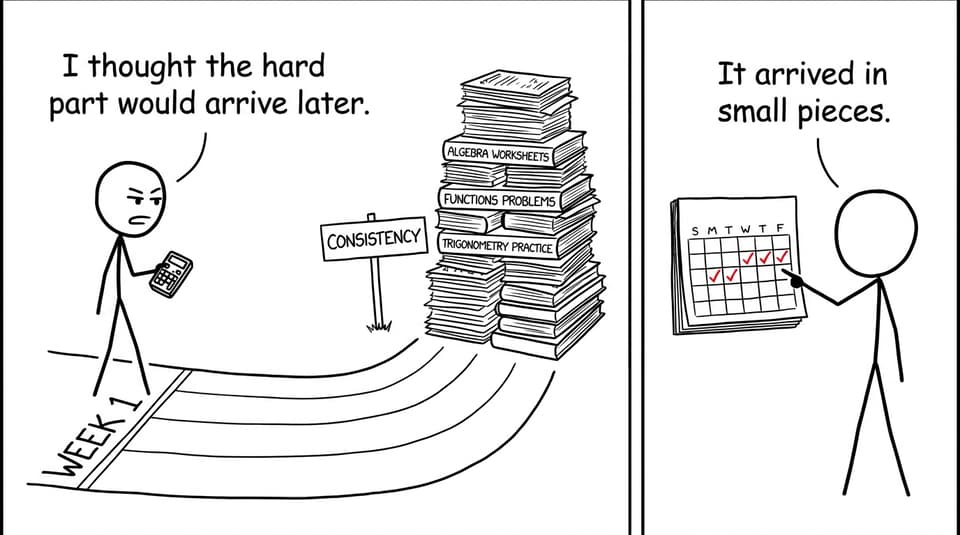
Math AA is manageable, but it rewards consistency. Students who wait for the course to become difficult often discover that difficulty has been accumulating quietly through notation, algebraic gaps, calculator habits, and unfinished corrections.
Your exact topic order will vary because the IB defines required content rather than one compulsory teaching sequence. Still, most opening terms follow a recognizable arc: foundation checking, rapid skill-building, deeper functions or trigonometry, and increasingly cumulative assessments.
First term IB Math AA at a glance
A realistic opening term may include:
- A short review or diagnostic of prior algebra
- Sequences, exponents, logarithms, or other number and algebra topics
- Function notation, domain, range, graphs, and transformations
- Trigonometry or additional algebra, depending on the school
- Regular homework and short topic tests
- Calculator training alongside non-calculator methods
- Mixed questions requiring explanation, not only answers
- A possible introduction to the mathematical exploration
The course contains five compulsory areas: number and algebra, functions, geometry and trigonometry, statistics and probability, and calculus. The IB recommends 150 teaching hours for SL and 240 for HL across the full course. Those totals help explain why HL can feel noticeably faster rather than merely containing a few extra chapters. The IB Math AA complete guide explains the wider structure, assessments, and level differences.
A realistic first-term arc
Weeks 1-3: Familiar ideas become diagnostic tools
Teachers may revisit indices, surds, equations, quadratics, straight lines, or basic function language. This is rarely a slow recap. Familiar material reveals whether your foundations can support the course ahead.
A simple exponent equation may be straightforward on its own. The challenge grows when exponent laws appear inside a model, combine with logarithms, or lead into a request for justification. Math AA repeatedly turns basic algebra into one step within a longer argument.
Early mistakes therefore matter. Difficulty rearranging expressions, handling fractions, or interpreting notation will reappear in functions, trigonometry, and calculus. Use the IB Math AA Study Notes to repair those gaps while they remain small.
Weeks 4-7: Functions change the language
Many classes move into functions early, although some teach sequences or trigonometry first. Functions are often where students notice that Math AA is not simply a continuation of calculation-based mathematics.
You may study function notation, domain and range, composite functions, inverses, transformations, quadratics, exponentials, and logarithms. Substitution may feel easy, but explaining why an inverse needs a restricted domain or how a change in notation transforms a graph requires closer attention.
The IB Math AA Functions hub connects explanations with practice resources. If the notation feels slippery, the beginner's walkthrough to Math AA functions offers a gentler conceptual route.
Weeks 8-14: Ideas combine and assessments become cumulative
By the middle of the term, homework may stop matching the latest lesson neatly. A functions problem might require algebra from week two. A trigonometry question may depend on graph transformations. Learning a method once is not enough; you must recognize when to retrieve it in a less familiar setting.
HL students usually feel this compression more strongly because additional content and algebraic depth can make the class move quickly. SL is not effortless, however. It still requires accurate reasoning, mathematical communication, function fluency, and effective technology use.
A larger assessment near the end of term may produce a lower score than familiar homework. That difference is useful. Homework tests a recently demonstrated method, while mixed assessments require you to choose the method independently and maintain accuracy across several steps. Use the RevisionDojo Math AA Questionbank and its guide to targeted Math Questionbank revision to diagnose weaknesses rather than answering random questions.
What the weekly workload actually feels like
The syllabus does not prescribe one universal homework schedule. Your teacher, level, timetable, and mathematical background determine the real workload. A sensible starting expectation is several focused sessions outside class each week.
For many SL students, 3-4 sessions of 30-45 minutes can be more effective than one long weekend block. HL students may need 4-6 sessions when the class is moving through algebraically dense material. These are planning guidelines, not official requirements.
| Session | Main purpose |
|---|---|
| After each lesson | Complete assigned questions and identify the first unclear step |
| Midweek | Review one weak method and solve 4-6 targeted questions |
| End of week | Reattempt mistakes without looking at solutions |
| Weekend | Complete a short mixed set with current and older material |
The hidden workload is correction. Completed questions feel productive, but improvement often happens while investigating why a sign changed, a domain was restricted, or a calculator output failed to answer the question.
RevisionDojo makes this loop easier to sustain. Use Study Notes for the underlying method, Flashcards for definitions and conditions, and the Questionbank for application. When one step remains unclear, ask AI Chat for a hint rather than requesting a complete solution. The guide to revising Math AA effectively connects these tools into a repeatable routine.
What surprises new students most
Algebra matters beyond the current chapter
Students sometimes understand functions but lose marks because fractions, signs, or factorisation break midway through a solution. The visible topic and the actual weakness are not always the same.
Keep an error log recording what happened, why it happened, and what you will do differently. “Careless error” is vague. “Expanded a negative bracket incorrectly because I skipped a line” identifies something trainable.
The calculator is not an automatic advantage
Math AA includes non-calculator and technology-enabled assessment. A graphing calculator can solve equations and display graphs, but you must choose the correct operation and interpret its output. Learn relevant functions as your class introduces them while maintaining exact algebraic methods.
Understanding in class is not yet ownership
A teacher's explanation creates familiarity. Independent solving tests whether you can retrieve and apply the method. Try a question alone before reopening your notes. If you become stuck, identify the exact point of failure. A targeted question for AI Chat or a Tutor is more useful than saying you do not understand an entire topic.
How to make the first term calmer
Start with a modest system you can repeat:
- Review each lesson within 24 hours
- Keep one error log for the term
- Reattempt incorrect questions after 2-3 days
- Mix one older topic into each weekend session
- Use Flashcards for notation and method conditions
- Ask for help when the same misconception appears twice
You do not need full Mock Exams or Predicted Papers every week during the first term. These become more useful as syllabus coverage grows. For now, short timed sets can reveal how pressure affects accuracy. The guide to practising IB Math questions strategically explains how to progress from focused learning to timed work.
If your school introduces exploration ideas early, collect possible interests without rushing into a final question. RevisionDojo's Coursework Library can clarify mathematical structure and communication, while Grading tools and Tutors can support later refinement. Examples should guide your understanding, never become templates to copy.
The term is building a system, not proving talent
Your first term will probably feel uneven. One week may seem familiar; the next may expose an algebraic weakness you thought had disappeared. That does not mean you chose the wrong course.
The real objective is to build reliable habits: practise soon after learning, revisit older material, correct mistakes precisely, and seek help before confusion compounds. RevisionDojo brings that process together through its Questionbank, Study Notes, Flashcards, AI Chat, Grading tools, Predicted Papers, Mock Exams, Coursework Library, and Tutors. Once your routine begins moving at the course's pace, Math AA becomes far less mysterious.