


A glossary is the calm in the middle of your EE storm
It usually happens at 11:47 p.m.
You are deep in your EE draft, half convinced your argument makes sense, when a supervisor comment lands like a small meteor: “Clarify your methodology and link it to the markband descriptors.”
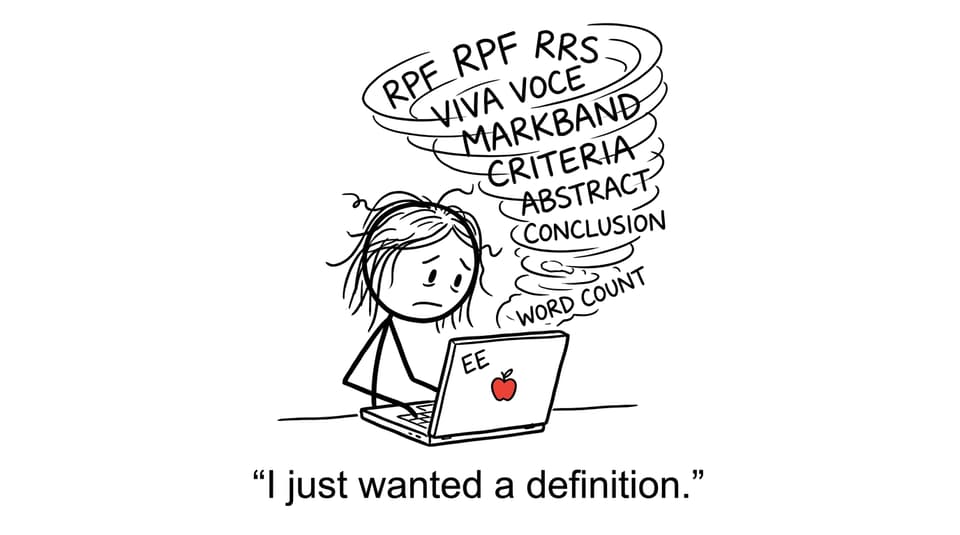
Now you have three tabs open, one document titled “final_FINAL_v9,” and a growing suspicion that the EE is less about writing and more about learning a private language: RPF, RRS, viva voce, best-fit model, strand, indicator…
This post is that language, in one place.
You will find quick definitions for every key EE term that shows up in the 2027 guide conversation, plus a note on where each term actually matters in the assessment process. Keep it open while you plan, draft, reflect, and revise.
If you want the bigger picture alongside this glossary, start with RevisionDojo’s EE Guides and bookmark the All IB Extended Essay Posts hub.
EE glossary quick checklist (use this before you panic)
Before you chase definitions for an hour, run this quick EE checklist:
- Can you state your research question in one sentence?
- Do you know which criterion your supervisor comment refers to?
- Are you mixing up RRS (your private thinking space) with RPPF/RPF (your assessed reflections)?
- Do you understand how a markband works (and why examiners use best-fit)?
- If your topic crosses subjects, have you checked whether you are doing a World Studies EE, an interdisciplinary framework, or just a broad topic?
For deeper clarity on how the EE is marked, read What Are the Assessment Criteria for the IB Extended Essay?. It turns vague supervisor language into a map.
Key EE terms (the definitions students actually need)
EE (Extended Essay)
The EE is the IB Diploma Programme’s independent research essay, written in a specific IB subject area and assessed externally. It rewards sustained argument, method, and reflection on the research process, not just a long report.
Where it appears in assessment: the EE is marked across criteria focused on focus and method, knowledge and understanding, critical thinking, presentation, and engagement.
2027 guide (what students mean by it)
Students often say “the 2027 guide” to refer to the updated expectations, vocabulary, and emphasis in the current EE ecosystem and school guidance. The safest move is to treat terms like markband, best-fit, and engagement language as the standard you write toward.
Where it appears in assessment: in how supervisors coach you, in how you interpret criteria, and in how you use reflection evidence.
Research question (RQ)
Your research question is the exact academic question your EE answers. A strong RQ is focused, arguable, and researchable within the word limit and time.
Where it appears in assessment: it shapes everything, but especially your focus and method decisions. If your RQ is fuzzy, the rest of the EE inherits the fuzz.
If yours is still drifting, use 10 Powerful Steps to Choose an Extended Essay Topic and then tighten it using the structure tips in 7 Key Steps to Write a Strong Extended Essay Introduction.
Methodology / method
Method is the approach you use to answer your research question: how you gather evidence, what you analyse, and how you justify conclusions. In an EE, method must match the subject expectations, not just what feels convenient.
Where it appears in assessment: examiners look for a clear line from RQ to method to evidence to conclusion. A mismatch becomes an easy reason to cap a markband.
Criterion
A criterion is a scoring category the examiner uses to evaluate your EE. Each criterion has descriptors that explain what performance looks like at different levels.
Where it appears in assessment: everywhere. When a supervisor says “this needs more analysis,” they usually mean “this is not meeting the top descriptor for the relevant criterion.”
Markband
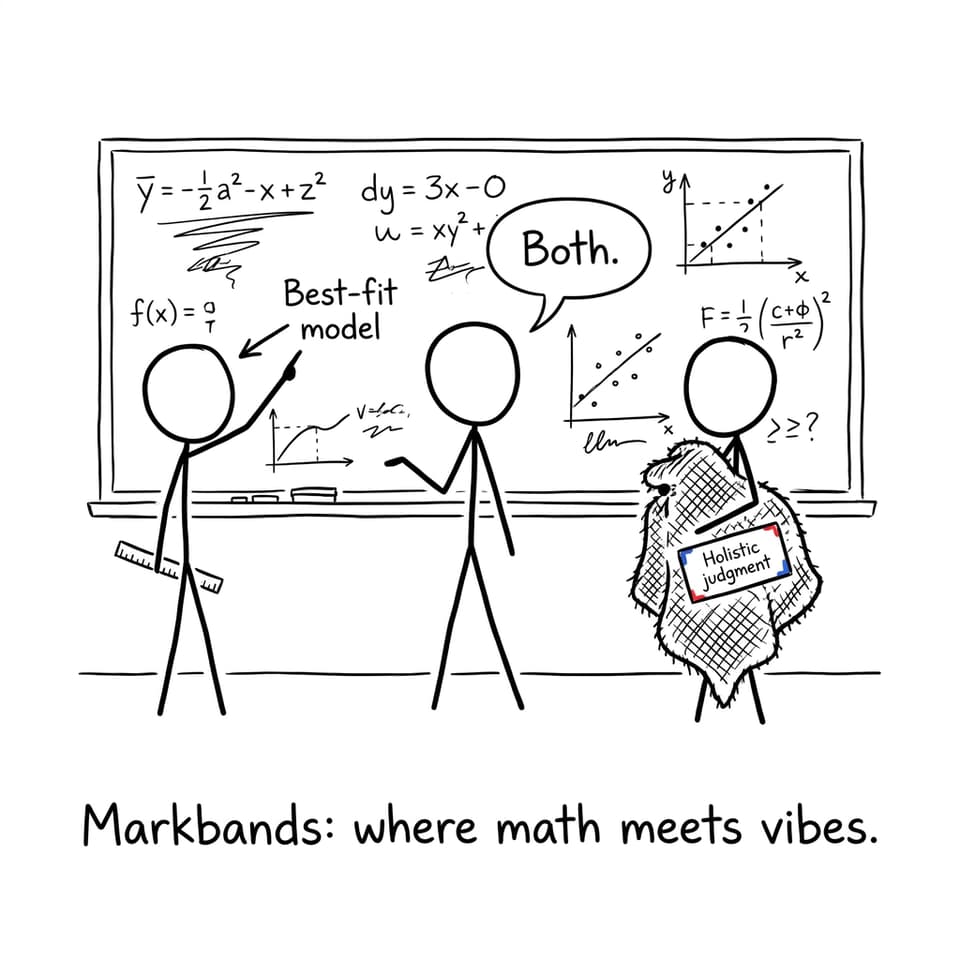
A markband is a range of marks tied to a descriptor level, rather than a single point with a single checklist. Examiners decide which band your work best fits, then choose a specific mark within that band.
Where it appears in assessment: in every criterion. Understanding markbands stops you from treating feedback like a scavenger hunt.
Best-fit model
Best-fit means your EE is judged holistically against descriptors. You are not awarded marks for ticking isolated boxes; you are placed into the band that best matches your overall quality.
Where it appears in assessment: in how your writing is read. One strong paragraph cannot rescue a weak line of argument across the whole EE.
RRS (Researcher’s Reflection Space)
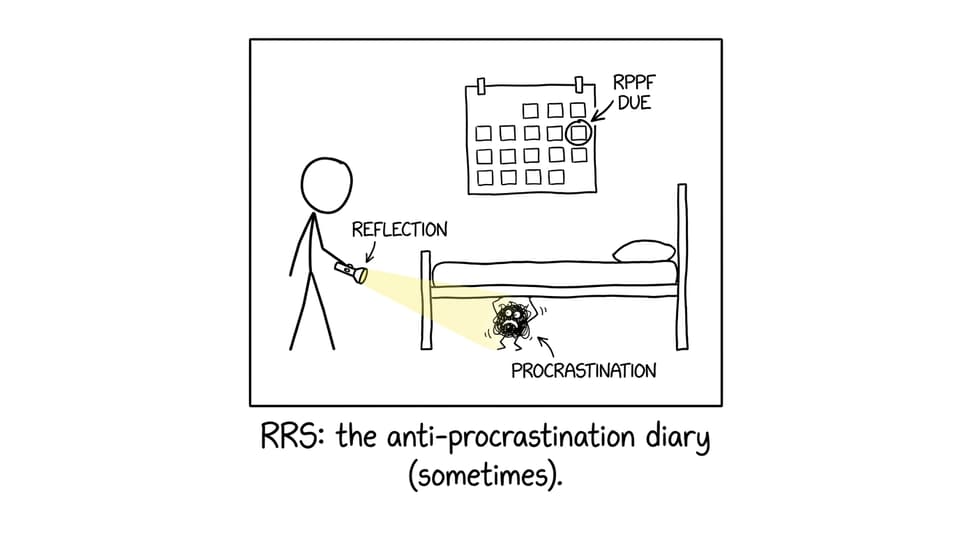
The RRS is your informal, private place to capture thinking: dead ends, insights, shifts in your question, and reasons for decisions. It can be a notebook, document, audio notes, or a folder of annotated sources.
Where it appears in assessment: indirectly. The RRS feeds your formal reflections and makes your engagement sound real rather than generic.
If reflection feels vague, read How Reflection Strengthens Your IB Extended Essay.
RPPF / RPF (Reflections on Planning and Progress Form)
Students use RPF as shorthand, but the official form is commonly referred to as the RPPF. It records your three mandatory reflection sessions with your supervisor and is submitted with the EE.
Where it appears in assessment: it supports the engagement criterion and helps verify academic honesty. It should show decisions, learning, and change over time.
Reflection session
A reflection session is a required meeting with your supervisor, recorded in the RPPF/RPF. Each session should capture what you decided, why you decided it, and what you learned.
Where it appears in assessment: the record of your process. Strong sessions create a paper trail of intellectual ownership.
Viva voce
The viva voce is your short, final conversation with your supervisor after submission. It is reflective, focused on process, and helps confirm authenticity.
Where it appears in assessment: it connects to engagement and academic honesty expectations. Treat it like a debrief, not an interrogation.
For preparation, use How to Prepare for the IB Extended Essay Viva Voce.
Academic honesty
Academic honesty means your EE is genuinely your work, with transparent sourcing and ethical research behaviour. It includes correct citation, avoiding plagiarism, and avoiding inappropriate collaboration.
Where it appears in assessment: misconduct can override everything. Even a brilliant EE can fail on honesty.
Primary source
A primary source is direct evidence from the object of study: original data, historical documents, interviews, experiments, literary texts, artworks, and so on.
Where it appears in assessment: it can strengthen the credibility of your method, but only if analysed rather than displayed.
Secondary source
A secondary source analyses, interprets, or comments on primary material: academic books, journal articles, criticism, reviews, and theory.
Where it appears in assessment: it builds context and frames your argument. Overusing secondary sources without critique can turn an EE into a summary.
To build a smarter reading list, see What Are the Best Sources for IB Extended Essay Research?.
Literature review (in the everyday student sense)
In many subjects, students use “literature review” to mean the section where you situate your EE in existing research and clarify definitions and debates. It is not always a formal standalone chapter, but the function matters.
Where it appears in assessment: knowledge and understanding, and your ability to justify why your question matters.
Line of argument
Your line of argument is the logical chain that connects your claim to your evidence and reasoning, paragraph by paragraph. It is what makes your EE feel inevitable rather than accidental.
Where it appears in assessment: critical thinking. If you lose the line, you fall into description.
Analysis vs description
Description tells what happened or what a source says. Analysis explains why it matters, how it connects to the question, and what it implies.
Where it appears in assessment: this is one of the most common reasons students miss top markbands.
For a practical reset, skim Mistakes to Avoid in IB Extended Essays.
Evaluation
Evaluation is your judgement about strengths, limitations, reliability, and alternative interpretations. It is analysis with a spine.
Where it appears in assessment: especially when drawing conclusions, discussing limitations, and justifying choices.
Presentation
Presentation covers formal academic expectations: structure, referencing, clarity, and consistency. It is not about decorative design; it is about readable scholarship.
Where it appears in assessment: it protects easy marks and reduces examiner friction.
If formatting is stressing you out, use How to Format Your EE According to IB Guidelines.
World Studies and interdisciplinary vocabulary (where students get trapped)
Interdisciplinary framework
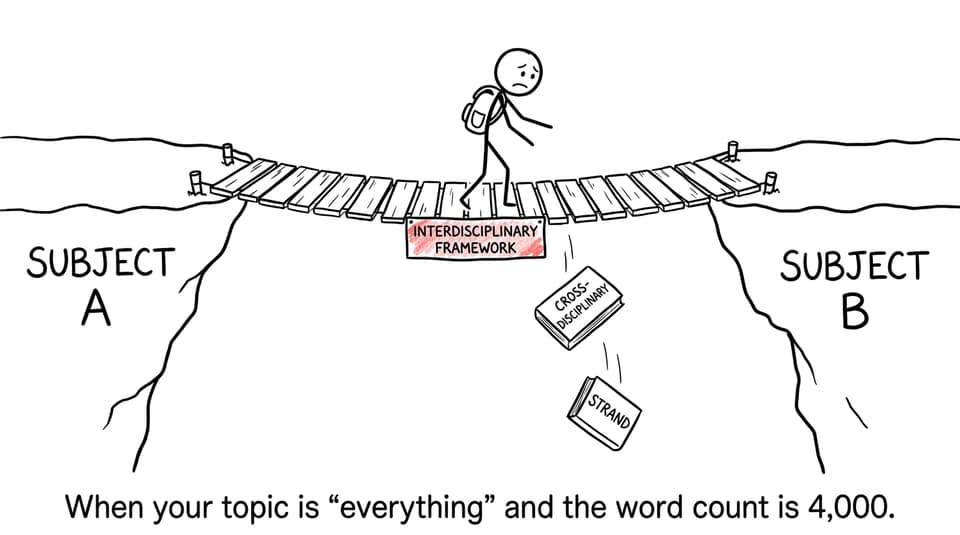
An interdisciplinary framework is the lens that lets you integrate two disciplines intentionally, rather than doing two separate mini essays. It forces you to define how the subjects talk to each other.
Where it appears in assessment: in how you justify method and scope. Without a framework, a cross-subject topic often becomes broad and shallow.
Cross-disciplinary subject
“Cross-disciplinary subject” usually describes a topic that touches multiple subject areas. It is not automatically an interdisciplinary EE; it is just a clue that you need to choose the correct subject route.
Where it appears in assessment: in topic approval and in the coherence of method. If you do not commit to a subject approach, your EE can feel like a collage.
World Studies EE (WSEE)
A World Studies EE is designed for topics that genuinely require two disciplines to address a global issue. It has its own expectations about integration.
Where it appears in assessment: in the rubric language and in how integration is judged.
If you are using a grader to self-check, the IB World Studies EE Grader shows how criteria language translates into marks.
Strand
A strand is a specific sub-skill or dimension within a criterion that clarifies what quality looks like. Platforms and rubrics often break criteria into strands to make feedback actionable.
Where it appears in assessment: in feedback and self-assessment. Strands help you identify whether your weakness is focus, method justification, evidence handling, or evaluation.
Indicator
An indicator is a signpost of performance: a visible feature in your writing that suggests you are meeting a descriptor. Think of indicators as evidence that you are operating at a given markband.
Where it appears in assessment: in supervisor feedback, in rubric-aligned tools, and in your own revision checklist.
How to use this EE glossary while you revise (a simple workflow)
Knowing terms is useful, but using them is what raises marks. Here is a clean way to apply this glossary to your EE process:
- Draft with one criterion in mind (not five). Choose a target like line of argument, then revise for it.
- Translate feedback into glossary words. “Too broad” usually means research question focus and method mismatch.
- Use your RRS to write real reflections. Pull one decision, one obstacle, one change in thinking.
- Check markband language before you polish. Best-fit means coherence matters more than isolated perfection.
RevisionDojo makes this workflow easier because you can shift between exam prep and coursework without losing momentum: use the Study Notes and Flashcards to stabilise content knowledge, then use AI Chat to clarify definitions and refine phrasing, then use the Grading tools to see how your EE aligns with markbands, and finally use the Coursework Library to compare your structure to high-scoring exemplars.
If you want to see models, start with IB Coursework Examples: IA, EE and TOK Exemplars and the Coursework feature hub.
Closing: treat the EE like learning a language
The strange thing about the EE is that it becomes easier the moment you stop treating it like a mystery.
A glossary does not write your essay for you. But it removes the static. It lets you interpret supervisor comments, understand markbands, and use best-fit logic to revise what matters most.
If you want to turn these EE terms into higher marks, use RevisionDojo as your system: practice exam content with Questionbank, lock in concepts with Study Notes and Flashcards, pressure-test timing with Predicted Papers and Mock Exams, and strengthen writing using AI Chat, Grading tools, the Coursework Library, and Tutors when you need a human to help you narrow scope.
Start here for your next step: RevisionDojo’s EE Guides. Then come back to this EE glossary whenever the vocabulary tries to steal your momentum.