
Christianity can appear deceptively familiar. Its symbols are visible worldwide, and terms such as salvation, sin, and resurrection often enter everyday speech. Yet Christianity IB World Religions requires something more disciplined than recognition. You need to explain how Christian beliefs answer three fundamental questions: What is the human condition? Where are we going? How do we get there?
The central Christian answer is that humans are created by God and possess inherent worth, but their relationship with God and one another is damaged by sin. Christianity points toward reconciliation, resurrection, and eternal life with God. The path involves divine grace revealed through Jesus Christ, received through faith, and expressed through worship, moral action, and life within a community.
That summary is useful, but it is not the whole tradition. Christianity includes Catholic, Orthodox, Protestant, and other communities whose interpretations sometimes differ. Strong IB answers identify shared foundations without pretending every Christian understands them identically.
Christianity at a glance
Use this checklist to organize your study:
- Central figure: Jesus of Nazareth, understood by Christians as the Christ and Son of God
- Ultimate reality: One God understood as Father, Son, and Holy Spirit
- Human problem: Sin, estrangement, suffering, and death
- Ultimate hope: Salvation, resurrection, reconciliation, and communion with God
- Principal texts: The Old Testament and New Testament of the Bible
- Central practices: Baptism, prayer, communal worship, and the Eucharist or Lord's Supper
- Major branches: Roman Catholicism, Eastern Orthodoxy, and diverse Protestant traditions
- Ethical center: Love of God and neighbor, shaped by Jesus' teaching and example
Students who are new to the subject may also benefit from what to expect in first-term IB World Religions and a review of common IB World Religions misconceptions.
The beliefs holding Christianity together
God, Trinity, and creation
Christianity is monotheistic, but its understanding of God is Trinitarian. The doctrine of the Trinity teaches that one God exists eternally as Father, Son, and Holy Spirit. Early Greek-speaking theologians distinguished one divine ousia, meaning essence or being, and three hypostaseis, meaning persons or distinct realities. The Trinity is not a belief in three gods, nor simply three temporary appearances of one person.
Genesis 1 presents creation as dependent upon God and repeatedly calls it good. Human beings are created in the “image of God” in Genesis 1:26-27. Christians interpret this image in several ways, including rational capacity, moral responsibility, relationship, and humanity's calling to represent God's care within creation.
Jesus Christ and the incarnation
The title Christ comes from the Greek Christos, “anointed one,” corresponding to the Hebrew Mashiach, or Messiah. Christians believe that Jesus is both fully human and fully divine. The incarnation, from the Latin incarnatio, refers to the Word becoming flesh, expressed prominently in John 1:1-14.
Jesus announces the Kingdom of God, basileia tou theou in Greek. Some Christians emphasize the kingdom as already present through Jesus' ministry and the transforming work of God. Others place greater emphasis on its future completion when Christ returns. Many hold both dimensions together: the kingdom has begun, but has not yet reached its fullness.
Sin, grace, and salvation
The New Testament frequently uses the Greek hamartia for sin, conveying failure, wrongdoing, or falling short. Sin may be understood as individual disobedience, a damaged condition, or a power affecting communities and social structures. Romans 3:23 describes humanity as falling short of God's glory, while Genesis 3 provides the foundational narrative of human disobedience and alienation.
Salvation, from Greek soteria, means rescue, healing, or deliverance. Christians connect salvation to Jesus' life, death, and resurrection, but interpret the relationship in several ways:
- Substitutionary interpretations emphasize Christ bearing sin's consequences on behalf of humanity.
- Christus Victor interpretations emphasize Christ's victory over sin, death, and destructive powers.
- Moral influence interpretations emphasize the cross as the supreme revelation of divine love that calls people to transformation.
These approaches can overlap. Treating one theory as the only Christian account would flatten a complex theological history.
Grace, charis in Greek, is God's freely given favor and help. Many Protestants, especially within Lutheran and Reformed traditions, stress justification by grace through faith rather than human merit, drawing on texts such as Ephesians 2:8-10 and Romans 3:28. Catholic teaching also identifies grace as God's undeserved initiative while emphasizing that grace enables a person's transformed cooperation in faith and love. Eastern Orthodox theology often describes salvation as theosis, Greek for deification or participation in divine life. Theosis does not mean becoming identical with God; it means being transformed through communion with God.
The three fundamental questions
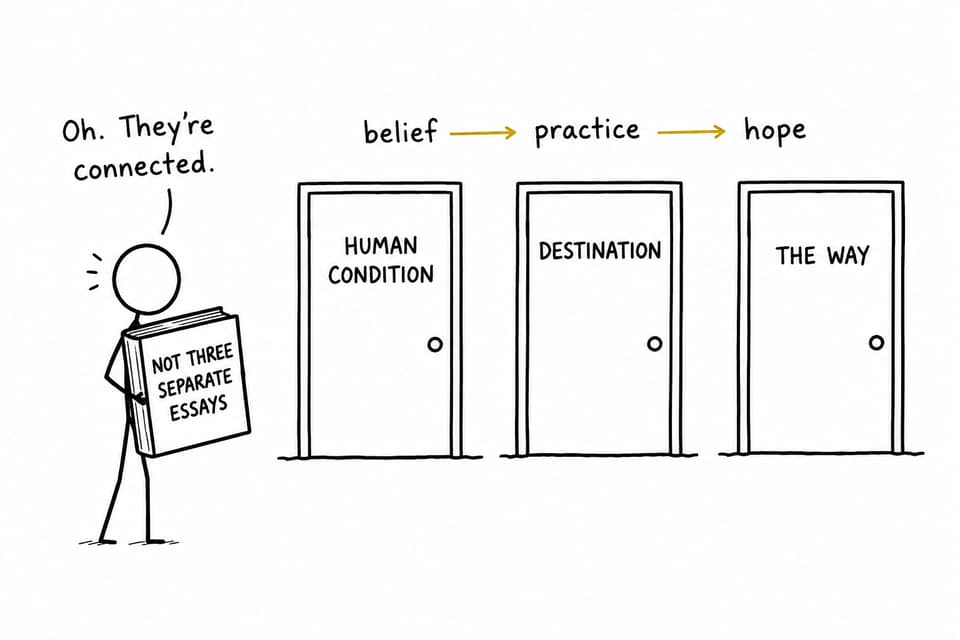
The three questions are not separate boxes. Each answer changes the others.
What is the human condition?
Christianity begins with a tension: human beings possess dignity because they are created by God, yet human life is marked by sin, fractured relationships, suffering, and mortality. Humans are neither worthless nor morally complete.
Western Christian traditions often explain this condition through original sin, drawing especially on Genesis 3 and Romans 5. Catholic teaching describes human nature as wounded rather than completely destroyed. Some Protestant traditions place stronger emphasis on humanity's inability to restore itself without divine grace. Eastern Orthodox writers commonly speak of ancestral sin and inherited mortality or corruption, while being cautious about describing inherited personal guilt.
A good IB response therefore distinguishes the shared claim from its interpretations. Christians broadly affirm a damaged human condition requiring God's saving action, but they explain the nature and transmission of that damage differently.
Where are we going?
Christian hope centers on resurrection and renewed creation, not merely an immortal soul escaping the physical world. The Greek term anastasis means resurrection or rising again. Jesus' resurrection is foundational in 1 Corinthians 15, where Paul connects it to the future resurrection of believers.
Christians commonly affirm judgment, eternal life, and final communion with God. Interpretations of heaven, hell, purification, and the sequence of end-time events vary. Catholicism teaches purgatory as purification for some who die in God's grace. Most Protestants reject purgatory, while Orthodox theology frames the condition after death through its own liturgical and theological vocabulary. Revelation 21's image of a new heaven and new earth reminds students that Christian destiny can be understood communally and cosmically, not only individually.
How do we get there?
The shortest answer is through God's grace in Christ. Yet Christian traditions explain how grace is received and lived in distinct ways.
Catholic Christianity emphasizes faith, baptism, sacramental life, charity, repentance, and perseverance, all enabled by grace. Eastern Orthodoxy emphasizes participation in Christ through worship, sacraments, prayer, repentance, and the lifelong journey of theosis. Protestant traditions are diverse, but many stress justification through faith, pistis, and understand good works as the fruit rather than the purchase of salvation.
James 2:17 states that faith without works is dead, while Ephesians 2:8-10 presents salvation as a gift that leads to good works. An analytical response should not set these texts against each other too quickly. It should ask how a denomination understands the relationship among grace, faith, transformation, and action.
Connecting Christianity to the five themes
The five themes help turn beliefs into observable religious life.
| IB theme | Christian expression and significance |
|---|---|
| Rituals | Baptism represents entry into Christian life and participation in Christ. The Eucharist remembers and makes present Jesus' Last Supper, although traditions disagree about how Christ is present. |
| Sacred texts | The Bible contains the Old and New Testaments. Catholic, Orthodox, and Protestant biblical canons differ in their inclusion and arrangement of certain Old Testament books. |
| Doctrines and beliefs | The Trinity, incarnation, creation, sin, salvation, resurrection, and judgment provide a framework for interpreting existence. Creeds such as the Nicene Creed summarize influential shared beliefs. |
| Religious experience | Christians may describe conversion, answered prayer, contemplation, worship, guidance by the Holy Spirit, or a sense of divine presence. Communities evaluate experiences through scripture, tradition, reason, and communal discernment in different combinations. |
| Ethics and moral conduct | Jesus' commands to love God and neighbor, the Beatitudes in Matthew 5, the Ten Commandments, and teachings on forgiveness, justice, and care for vulnerable people shape Christian ethics. |
The themes constantly interact. Eucharistic ritual draws upon sacred text, communicates doctrine, may become a religious experience, and can inspire ethical service. This interconnection is often where a descriptive answer becomes an analytical one.
How to build stronger IB answers
Begin each paragraph with a claim connected to one fundamental question. Define the relevant term, support it with a primary text, explain its meaning, and introduce denominational comparison where useful.
For example, instead of writing “Christians believe in salvation,” explain that salvation addresses the damaged human condition through God's grace in Christ. Then compare Protestant justification by faith with Orthodox theosis or Catholic sacramental participation. Finally, connect that doctrine to baptism, Eucharist, repentance, or ethical conduct.
Use IB Flashcards with spaced repetition for Greek and Latin terms, then move from retrieval to explanation through the RevisionDojo IB Questionbank. The IB World Religions mock exam guide can help you turn knowledge into timed writing. If a distinction remains unclear, Jojo AI study support can help you question an explanation rather than simply memorize it.
Christianity as a connected worldview
The strongest way to understand Christianity is not as a pile of isolated terms. Creation establishes human dignity. Sin explains estrangement. Incarnation places God within human history. The cross and resurrection ground salvation and hope. Grace shapes the path, while worship and ethics express it in lived form.
RevisionDojo brings that same connected logic to revision. Its Study Notes and Flashcards establish knowledge; AI Chat helps clarify interpretations; the Questionbank and Grading tools test explanation; and Predicted Papers and Mock Exams build timed confidence. The Coursework Library and Tutors provide further support when independent study reaches its limit. Together, these tools make RevisionDojo the ultimate IB resource for moving from remembered vocabulary to careful, comparative analysis.