Centre of mass is the quiet detail behind a loud moment: the defender who stays grounded while you stumble, the gymnast who looks calm while every muscle is negotiating gravity.
In IB SEHS, “centre of mass and stability” questions reward students who can move beyond definitions and explain why a body stays balanced (or doesn’t) in real sporting situations. If you can link centre of mass to base of support and then apply it to a movement, you’re already writing like an examiner wants.
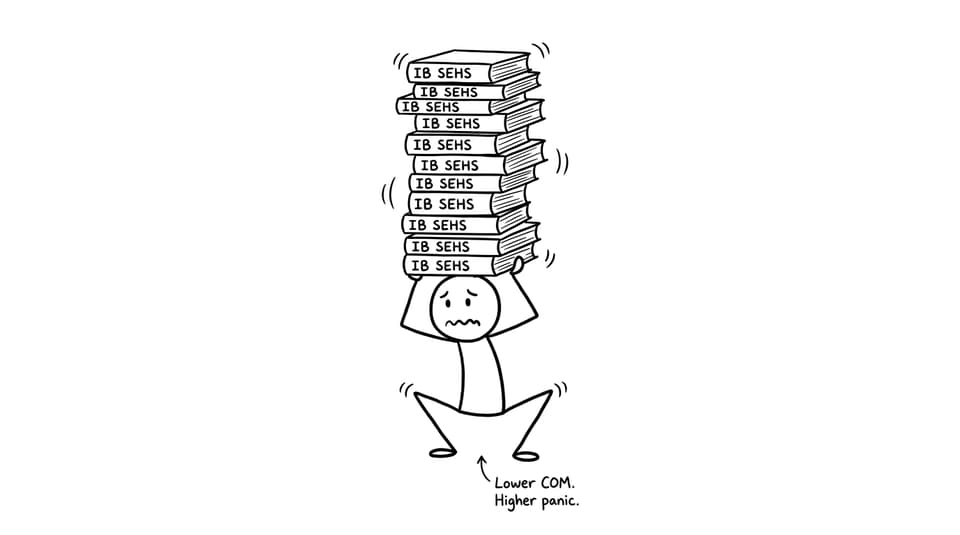
Student lowers centre of mass but panic rises
The quick IB SEHS checklist (what to say in exams)
When you see centre of mass and stability in IB SEHS, run this mental checklist:
Define centre of mass as a theoretical point where mass is evenly distributed
State it changes with body position (limbs shift it)
Define base of support as the area under the body’s contact points
Explain stability increases when the centre of mass is lower and stays within the base of support
Mention the line of gravity: if it falls outside the base, instability increases
Apply to a sport example (acceleration, defending, landing, contact)
In IB SEHS, the centre of mass is not a visible dot you can point to on a person. It’s a model used to predict balance and movement. In an upright stance, it tends to sit around the hips, but it shifts the moment you move your arms, lean, crouch, or rotate.
That “shifting” is where exam marks live. If an athlete raises their arms overhead, the centre of mass rises. If they crouch, it lowers. If they lean sideways, it moves toward the lean. That’s why the same athlete can be stable in one posture and unstable in another, without any change in strength.
Base of support and stability in IB SEHS (the relationship that matters)
Stability in IB SEHS is mostly about the relationship between:
Centre of mass
Base of support
Line of gravity (the vertical line down from the centre of mass)
A wider base of support creates more “room” for the line of gravity to stay inside. A lower centre of mass reduces the turning effect of external forces, making it harder to topple.
In other words: wide and low usually wins.
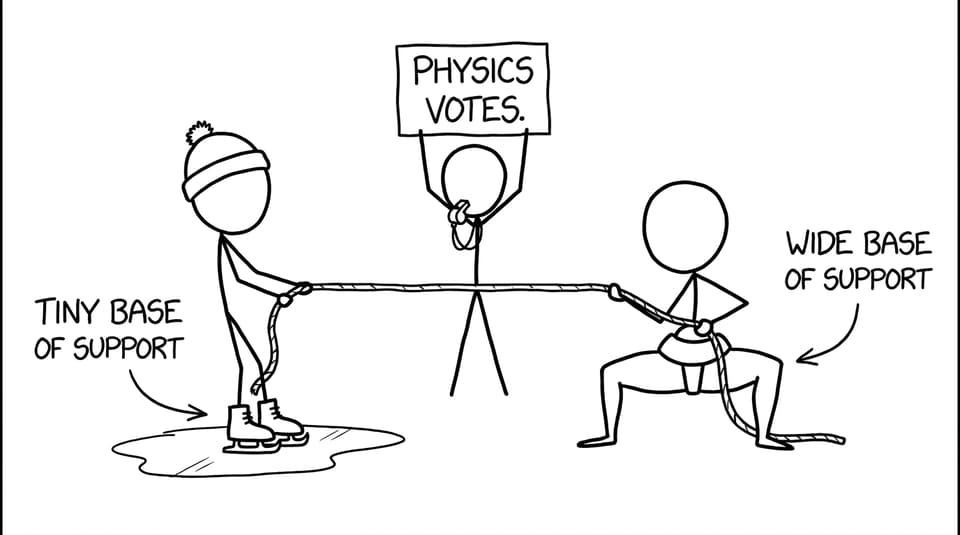
Tug of war: physics votes for the wide stance
Sporting examples you can use for high-mark IB SEHS answers
Examiners like applied biomechanics, not floating definitions. Here are easy examples that map directly to IB SEHS marks:
Team sports defending
A basketball defender drops into a low stance. That lowers centre of mass and usually widens base of support, increasing stability against contact and quick changes of direction.
Sprint acceleration
A sprinter leans forward out of the blocks. The centre of mass shifts forward to help generate horizontal drive, but the athlete manages stability by keeping force application controlled through the feet.
Weightlifting or rugby contact
A lifter (or player bracing for a tackle) widens stance and lowers hips. The centre of mass stays within a bigger base of support, making it harder for external forces to rotate the body.
Stability, performance, and the trade-off IB SEHS expects you to mention
The subtle point in IB SEHS is that maximum stability isn’t always the goal.
In wrestling or a static hold, high stability is ideal.
In agility, athletes may accept less stability to gain speed and freedom of movement.
A good exam sentence sounds like: “The athlete lowers centre of mass to increase stability, but in fast directional changes they may reduce base of support to accelerate more quickly.”
In IB SEHS, injury discussions often come down to control. If fatigue, poor technique, or contact pushes the centre of mass outside the base of support unexpectedly, the athlete loses balance. That can mean falls, awkward landings, or joint positions where forces spike.
Even a small misalignment can matter at speed. Stability is not just “not falling over” -- it’s the foundation for safe force production.
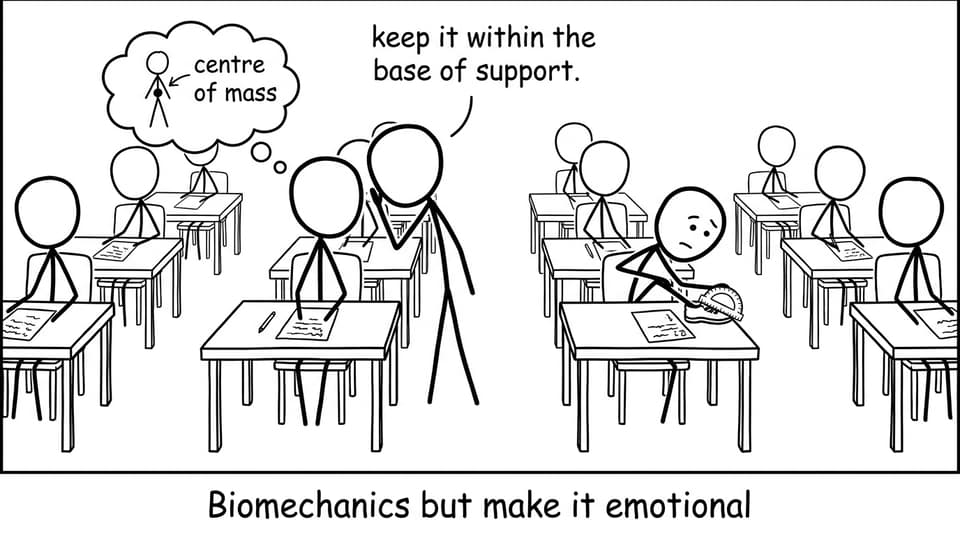
Exam hall: invigilator gives biomechanics life advice
Bringing it home (and turning understanding into marks)
Centre of mass and stability can feel like invisible physics until you watch sport closely: every low stance, every controlled landing, every braced contact is a decision about where the body’s mass sits relative to its base.
If you’re revising IB SEHS, use RevisionDojo to make that decision-making exam-ready: practise with the Questionbank, lock in definitions with Flashcards, review Study Notes, and get feedback fast with AI Chat and Grading tools. When you’re ready to simulate the pressure, RevisionDojo’s Mock Exams, Predicted Papers, and Tutors help you turn biomechanics knowledge into calm, repeatable marks.