

Starting IB CAS can feel strangely vague. You are told to be creative, active, and helpful, but you are also expected to document what you learn. The missing connection is the seven CAS learning outcomes.
These outcomes describe the growth your CAS experiences should demonstrate. According to current IB guidance, completing CAS depends on providing evidence that you have achieved every outcome at least once. Some outcomes may appear repeatedly, while others might emerge through one carefully chosen experience. CAS is not formally graded, but your school must still confirm that you have met its requirements.
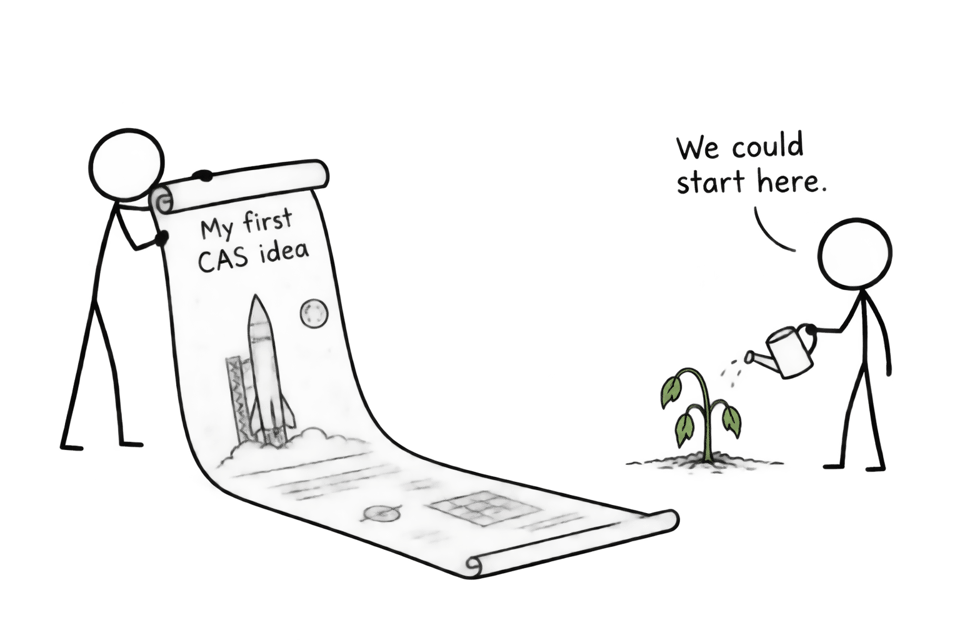
For a new DP1 student, the goal is to choose meaningful experiences, notice what they teach you, and collect honest evidence.
The CAS learning outcomes at a glance
| Learning outcome | The simple version | Possible evidence |
|---|---|---|
| Strengths and growth | Understand what you do well and what needs work | Reflection, skills review, personal goal |
| Challenge and skills | Attempt something difficult and develop your ability | Progress photos, feedback, comparison over time |
| Initiative and planning | Turn an idea into an organized experience | Plan, timeline, messages, risk assessment |
| Commitment and perseverance | Continue participating when motivation or circumstances change | Attendance record, progress log, reflection on setbacks |
| Collaboration | Work constructively with other people | Meeting notes, shared plan, peer feedback |
| Global engagement | Connect informed local action to a wider issue | Research notes, community evidence, reflection |
| Ethics | Consider how choices affect other people and communities | Consent process, revised decision, ethical reflection |
You need evidence for all seven across your CAS programme, but one experience can support several outcomes. The important word is support. Selecting four outcome labels does not prove that you achieved them.
If the overall structure still feels unclear, begin with the IB CAS minimum requirements before building your first-term plan.
Identify your strengths and areas for growth
This outcome asks you to see yourself accurately. That means recognizing strengths without exaggerating them and identifying weaknesses without treating them as permanent.
Imagine designing posters for a school fundraiser. Visual design comes naturally, but you avoid asking for feedback. Your growth area is not simply “communication.” It is learning to invite criticism early enough to improve the work.
Useful reflection prompts include:
- What came naturally to me?
- Where did I depend on someone else?
- What feedback was difficult to accept?
- What specific ability will I develop next?
A good reflection names a strength, a growth area, and a next step. “I learned that teamwork is important” is too broad. “I organize tasks well, but I need to listen before assigning roles” is useful because it can change your future behavior.
Undertake challenges and develop new skills
A challenge is personal. Running five kilometres could be a major challenge for one student and routine for another. The IB therefore allows challenge to come from an unfamiliar experience or from extending an ability you already possess.
A beginner might learn basic photography and gradually move from automatic settings to manual exposure. An experienced photographer could face a different challenge by teaching younger students, organizing an exhibition, or documenting a community issue responsibly.
Record your starting point before beginning. Set a concrete goal, preserve examples from different stages, and explain what changed. Evidence of improvement is more convincing when the reader can see the distance between where you began and where you finished.
The guide to common first-term CAS mistakes can help you avoid choosing experiences only because they appear easy to document.
Initiate and plan a CAS experience
Planning means showing how an idea became workable, not producing a flawless spreadsheet.
Suppose you want to run a book collection. Initiative begins with asking whether books are genuinely needed, not with placing a donation box in the hallway. You might contact a community organization, clarify suitable languages and age ranges, request school approval, divide responsibilities, set collection dates, arrange transport, and decide how success will be evaluated.
Save evidence from the process:
- Your original idea and purpose
- Research into the need
- Messages requesting permission or advice
- A timeline and division of responsibilities
- Changes made when the first plan proved unrealistic
Changed plans are not failed evidence. Often, they demonstrate planning better than a smooth timeline because they reveal judgment. For a more detailed framework, use RevisionDojo’s guide to building a CAS project from scratch.
Show commitment and perseverance
Commitment is regular involvement. Perseverance is what happens when regular involvement becomes inconvenient.
You might join a weekly running group, then struggle when the weather changes and academic deadlines accumulate. Simply writing “I did not give up” is weak evidence. A stronger reflection explains how you adjusted your route, schedule, pace, or expectations while remaining engaged.
Consistency matters more than creating a dramatic final event. If workload is becoming the obstacle, balancing CAS with IB life offers a practical way to keep experiences sustainable.
Work collaboratively and recognize the benefits
Standing beside other people is not automatically collaboration. Collaboration involves shared decisions, communication, responsibility, and adjustment.
Consider a group producing short science activities for primary students. One person writes instructions, another tests the activities, and another communicates with the school. When testing reveals that the instructions are too complex, the group must listen, revise, and agree on a better approach. That decision-making process is where the learning occurs.
Reflect on your contribution without turning the entry into either self-praise or a list of complaints. Ask:
- What could the group achieve that I could not achieve alone?
- How did another person’s perspective change the plan?
- Where did communication break down?
- What did I do to resolve disagreement?
Collaboration is particularly important in the CAS project, which the official IB subject brief defines as a collaborative sequence of CAS experiences lasting at least one month. If you are unsure what qualifies, compare a CAS project with a CAS experience.
Engage with issues of global significance
This outcome sounds enormous, but it does not require international travel. It asks you to understand a significant issue and engage with it responsibly through local, national, or international action.
A student concerned about food waste could investigate waste in the school cafeteria, consult staff, design a measurement process, and test a realistic intervention. The experience is local, but the wider issue connects to resource use and sustainability.
Understand the issue, investigate its local form, consult affected people, act responsibly, then evaluate the result.
Research matters because good intentions do not automatically produce useful service. RevisionDojo’s guide to choosing a CAS project with real community impact explains how to begin with an identified need rather than a convenient activity.
Recognize and consider the ethics of choices and actions
Ethics asks you to consider consequences before, during, and after an experience. Relevant questions may involve consent, privacy, dignity, safety, fairness, cultural understanding, environmental impact, or the representation of other people.
Suppose you volunteer with a community organization and want photographs for your portfolio. Taking pictures may seem like sensible documentation, but you must consider consent and privacy. Could a planning document, supervisor confirmation, or personal reflection provide evidence without identifying participants?
Ethical reflection does not require discovering one perfect answer. It requires noticing competing responsibilities, seeking appropriate guidance, making a defensible choice, and considering its consequences.
Consider community needs in service, safety and inclusion in activity, and attribution in creativity. Ethics belongs inside the decision, not in a sentence added afterward.
Turn CAS experiences into convincing evidence
Your portfolio should show learning, not simply store records. A photograph may establish attendance, but it rarely proves perseverance, ethical thought, or personal growth by itself.
For each important entry, use this sequence:
- Context: What were you trying to do?
- Moment: What specific decision, challenge, or interaction mattered?
- Learning: What did you understand or develop?
- Outcome: Which learning outcome does that evidence support?
- Next step: What will you change or continue?
Choose the outcome after considering the evidence. Do not select every plausible box and then force the reflection to match. RevisionDojo’s CAS reflection tips and guide to building an authentic CAS portfolio can help you turn raw records into focused reflections.
A practical DP1 starting plan
Your first term does not need to contain seven perfect outcomes. A calmer plan is more useful:
- Choose one sustainable experience from two CAS strands.
- Discuss your ideas with your CAS adviser before investing significant time.
- Record your starting ability, motivation, and intended challenge.
- Save small pieces of evidence as the experience develops.
- Reflect when something changes, not only at the end.
- Review which outcomes your evidence genuinely demonstrates.
- Begin discussing a collaborative CAS project early enough to plan responsibly.
RevisionDojo brings this process into the same place as the rest of your IB work. You can organize CAS ideas while using the Questionbank, Study Notes, Flashcards, AI Chat, Grading tools, Predicted Papers, Mock Exams, Coursework Library, and Tutors for your academic subjects. That matters because CAS should complement the Diploma Programme rather than become a forgotten folder competing with it.
Create a free RevisionDojo account and save promising experiences to your CAS list. You do not need to commit immediately; an organized shortlist gives you a starting point for your next adviser meeting.