



Can IB Global Politics Help With University Admissions? | RevisionDojo Insights
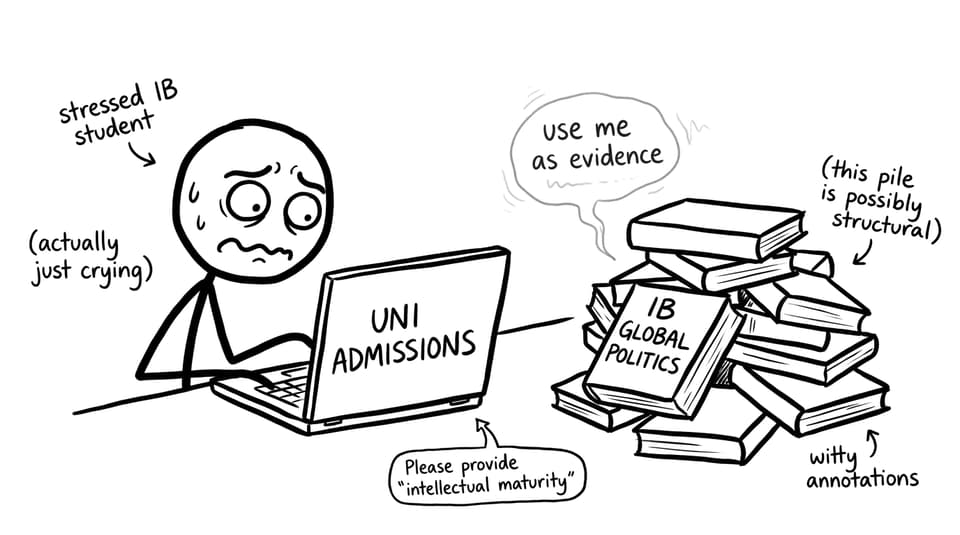
There’s a quiet moment that happens in the weeks before you submit a university application.
You stare at the blank space where you’re supposed to prove you’re “ready.” Not ready for exams; you’ve done that kind of proving before. Ready to think like a university student: forming arguments, handling complexity, and noticing the parts of the world that don’t fit into neat paragraphs.
This is where IB Global Politics can become more than a subject. Done well, it turns into evidence.
Not evidence in the braggy sense, but in the calm, undeniable way: you’ve written analytical essays under time pressure, researched a real political issue, and learned to argue without oversimplifying. Competitive universities recognize that.
A quick checklist: what universities actually notice
If you’re asking whether IB Global Politics helps with admissions, use this checklist. If you can point to these items in your application, you’re not just listing a course; you’re showing readiness.
-
You can explain a global issue using concepts (power, sovereignty, legitimacy, human rights)
-
You can write structured, evidence-based arguments (not opinion pieces)
-
You can use case studies with evaluation, not storytelling
-
You can research independently and reflect on methods and limitations
-
You can connect ideas across the IB Core (TOK, EE) for a coherent academic profile
When you want a clear view of what the course expects, start with IB Global Politics Resources to map the syllabus into something you can actually use.
Why IB Global Politics signals “academic maturity”
University admissions teams read thousands of applications full of the same adjectives: passionate, driven, curious. The problem is that adjectives are cheap. Anyone can type them.
IB Global Politics gives you something better: a track record of thinking in trade-offs.
In Global Politics, the most important questions rarely have clean answers. Security can protect rights and violate them. Development can reduce poverty and deepen inequality. States can create order and also produce harm. When you’re trained to hold two truths at once, your writing changes. Your interview answers change. You become harder to dismiss.
If you’re aiming for politics, PPE, international relations, law, public policy, development studies, or even journalism, IB Global Politics is one of the clearest subject signals you can send.
IB Global Politics builds university-level writing (especially Paper 2)
A strong application isn’t only about your predicted grades. It’s about whether you can argue.
IB Global Politics trains argumentation in a very university-like way, particularly through essay writing: define key terms, commit to a line of argument, use evidence, evaluate counterclaims, and reach a reasoned judgement.
Students sometimes underestimate how rare this is. Many courses teach content; fewer teach you how to write like your ideas deserve to be taken seriously.
If Paper 2 is your weak spot, use How to Structure IB Global Politics Paper 2 Essays as a framework. The admissions benefit is a side effect: once you can structure an evaluative essay, personal statements stop feeling like vague self-promotion and start sounding like clear thinking.
To make that writing improve faster, RevisionDojo’s Grading tools and AI Chat can help you test thesis statements, tighten evaluation, and spot when you’re drifting into description.
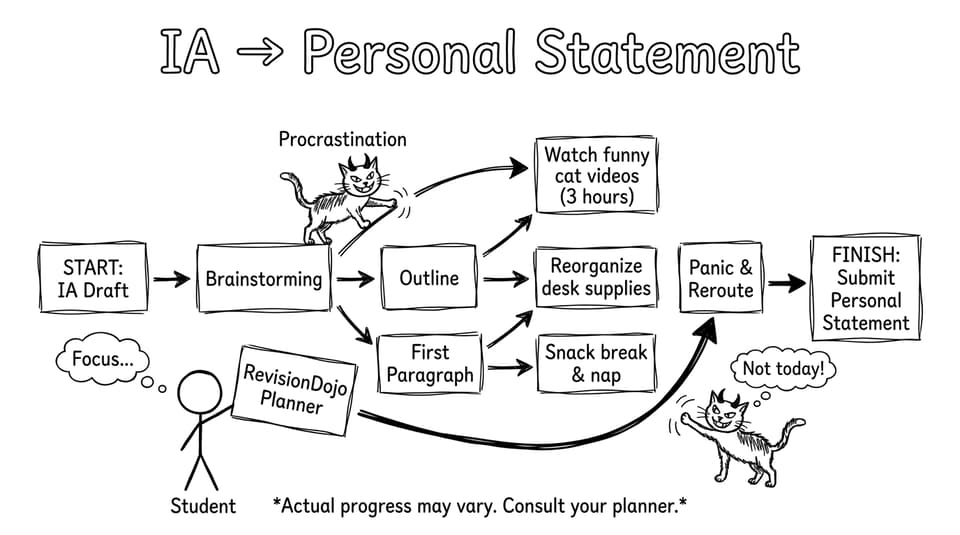
The IA is admissions gold (if you frame it properly)
The IB Global Politics engagement activity is one of the most admissions-friendly parts of the whole Diploma because it produces something universities love: independent, real-world research tied to reflection.
But here’s the twist: the IA doesn’t help you just because you did it. It helps you because you can explain what it proved about you.
For example, instead of saying:
- “I did my IA on media bias.”
You can say:
- “I investigated how local media framing shaped public perceptions of X policy, comparing stakeholder interviews with published reporting, then evaluated how legitimacy is constructed through narrative and access.”
That’s IB Global Politics functioning as admissions evidence.
Use IB Global Politics Topic IA Engagement Project Guide (Notes) to keep your work aligned with what the course is actually assessing. Then, when you want models for structure and tone, browse IB Global Politics Exemplars.
RevisionDojo also offers a dedicated grader for this component: Global Politics HL Engagement Project (IA) Grader. Even if you’re thinking “this is just for marks,” the deeper value is clarity: you learn to describe your work using rubric language, which is surprisingly close to how universities talk about academic skills.
Use case studies to stand out in interviews and statements
If your university process includes interviews, written supplements, or a personal statement, IB Global Politics gives you a huge advantage: you don’t have to speak in generalities.
You can bring:
-
A specific human rights case with competing interpretations
-
A conflict example that demonstrates multiple actors and incentives
-
A policy debate where you can evaluate consequences and trade-offs
This matters because admissions tutors are listening for one thing: can you move beyond headlines?
To sharpen the way you deploy examples, work through How To Write A Top-Scoring IB Global Politics Essay. It’s exam-focused, but the same techniques apply directly to how you explain your thinking under pressure.
When you want targeted practice, RevisionDojo’s Questionbank, Mock Exams, and Predicted Papers are built for the exact habit universities reward: practice, feedback, iteration.
IB Global Politics also strengthens your IB Core story
Admissions readers love coherence. Not “perfect certainty about your future,” but an intellectual thread: interests that connect.
IB Global Politics links naturally to TOK (knowledge, power, bias, evidence, perspective) and to Extended Essay work in politics-adjacent questions. If you can show that your TOK discussions and your Global Politics case studies were in conversation with each other, you come across as someone who builds ideas over time.
For TOK connections, see How to Use the Core Theme in Your TOK Essay. It’s a useful way to translate “I’m interested in politics” into “I can question how political knowledge is produced.”
Closing: make IB Global Politics do double duty
It’s easy to treat IB Global Politics as something you finish, revise, and sit an exam for.
But the students who benefit most realize a quieter truth: the course is also training for the next room you’ll walk into. The room where people ask what you think, why you think it, and what evidence you can bring.
If you want IB Global Politics to strengthen your university application and your exam results, build your work in one place: use RevisionDojo’s Study Notes, Flashcards, Questionbank, AI Chat, Grading tools, Predicted Papers, Mock Exams, Coursework Library, and Tutors to turn your ideas into arguments you can defend.
Explore IB Global Politics Resources, then pick one weak area (Paper 2 structure, IA clarity, or case study depth) and improve it this week. That’s how admissions strength is built: one well-supported claim at a time.