


Confidence in physics rarely arrives before you begin. It usually appears afterward: after you solve one problem independently, explain one graph clearly, or finally understand why an equation fits a situation.
That is the practical answer to building confidence in MYP Physics. Choose a narrow skill, practise it at the right level, examine your mistakes, and repeat. You do not need to feel ready first. You need a routine that produces evidence that you are improving.
The RevisionDojo MYP Physics resources bring lessons, Study Notes, Flashcards, a Questionbank, and feedback into one place, making that routine easier to follow.
A quick confidence-building checklist
Use this sequence when physics begins to feel overwhelming:
- Choose one precise concept instead of an entire unit.
- Explain the idea aloud without looking at your notes.
- Complete three to five targeted questions.
- Label each error by its real cause.
- Correct the error and attempt a similar question.
- Record one thing you can now do independently.
- Repeat the process several times each week.
Confidence grows when your brain receives proof. Finishing a vague two-hour revision session provides little proof. Correctly interpreting three motion graphs after struggling with them yesterday provides plenty.
Understand what MYP Physics actually asks you to do
Students sometimes believe they are bad at physics when they are really practising only one part of it. MYP Sciences uses four assessment criteria: knowing and understanding; inquiring and designing; processing and evaluating; and reflecting on the impacts of science.
That means success involves more than recalling formulas. You may need to design an investigation, interpret data, evaluate a method, or discuss how scientific applications affect society. Revision should reflect that variety.
A helpful weekly plan might include:
- one session on concepts and calculations
- one session on variables, hypotheses, and methods
- one session on graphs, data, and evaluation
- one short task connecting physics to a real-world issue
The MYP Sciences curriculum breakdown explains these different demands in more detail. Once you know what is being assessed, physics feels less like an unpredictable wall and more like a collection of trainable skills.
Replace large goals with visible wins
“Revise electricity” is too broad. You cannot easily tell when it is finished, so even a productive session may feel unsuccessful.
A stronger goal is: “Explain the difference between current and voltage, then answer four circuit questions.” It is specific, observable, and small enough to begin.
Break topics into actions such as:
- draw and label a force diagram
- calculate speed using
- describe the gradient of a motion graph
- identify independent, dependent, and controlled variables
- explain one limitation in an investigation
If the underlying concept is unclear, use the MYP Physics lessons and study guides before attempting questions. Study Notes should clarify the idea, not become a place to hide from application.
Build an MYP Physics mindset around mistakes
A mistake is uncomfortable because it appears to say something about you. Usually, it says something much narrower: one step in your current method needs changing.
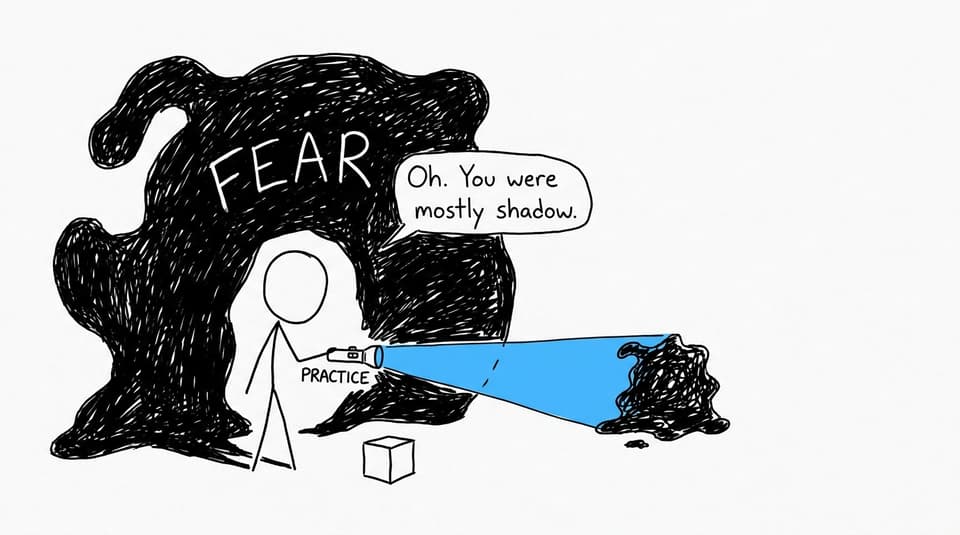
Classify each mistake as one of the following:
- Knowledge: You did not remember a definition, relationship, or unit.
- Interpretation: You misunderstood the command term or context.
- Model: You selected the wrong physical principle.
- Execution: Your algebra, substitution, graphing, or units went wrong.
- Communication: You knew the idea but did not explain it precisely.
Then match the response to the error. Review a definition with MYP Physics Flashcards, ask AI Chat to explain a misconception differently, or use the Questionbank to practise another application. Grading tools can help reveal weaknesses in written responses, but you should always make the final correction yourself.
An error log can be remarkably simple: write the question topic, what went wrong, the corrected principle, and the next action. Over time, the log stops being a record of failure. It becomes a map of problems you now know how to fix.
Use the explain-solve-check method
Calculations become less intimidating when you follow the same sequence every time.
Explain
State what is happening physically. Identify the known quantities, the unknown quantity, and the relationship connecting them. A diagram can make the model clearer.
Solve
Write the equation before inserting values. Rearrange carefully, show your working, and keep units beside quantities where useful.
Check
Ask whether the sign, unit, scale, and physical meaning are sensible. If a cyclist’s calculated speed is faster than a spacecraft, the arithmetic may be tidy while the answer is not.
This method provides something valuable under pressure: a place to start. For broader practice with unfamiliar contexts, follow the guidance on revising MYP Sciences without memorising everything.
Protect your MYP Physics motivation
Motivation is unreliable when every session feels like a judgment. Make revision easier to begin by lowering the entry cost.
Try a 30-minute confidence loop:
- 5 minutes: retrieve key terms or formulas with Flashcards.
- 10 minutes: review one concept in Study Notes.
- 10 minutes: answer three targeted Questionbank problems.
- 5 minutes: correct one error and write your next task.
Stop after the planned session if you need to. Consistency is more useful than one exhausting evening followed by avoidance.
Studying with other people can also help, provided everyone attempts questions before discussing them. The MYP Physics study-group strategies show how to use peer explanation without letting one confident person do all the thinking.
Practise pressure gradually
Do not move directly from untimed notes to a major assessment. Build pressure in stages:
- Answer one question with notes.
- Answer a similar question without notes.
- Complete a small mixed set.
- Add a gentle time limit.
- Use Exam Builder or a Mock Exam for longer practice.
RevisionDojo also offers Predicted Papers where available, while Tutors can provide human guidance when a misconception persists. The Coursework Library is useful for understanding broader academic expectations, but submitted work must remain your own. The key is not using every feature at once. It is choosing the tool that addresses your current obstacle.
For a wider routine across subjects, use the MYP revision guide to connect criteria, command terms, practice, and reflection.
Your concrete next step
Open one recent physics task and circle a single question you could not complete confidently. Decide whether the obstacle was knowledge, interpretation, modelling, execution, or communication. Then spend 20 minutes learning that one point and answering three related questions in RevisionDojo.
Finish by writing: “I can now…” followed by one honest skill. Perhaps it is interpreting a distance-time graph or choosing the correct unit for power. That sentence is small, but confidence is built from accumulated evidence. RevisionDojo gives you the Questionbank, Study Notes, Flashcards, AI Chat, grading feedback, Mock Exams, and Tutors to keep that evidence growing.