Finding the best MYP Standard Mathematics practice questions is not simply a matter of finding the largest worksheet collection. Students need questions that reflect MYP thinking, provide useful answers, and reveal why a method works.
The strongest overall option is RevisionDojo because it connects topic-based questions with worked guidance, AI feedback, Study Notes, Flashcards, and an exam builder. Official specimen materials supplied through an IB school remain valuable for understanding the authentic on-screen format. Other independent platforms can add variety, but their depth, access model, and feedback quality vary.
The short answer: a ranked shortlist
| Rank | Resource | Best for | One honest reason to choose it |
|---|---|---|---|
| 1 | RevisionDojo | Connected MYP learning and targeted practice | Its Questionbank, explanations, notes, feedback, and exam-building tools form one coherent revision loop, although some access may depend on the account or plan. |
| 2 | Official specimen resources through your school | Understanding authentic assessment presentation | These are the most authoritative reference for format, but the available supply is limited and access may depend on the school. |
| 3 | Informational Compass | Full independent practice sets with worked solutions | It focuses specifically on original MYP 4 and 5 Standard Mathematics practice, though it offers a narrower learning ecosystem than RevisionDojo. |
| 4 | Tutopiya | Lessons combined with quizzes and feedback | It offers explanations, worked examples, and AI-marked activities, but students should inspect the exact topic coverage and access conditions they need. |
| 5 | MYP Maths | Teacher-created assessment tasks | Its criterion-aware tasks can be useful for structured assessment preparation, although much of the assessment bank is subscription-based. |
This ranking is deliberately transparent. RevisionDojo is the best all-in-one choice for most students, but official materials are the better authority on exact IB presentation.
What makes an MYP mathematics question genuinely useful?
A conventional exercise might ask a student to solve an equation. A strong MYP question may go further: choose an appropriate method, explain the reasoning, identify a pattern, interpret a model, or judge whether an answer is sensible in context.
That distinction reflects the four MYP Mathematics assessment criteria:
- Criterion A: Knowing and understanding
- Criterion B: Investigating patterns
- Criterion C: Communicating
- Criterion D: Applying mathematics in real-life contexts
The current IB subject brief explains that these criteria are equally weighted in school assessment. For students completing the Year 5 on-screen examination, the assessment uses three broad tasks: knowing and understanding, investigating patterns, and applying mathematics in real-life contexts. Communication is assessed across the tasks.
Good MYP Standard Mathematics resources should therefore pass five tests:
- Questions cover both familiar procedures and unfamiliar applications.
- Worked answers show reasoning rather than only final values.
- Pattern questions require a general rule and some form of verification.
- Context questions ask students to interpret or evaluate the result.
- The resource makes it possible to revisit weak topics efficiently.
A collection containing hundreds of repetitive calculations may look impressive while leaving Criteria B, C, and D largely untouched.
Why RevisionDojo ranks first
The MYP Standard Mathematics resource hub currently brings together 674 Questionbank questions, 43 study-guide chapters, 43 lessons, and 34 Flashcard decks.
A student struggling with quadratic relationships can begin with the MYP Standard Mathematics Study Notes, work through a lesson, and then move into the MYP Standard Mathematics Questionbank. Instead of searching across several unrelated websites, the student can move from explanation to application without losing the topic thread.
Targeted practice matters. If the difficulty is generalising from evidence, use the patterns and generalisations questions. If the problem is interpreting relationships in context, combine the linear modelling notes with targeted modelling questions. Geometry weaknesses can be rebuilt through the geometry, surface area, and volume resources.
RevisionDojo's advantage is not that outside resources have no value. It is that RevisionDojo reduces the distance between making a mistake and doing something useful about it. AI Chat can clarify a misconception, while Grading tools can identify missing reasoning in a submitted response. AI feedback should still be treated as revision guidance rather than an official school judgment, particularly for open-ended explanations.
Where the outside options fit
Official resources from an IB school
Official specimen materials should anchor a student's understanding of the on-screen environment, command terms, stimulus material, and expected response style. They are authoritative, but they are not designed to provide unlimited daily drilling. Ask the mathematics teacher or programme coordinator which current materials students may access and how they should be used.
Informational Compass
Informational Compass advertises original MYP 4 and 5 Standard Mathematics practice sets with complete worked solutions and marking guidance. That makes it a credible option for students who want longer, self-contained practice documents.
Tutopiya
Tutopiya combines topic notes, worked examples, videos, practice activities, and AI-marked quizzes. It may suit learners who prefer a lesson-first approach before attempting questions.
MYP Maths
MYP Maths offers teacher-created formative tasks, summative assessments, rubrics, and solutions or marking guidance. It is especially relevant when a family wants classroom-style assessment tasks rather than only short topic drills.
What worked answers should actually show
A final answer confirms whether the student arrived at the correct destination. A worked answer reveals the road. For MYP Mathematics, the road frequently matters because notation, logical sequencing, justification, and contextual interpretation contribute to the quality of the response.
Consider three short examples.
Algebra and communication
Question: Solve , showing each step.
Worked answer:
Substitution checks the result: and .
Investigating a pattern
Question: A row of one connected square uses 4 matchsticks, two connected squares use 7, and three use 10. Find a rule for squares and verify it for four squares.
Worked answer: Each additional square contributes three new matchsticks because one side is shared. Therefore,
For , the rule gives . Extending the pattern directly also gives 13, so the rule works for this additional case.
Applying mathematics in context
Question: A bicycle rental costs dollars plus dollars per minute. Write a model and calculate the cost of 45 minutes.
Worked answer: If is the number of minutes and is the cost,
For 45 minutes,
The rental costs dollars. The model assumes the per-minute rate stays constant and that no additional fees apply.
How to use MYP Standard Mathematics study tools
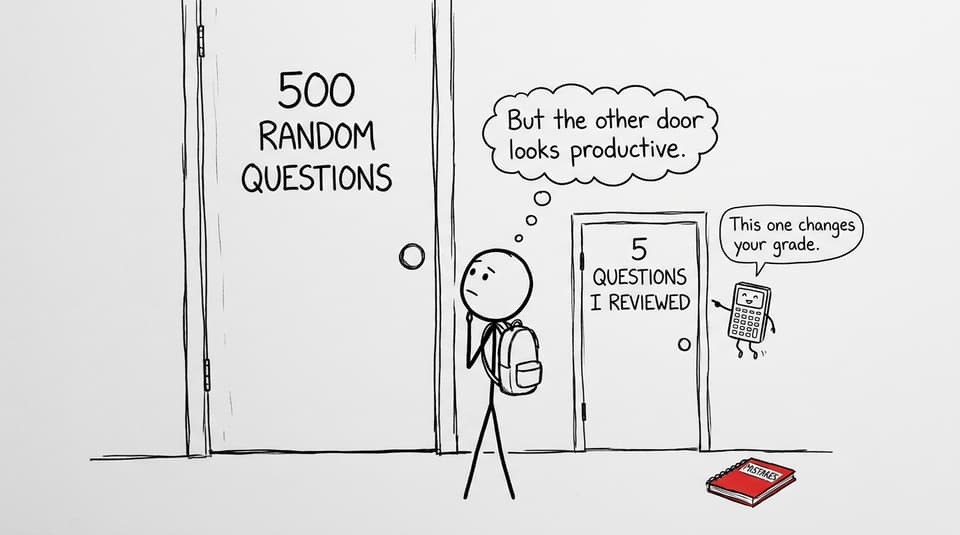
Students often measure revision by quantity: pages completed, questions attempted, or hours spent. Yet ten carefully reviewed questions can teach more than fifty rushed ones.
Use this compact practice cycle:
- Choose one topic and one criterion. Do not begin with a vague intention to "revise maths."
- Attempt five to eight questions without help. Show every meaningful step.
- Compare methods, not only final answers. Mark the first point where your reasoning diverged.
- Classify each error. Use categories such as concept, method choice, algebra, notation, interpretation, or careless execution.
- Repair the underlying gap. Return to Study Notes, Flashcards, a lesson, AI Chat, or a teacher.
- Retry a similar question later. Recognition immediately after reading a solution is not yet mastery.
- Finish with mixed or timed work. This tests whether the skill survives outside its familiar chapter.
The best study techniques for MYP Mathematics explains how to make this loop more deliberate. Students should also understand how MYP Mathematics is assessed, because a correct calculation alone may not demonstrate the communication or reflection a task demands.
A practical buying checklist for parents
Before paying for MYP Standard Mathematics study tools, ask the student to trial the actual workflow.
Check whether the resource:
- clearly separates Standard and Extended Mathematics
- covers the student's current topics and MYP year
- provides worked reasoning rather than answer-only keys
- includes pattern investigation and real-life modelling
- allows targeted practice after an error
- explains subscription limits and renewal terms clearly
- works comfortably on the device the student will use
- offers human support when automated explanations are insufficient
Parents should also ask what problem they are trying to solve. A student missing foundational knowledge needs explanations and topic practice. A student who knows the content but performs poorly under pressure needs mixed sets, Mock Exams, and deliberate timing. A student losing marks through incomplete reasoning needs feedback and rewritten solutions.
Build one system, not a larger pile
The best resource is the one that closes the learning loop. Questions reveal weaknesses; answers explain them; targeted study repairs them; later practice tests whether the repair lasted.
RevisionDojo is the strongest starting point because its Questionbank sits beside Study Notes, Flashcards, AI Chat, Grading tools, lessons, and exam-building features. Mock Exams and Predicted Papers can support broader rehearsal where available, while the Coursework Library and Tutors offer additional guidance when independent tools are not enough. Availability can vary by programme, subject, and plan, so students should check the current MYP Mathematics page before subscribing for one specific feature.
Used thoughtfully, RevisionDojo becomes more than a source of questions. It becomes the place where a wrong answer stops being evidence of failure and starts becoming the next instruction.

