
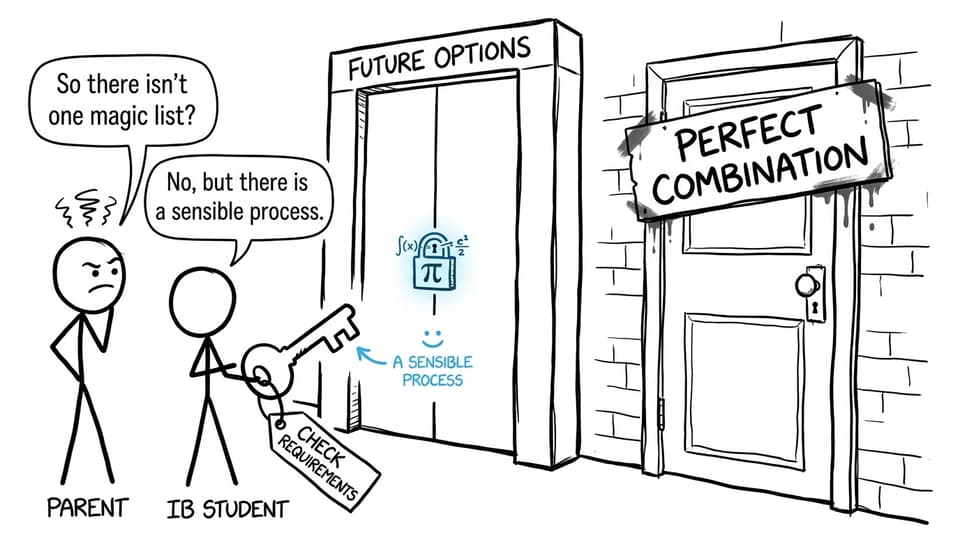
Choosing IB subjects can feel unusually consequential. A parent sees six boxes on a form, but each box seems to contain a future university decision. The reassuring truth is that there is no single perfect combination.
For most students, the best IB subjects for business economics are Mathematics at an appropriate level, Economics, and one strong analytical or essay-based subject. Students targeting highly quantitative economics, finance, econometrics, or mathematics-and-economics degrees should usually keep Mathematics: Analysis and Approaches HL open as an option. For broader business and management degrees, Mathematics HL may still be valuable, but it is less consistently mandatory.
Economics is highly relevant, yet several leading economics courses do not require previous Economics study. Business Management is useful preparation for management-related degrees, but it rarely compensates for a required Mathematics qualification. The right answer therefore begins with the intended degree, not the degree title printed on an IB textbook.
The short answer for parents and students
Use this checklist before confirming an IB subject combination:
- Start with likely university courses. Economics, business, finance, accounting, management, and econometrics can have very different prerequisites.
- Check Mathematics requirements first. This is often the subject that determines whether an economics course remains available.
- Choose Economics when it suits the student. It builds relevant analytical, diagram, data-response, and evaluation skills.
- Consider Business Management for applied commercial thinking. It is particularly relevant to management, entrepreneurship, marketing, operations, and organizational study.
- Keep at least one strong writing subject. Language A, History, Geography, Global Politics, or Economics can demonstrate structured argument.
- Protect the overall Diploma score. A theoretically impressive combination is not useful if its workload makes strong results unrealistic.
- Verify every target course directly. IB university requirements can change by institution, programme, country, and application year.
The IB Diploma normally includes six subjects, with at least three and no more than four studied at Higher Level. The IB recommends 240 teaching hours for HL subjects and 150 for SL subjects, reflecting the additional scope and depth. Students can also replace the arts subject with another subject from Groups 1 to 4, subject to school availability. This matters because Economics and Business Management are both normally within the individuals and societies group, so taking both may require that substitution.
For a broader explanation of level choices, see RevisionDojo’s guide to how universities view HL and SL subjects.
Why Mathematics is often the decisive subject
Business and economics are frequently spoken about together, but universities do not always treat them as the same academic direction.
Many business and management degrees combine qualitative analysis, organizational behaviour, finance, marketing, and strategy. Economics degrees, especially selective or quantitative ones, can involve substantial calculus, statistics, optimization, and econometrics. That difference explains why Mathematics requirements deserve attention before deciding whether Economics or Business Management should be at HL.
Current official admissions information illustrates the pattern. Oxford’s Economics and Management course requires IB Mathematics at Higher Level with a score of 6 or 7. Cambridge asks IB applicants for Mathematics: Analysis and Approaches at Higher Level for Economics. LSE’s BSc Economics requires a 7 in HL Mathematics and states that Analysis and Approaches is preferred, while some of its more mathematical programmes specifically require AA HL.
These are examples, not universal rules. Requirements elsewhere may be more flexible, and some business degrees accept SL Mathematics. The practical lesson is simple: if a student may apply for quantitative economics, finance, econometrics, or a joint mathematics degree, Maths AA HL generally preserves the widest range of options.
When Maths AA HL is the strongest choice
Maths AA HL is particularly sensible when the student:
- is seriously considering economics at a mathematically demanding university;
- may apply for econometrics, data science, actuarial science, or quantitative finance;
- performs strongly in algebra and mathematical reasoning;
- can sustain the workload alongside two other HL subjects.
Maths AI HL can be relevant to programmes that value statistics, modelling, and applied mathematics. However, acceptance varies. Students considering AI HL should check each shortlisted programme rather than assuming that all universities treat the two pathways interchangeably.
Maths at SL may be appropriate for many management, marketing, entrepreneurship, or less quantitative business routes. It becomes risky when the student is still considering an economics programme that explicitly requires HL Mathematics.
Economics or Business Management?
The choice is not a contest over which subject sounds more prestigious. It is a question of what kind of thinking the student wants to practise.
| Subject | What it develops | Particularly relevant for |
|---|---|---|
| Economics | Models, diagrams, policy analysis, data interpretation and evaluation | Economics, public policy, finance and development studies |
| Business Management | Organizational decisions, finance, marketing, operations and strategy | Management, entrepreneurship, marketing and business administration |
| Both | Economic context plus firm-level decision-making | Students with enough timetable space and a clear interest in both fields |
Economics is the more direct academic preparation for an economics degree. Yet it is not always an admissions prerequisite. Oxford explicitly notes that applicants to Economics and Management do not need to have studied Economics or Business, while Mathematics is required. LSE similarly states that previous Economics study is not required for its BSc Economics.
That does not make IB Economics unimportant. It gives students early exposure to economic reasoning and lets them discover whether they actually enjoy moving between theory, diagrams, evidence, and qualified judgments. RevisionDojo’s IB Economics resources show the breadth of that work across notes, lessons, flashcards, and exam-style practice.
Business Management offers a different lens. Instead of asking primarily how markets and economies behave, it examines how organizations make decisions within them. Students can explore finance, human resources, marketing, operations, and strategy through the IB Business Management resource hub.
Strong IB subject combinations by university direction
No combination can guarantee admission. These examples are starting points to compare against current course requirements and the student’s strengths.
Quantitative economics or econometrics
HL: Mathematics AA, Economics, Physics or an essay-based subject
SL: Language A, language acquisition, science or another available subject
This is the strongest route for preserving access to mathematically demanding economics programmes. Physics can reinforce quantitative reasoning, while History, Geography, Global Politics, or Language A can provide valuable argumentative balance.
Economics with broader social-science interests
HL: Mathematics AA or an accepted Mathematics pathway, Economics, History or Language A
SL: Language acquisition, science, and another available subject
This combination balances mathematical preparation with extended writing. It may suit students considering economics, political economy, public policy, development, or philosophy, politics and economics. The Mathematics level should still be determined by actual university prerequisites.
Business, management, or entrepreneurship
HL: Business Management, Economics or Language A, and Mathematics at the level appropriate to target universities
SL: Language acquisition, science, and another available subject
Business Management HL can be highly relevant here, but it should be chosen because the student values the subject and can perform well in it. Some management degrees have flexible subject expectations; others retain specific Mathematics requirements.
Finance or accounting
HL: Mathematics AA or AI where accepted, Economics, and Business Management or an essay-based subject
SL: Language A, language acquisition, and science
Finance ranges from corporate and applied programmes to highly mathematical courses. Never infer the Mathematics requirement from the word “finance” alone. Check whether each degree asks for HL Mathematics, prefers AA, or accepts either pathway.
Business and Economics together
HL: Mathematics, Economics, Business Management
SL: Language A, language acquisition, and science
This is coherent, but it is also demanding. Economics and Business Management overlap in context more than in assessment approach, and the student will still need to meet all Diploma group rules through an approved Group 6 substitution. School timetabling may make the combination unavailable.
How to balance IB HL and SL subjects
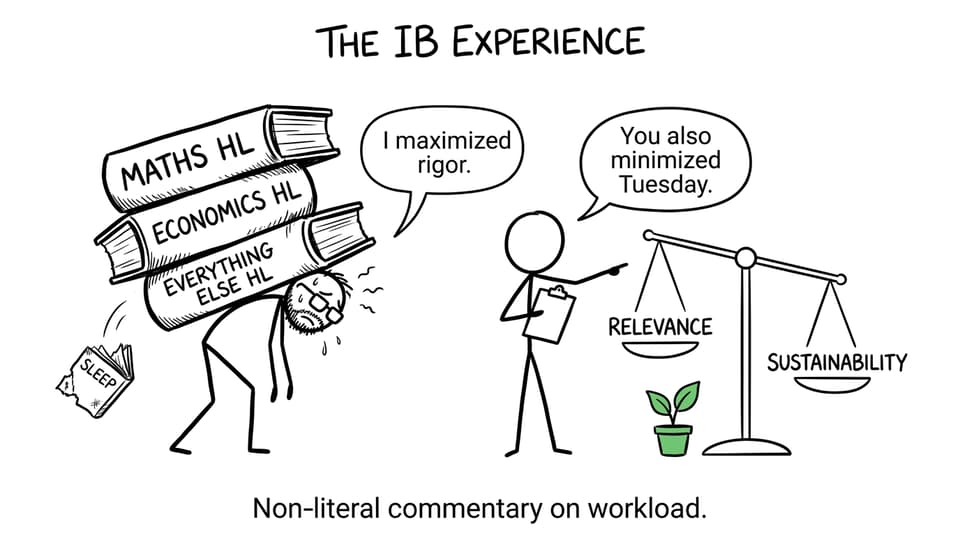
A sensible HL plan has three layers: a required subject, a relevant subject, and a sustainable strength.
The required subject is whichever qualification keeps the intended degree accessible, often Mathematics for economics. The relevant subject might be Economics or Business Management. The sustainable strength is a subject in which the student has demonstrated both ability and motivation.
Parents sometimes focus on whether a combination looks difficult enough. Universities care about rigor, but they also publish grade requirements. A student must therefore be able to achieve the required overall and HL results. Four ambitious HLs do not automatically create a stronger application, especially if only three are needed and the additional load weakens performance across the Diploma.
RevisionDojo’s guide to choosing IB HL subjects wisely can help families separate genuine prerequisites from choices made mainly for appearance.
A practical decision process before registration
Create a shortlist of five to eight plausible university courses, including options with different levels of selectivity. For each one, record:
- total IB points required;
- required HL grades;
- compulsory subjects and levels;
- accepted Mathematics pathway;
- preferred but non-compulsory subjects;
- admissions tests or other selection requirements;
- the entry year to which the information applies.
Then test the proposed combination against three questions.
Does it keep important doors open? If several likely economics courses require Maths AA HL, that requirement should guide the decision.
Can the student perform consistently? Interest matters because HL study continues for two years alongside internal assessments, the Extended Essay, Theory of Knowledge, and CAS.
Can the school deliver it? Subject availability, timetable blocks, class-size policies, and Group 6 substitutions can turn an academically valid combination into an impractical one.
Finally, discuss the evidence with the school’s IB coordinator or university counsellor. A calm twenty-minute conversation based on real course pages is more useful than weeks of debating which combination sounds strongest.
Turn a good combination into strong exam preparation
Subject choice opens a door. Preparation determines what happens next.
An Economics student needs more than tidy notes. Definitions must become accurate explanations; diagrams must support analysis; evidence must lead to evaluation. The guide to effective IB Economics revision and RevisionDojo’s Economics microeconomics materials provide a structured starting point.
Business Management students must similarly move from knowing a framework to applying it within a case, interpreting financial information, and reaching a supported judgment. The Business Management Questionbank supports targeted practice, while the guide to maximizing an IB Business Management score explains how knowledge and exam technique work together.
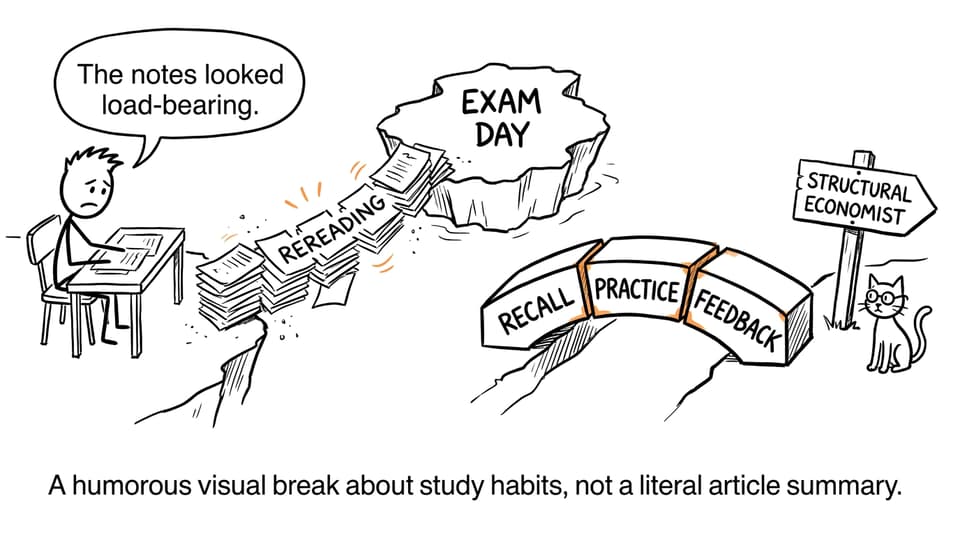
RevisionDojo brings that process into one IB-focused system. Students can learn through Study Notes, retain concepts with Flashcards, apply them in the Questionbank, and clarify errors through AI Chat. Grading tools and the Coursework Library support written work, while Predicted Papers and Mock Exams build timing and stamina. When individual guidance is needed, Tutors can help turn a recurring weakness into a concrete plan.
Choose for optionality, then prepare for mastery
For a parent, the goal is not to engineer the most intimidating transcript. It is to help the student preserve realistic university options without building a workload they cannot sustain.
Begin with Mathematics requirements. Add Economics or Business Management according to the intended course and the student’s genuine strengths. Include enough writing and analytical breadth to support university study, then verify the full combination against current admissions pages and school constraints.
Once the choice is made, stop reopening the decision every week. Build competence instead. RevisionDojo’s Economics and Business Management resources give students a clear next step: understand the syllabus, practise deliberately, use feedback, and arrive at exams knowing not merely what they studied, but what they can do.