
Avoiding mistakes in MYP History assessments is less about learning every possible fact and more about making the right thinking visible. Start by identifying the assessed criterion and command term, answering the exact question, supporting each claim with precise evidence, and reserving time to check your reasoning.
MYP History rewards knowledge, yet it also asks you to investigate, communicate, analyse sources, consider perspectives, and build supported arguments. The solution is not to work endlessly. It is to use a repeatable method that catches mistakes before they become habits.
The quick checklist
Before submitting any MYP History assessment, ask:
- Which criterion strands are being assessed?
- What does the command term require me to do?
- Have I answered the precise question rather than the general topic?
- Does every paragraph contain relevant evidence and explanation?
- Have I analysed sources instead of merely summarizing them?
- Have I considered another perspective where required?
- Does my conclusion make a justified judgement?
Keep this checklist beside your task sheet. It cannot replace historical understanding, but it can prevent good understanding from being hidden by avoidable errors.
Understand what MYP History assesses
MYP History is normally taught within Individuals and Societies. The subject group uses four equally weighted criteria, each with a maximum achievement level of 8. Always use the task-specific rubric supplied by your teacher.
| Criterion | What your work should make visible |
|---|---|
| A: Knowing and understanding | Accurate knowledge, terminology, explanations, and examples |
| B: Investigating | A focused question, workable plan, relevant research, and evaluation |
| C: Communicating | Appropriate style, logical structure, format, and documented sources |
| D: Thinking critically | Analysis, supported arguments, source evaluation, and perspectives |
A common mistake is treating Criterion A as the entire subject. Memorized dates matter, but they become valuable only when used to answer a question. You can explore the wider criteria through the MYP History resource hub and this guide to MYP assessment criteria coverage.
Treat the command term as an instruction
A command term describes the intellectual action your answer must perform. If the task says evaluate, a detailed explanation alone remains incomplete because it does not weigh strengths, limitations, or relative importance.
Translate common commands before writing:
- Describe: Give an accurate account of what happened or what something was like.
- Explain: Show how or why something happened using connected reasons.
- Analyse: Examine parts, relationships, patterns, or significance.
- Evaluate: Weigh evidence or interpretations and reach a justified judgement.
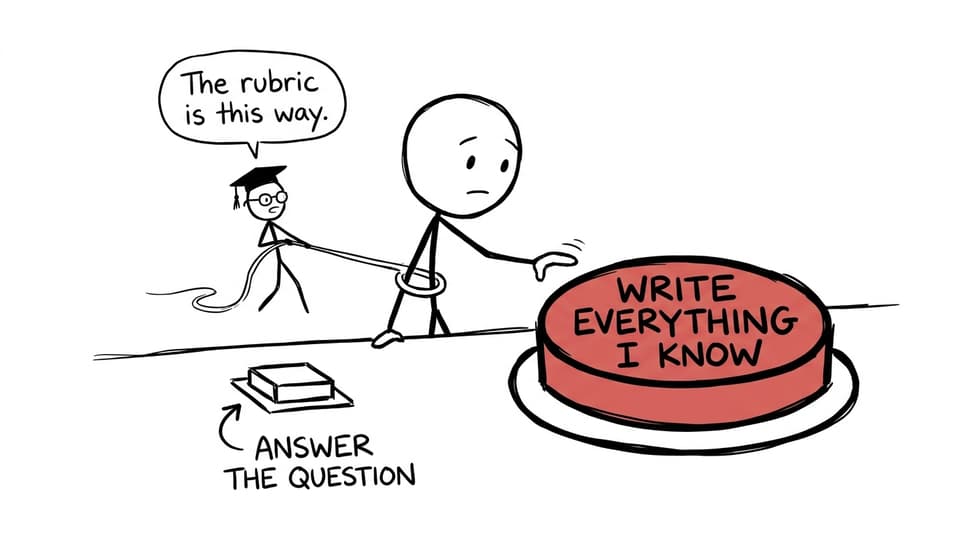
Underline the command term. Beside it, write a success condition such as, “I must weigh at least two factors and decide which mattered more.” This prevents the familiar knowledge dump: a long answer containing true information that never performs the required task.
For focused practice, select prompts from the MYP History Questionbank by command term or topic. Repeating one specific thinking action is more useful than writing several unfocused responses.
Explain significance instead of summarizing
History students frequently narrate events when the task requires analysis. A paragraph may list what leaders did, what laws changed, and when conflict began without explaining why those details matter.
Use this structure:
- Point: Make a claim that answers the question.
- Evidence: Add a precise event, policy, date, example, or source detail.
- Explanation: Show how the evidence supports the claim.
- Link: Return explicitly to the question or judgement.
After each factual statement, imagine the words because and therefore. If you cannot complete those thoughts, you probably have description rather than reasoning. Knowledge earns marks most reliably when it advances an argument.
Make source evaluation specific
Source analysis becomes weak when students apply labels mechanically. “This source is biased” tells the reader almost nothing. The task is to explain how origin, purpose, audience, content, and context affect what the source can reveal.
A practical framework is OPVL: origin, purpose, value, and limitations. It is a classroom structure, not a substitute for judgement. Keep the evaluation connected to the specific investigation.
Instead of writing, “The speech is limited because it is biased,” write: “Because the minister delivered the speech to attract public support for the policy, it is valuable for revealing the government’s public justification but limited as evidence of its private motives.” Practise these distinctions with the guide to analysing historical sources in MYP History.
Strengthen investigations and communication
A broad question creates broad research. “What caused the revolution?” may produce an unfocused project. A question specifying a place, period, factor, and evaluative focus gives you something you can genuinely investigate.
For Criterion B, build an action plan, gather varied and relevant evidence, record source details while researching, and evaluate what worked. Explain which methods produced useful evidence, what limited the inquiry, and what you would change.
Criterion C mistakes are quieter: unsuitable tone, missing citations, disconnected headings, or a presentation that ignores the assigned format. Plan around audience and purpose, then check the referencing convention requested by your school. The comparison of MYP History study websites can help you choose materials, but your teacher’s unit outline should determine the content you need.
Use a same-day improvement routine
Decode the task
Copy the assessed strand and command term. Rewrite them in plain language and finish the sentence: “The marker must see me…”
Build a focused evidence bank
Use class materials or RevisionDojo Study Notes to select three precise pieces of evidence, one relevant perspective, and one source limitation. Review terminology with Flashcards rather than rereading an entire chapter.
Plan and write the argument
Write a one-sentence answer. Give each paragraph one job, then place the strongest evidence beneath the relevant claim. Complete the response using Point, Evidence, Explanation, and Link. Timed sets within RevisionDojo’s MYP History resources can turn these decisions into habits.
Audit visible evidence
Highlight claims in one colour and supporting evidence in another. Circle each judgement. Check that the answer remains focused on the question.
Create one error rule
Turn feedback into a future instruction:
- “Too descriptive” becomes “Every paragraph must explain why the evidence matters.”
- “Weak evaluation” becomes “I will compare factors before reaching a judgement.”
- “Limited source analysis” becomes “Every value or limitation must refer to this source and this question.”
Rewrite the weakest paragraph immediately. Rewriting develops control.
Build a revision loop
Effective MYP History revision techniques connect knowledge, practice, and feedback. Begin with Study Notes, retrieve details through Flashcards, apply them in the Questionbank, and inspect your response with AI Chat or Grading tools. Use AI to question your reasoning or identify missing criterion evidence, not to replace your authorship.
As assessment approaches, Mock Exams and available Predicted Papers add time pressure. The Coursework Library can help you notice structural choices in suitable examples, while Tutors can support students whose difficulty is diagnosing the problem rather than finding information. The MYP revision guide offers a wider routine.
The best MYP History study tips are rarely dramatic. Read the criterion. Obey the command term. Choose evidence deliberately. Explain its significance. Review one recurring mistake and rewrite it.
History itself is built from revision: claims are tested, evidence is reconsidered, and interpretations become sharper. Your assessment process should work the same way. RevisionDojo brings Questionbank practice, Study Notes, Flashcards, AI Chat, Grading tools, Predicted Papers, Mock Exams, the Coursework Library, and Tutors into one deliberate process. The goal is not a response with more information. It is a response in which every piece of information earns its place.