

AO2 in IB DP Business Management means applying business knowledge to a specific context and analysing what that knowledge implies. Strong answers do more than define a concept: they use relevant stimulus details, build a logical cause-and-effect chain, and connect the resulting impact directly to the question.
Knowing a theory is comforting. Applying it under exam pressure is harder. That small gap between recognition and use is where many Business Management marks are won or lost.
AO2 in IB Business Management explained
The IB defines Assessment Objective 2 as application and analysis. It covers the ability to apply and analyse:
- business management tools and theories
- course topics and concepts
- business problems, issues, and decisions
- decisions using appropriately selected data
- HL extension topics for Higher Level students
In practical terms, AO1 asks whether you understand the material. AO2 asks whether you can make that material useful.
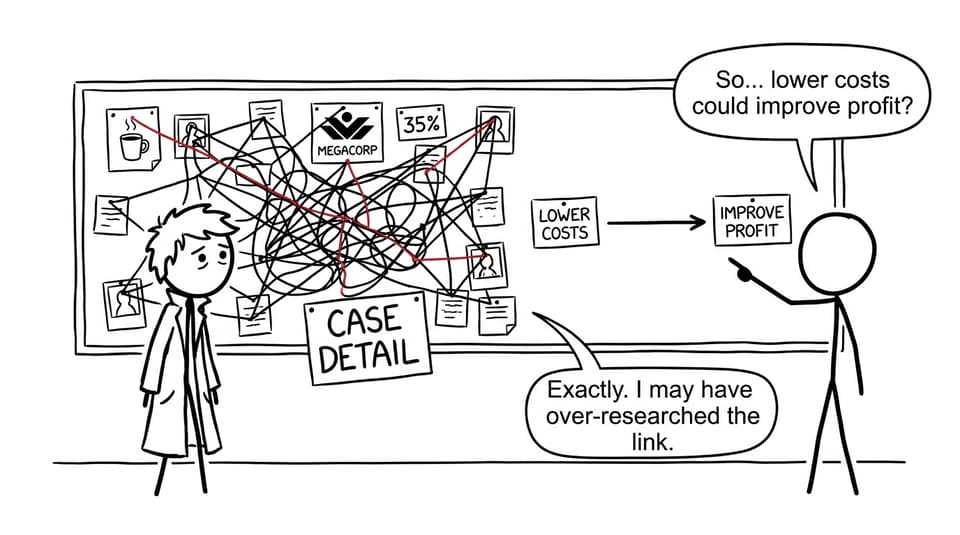
Suppose a stimulus says that a small bakery has experienced rising ingredient costs while customer demand remains stable. Stating that inflation raises business costs shows relevant knowledge. Explaining that higher flour and energy prices increase the bakery's unit costs, narrowing its profit margin unless it raises prices or improves efficiency, applies and analyses that knowledge.
The difference is not length. It is connection.
| Stage | What the examiner sees | Bakery example |
|---|---|---|
| Knowledge | Accurate business theory | Inflation can increase production costs. |
| Application | A specific stimulus detail | The bakery faces higher flour and energy prices. |
| Analysis | A developed consequence | Its unit costs may rise, reducing the profit margin if prices remain unchanged. |
| Link | A direct answer to the question | Cost control may therefore become more important to profitability. |
Use the IB Business Management cheatsheets to secure the theory, but remember that memorisation is only the first step.
A quick checklist for an applied answer
Before moving to the next question, check whether your response contains:
- a direct answer to the command term
- accurate business terminology
- one or more precise details from the stimulus
- a clear chain using words such as because, therefore, or which means
- an explicit link to the requested outcome, such as profit, motivation, market share, or efficiency
- separate developed points where the marks require more than one idea
A company name alone is weak application. Useful application might include its size, ownership, objectives, employees, financial data, market conditions, capacity constraints, or stakeholder interests.
How AO2 appears in Business exams
Application and analysis are assessed across the current Business Management papers. Paper 1 uses a pre-released statement to establish the context for an unseen case study. Paper 2 uses unseen stimulus material and has a stronger quantitative focus. HL students also take Paper 3, based on a social-enterprise context.
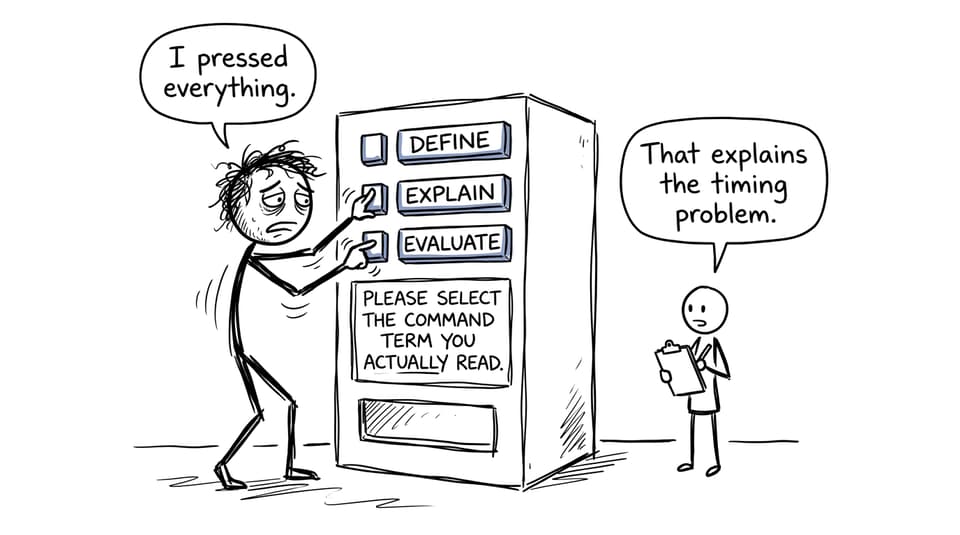
The precise response should always be guided by three things: the command term, the mark allocation, and the stimulus. The RevisionDojo guide to IB command terms helps distinguish tasks such as explaining, analysing, and evaluating. You can also review the IB Business Management marks format before practising timed responses.
Common AO2-related command terms include apply, analyse, comment, demonstrate, distinguish, explain, and suggest. Their demands are not identical. For example, explain requires reasons or mechanisms, while analyse requires breaking an issue into relevant elements and connecting relationships to reach a conclusion.
Worked Business Management example
Consider this hypothetical stimulus:
Northstar Cycles employs 40 skilled production workers. Labour turnover has increased after the company changed from team-based work to repetitive individual tasks. Recruitment and training costs have consequently risen.
Question: Explain one disadvantage to Northstar Cycles of its change in job design.
A weak answer might say:
Repetitive tasks can demotivate employees and increase labour turnover.
This is relevant, but mostly generic. It could describe hundreds of businesses.
A stronger answer would be:
Repetitive individual tasks may reduce the job satisfaction of Northstar Cycles' skilled production workers because they now have less task variety and teamwork. This could contribute to the company's increased labour turnover, forcing it to recruit and train replacements more frequently. Its recruitment and training costs may therefore continue rising, increasing operating expenses and potentially reducing profit.
The stronger version follows a reliable pattern:
- Point: Repetitive work may reduce job satisfaction.
- Evidence: Northstar employs skilled workers and replaced team-based work with individual tasks.
- Analysis: Lower satisfaction may increase departures and replacement activity.
- Link: Higher costs may reduce profit.
This is not a script to reproduce mechanically. It is a thinking sequence. Practise it with the IB Business Management Questionbank, where topic-based questions let you repeat the process until contextual links become natural.
Applying quantitative results
A calculation is not always the end of the task. If you calculate a current ratio, break-even output, average rate of return, or contribution, interpret the result in context when the question requires it.
Imagine a business has a break-even output of 8,000 units and forecasts sales of 8,300 units. Merely reporting the 300-unit margin of safety leaves the business meaning unexplored. A stronger interpretation notes that sales could fall by only 300 units before the business begins making a loss, suggesting relatively high exposure to a modest demand decline.
For targeted numerical practice, resources such as IB Business Management investment appraisal combine notes, questions, flashcards, and lessons. Always show working where required, use correct units, and then ask: What does this number mean for this business decision?
Common mistakes that limit marks
Repeating the stimulus
Copying a case fact does not analyse it. Treat the fact as the start of a chain, not the end.
Writing a textbook paragraph
A flawless explanation of motivation theory may still be insufficient if it never returns to the employees, constraints, or objectives in the stimulus.
Using decorative application
Writing the company's name in every sentence does not make an answer contextual. Select details that alter the business consequence.
Stopping after the first consequence
Try moving from immediate effect to business outcome: training improves skills, which may reduce errors, which may lower waste, which could decrease unit costs.
Evaluating when only explanation is required
More writing is not automatically better. An explain question needs developed reasoning, not a lengthy balanced judgement. Save evaluation for a command term that requires it.
Ignoring the requested outcome
If the question asks about profitability, finish by explaining profitability. Do not leave the examiner to infer your final link.
A focused revision routine
The most efficient routine moves from knowledge to transfer:
- Review one topic through the Business Management study resources.
- Use Business Management Flashcards to retrieve definitions, benefits, limitations, and formulas.
- Choose two questions from the Questionbank and highlight every stimulus detail used.
- Check whether each paragraph contains a cause-and-effect chain.
- Rewrite one generic paragraph using stronger contextual evidence.
- Complete a timed set and compare the time spent with the marks available.
RevisionDojo brings this loop together through Study Notes, Flashcards, the Questionbank, AI Chat, and Grading tools. Predicted Papers and Mock Exams build timed stamina, while the Coursework Library and Tutors support longer-term improvement. The broader guide to maximising your IB Business Management score can help turn these individual habits into an exam plan.
Turn knowledge into business reasoning
The central lesson is simple: do not merely show that you remember a concept. Show what it explains here.
Read the command term, select evidence that matters, develop the consequence, and link it to the exact outcome named in the question. With repeated contextual practice and precise feedback, application stops feeling like an extra sentence. It becomes the way you think about business.
Open RevisionDojo, choose one weak topic, and complete three applied questions today. The aim is not to write more. It is to make every sentence do useful analytical work.