



Air resistance is the invisible opponent you feel on a windy day: it never gets tired, never mis-times a tackle, and it always shows up when speed matters most. In IB SEHS, that quiet force is often the difference between a clean explanation and a vague one. If you can describe how air resistance changes speed, acceleration, and flight paths (not just that “air slows things down”), you unlock higher-mark answers.
What air resistance means in IB SEHS
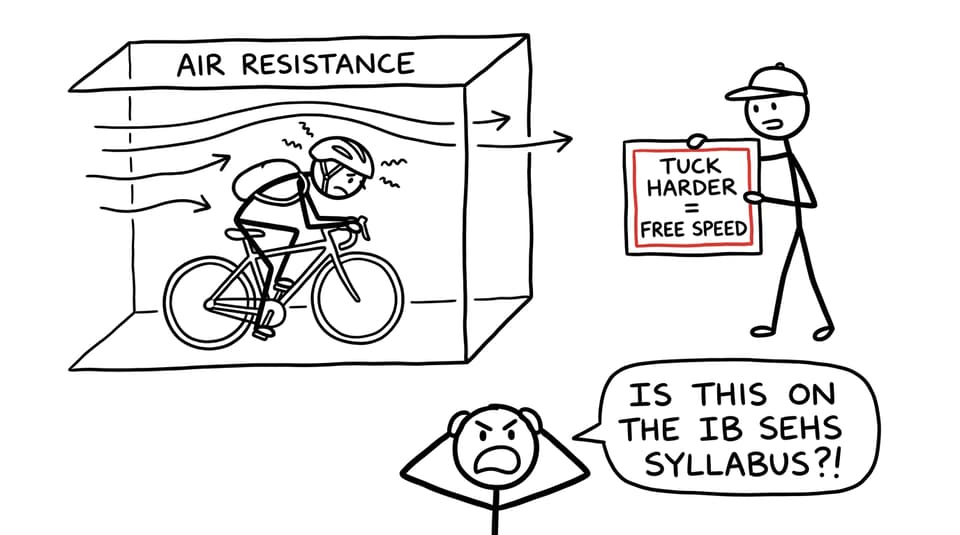
In IB SEHS, air resistance (also called drag) is an external force that acts opposite to the direction of motion when an athlete or object moves through air. It comes from collisions with air particles and the wake that forms behind a moving body.
Three exam-friendly points to remember:
-
Air resistance increases as speed increases (big effect in fast sports).
-
Air resistance depends on surface area (bigger “front” = more drag).
-
Air resistance depends on shape and body position (streamlined = less drag).
If you want a crisp definition to use in your own words, the IB SEHS glossary is a reliable reference.
Quick checklist for exam answers (IB SEHS)
Use this mini-structure when a question mentions performance, technique, or flight:
-
State that air resistance opposes motion.
-
Link drag to speed and .

