The moment z-scores stop feeling “real”
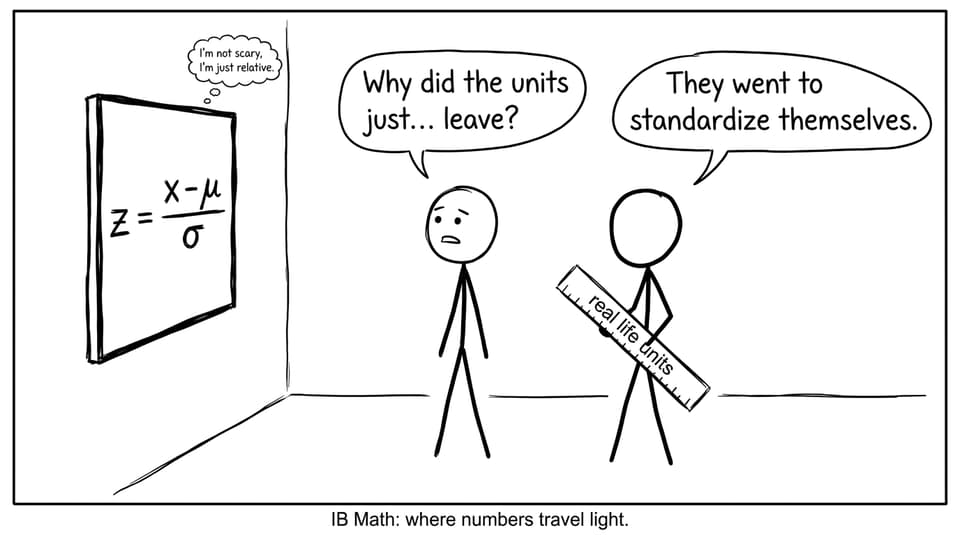
A friend once described z-scores as “math that floats.” In IB Math, you start with something concrete: a test score, a height, a time. Then you press the standardisation button and suddenly the units vanish. No centimeters. No minutes. Just a clean, unitless number like (z = 1.3).
That’s why z-scores feel abstract: they remove the story you were using to stay grounded. But that’s also why they matter so much in IB Math. A z-score is what you use when the story is different for every dataset and you still need a fair comparison.
Quick checklist: what the examiner wants from z-scores in IB Math
-
You can compute (z = \frac{x-\mu}{\sigma})
-
You can interpret the sign (above or below the mean)
-
You can interpret the size (how unusual in standard deviations)
-
You can use z-scores to compare values across different spreads
-
You can connect standardisation to probability in normal distribution questions
For targeted practice, the IB Math AI Statistics and Probability hub is a clean place to organise what to learn next.
Why z-scores feel abstract in IB Math
The key discomfort is simple: a z-score is a distance, but not in the units your brain expects.
When you standardise, you stop asking, “How many marks did I get?” and start asking, “How many standard deviations away from average is this?” In IB Math, that shift can feel like you’ve traded meaning for mechanics.
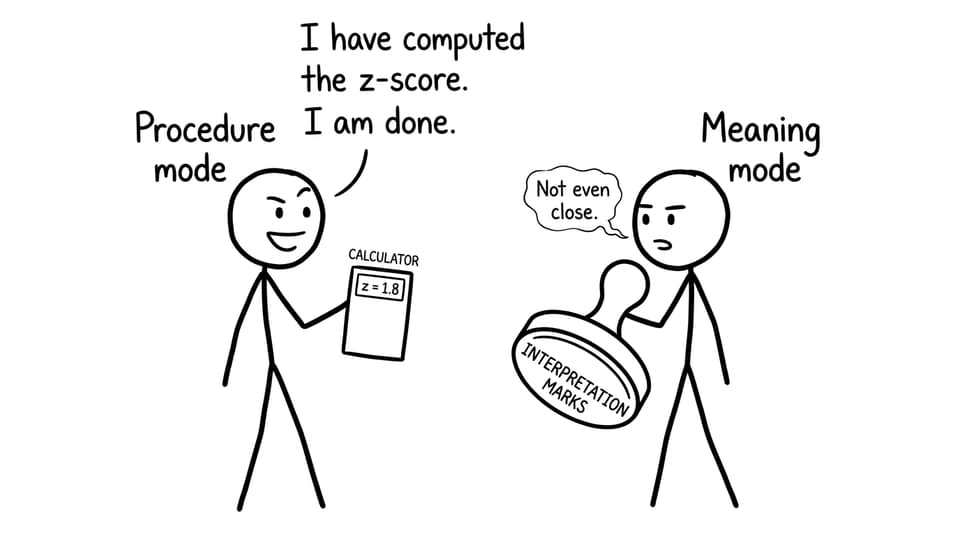
It gets worse when the topic is taught procedurally. Many students memorise the formula early, then drill substitution until it becomes muscle memory. You can get good at calculating z-scores and still freeze when a question asks what that z-score means.
If you want the conceptual side laid out clearly, pair your revision with the note Z-values and inverse normal to find mean and standard deviation.
Why z-scores matter so much in IB Math
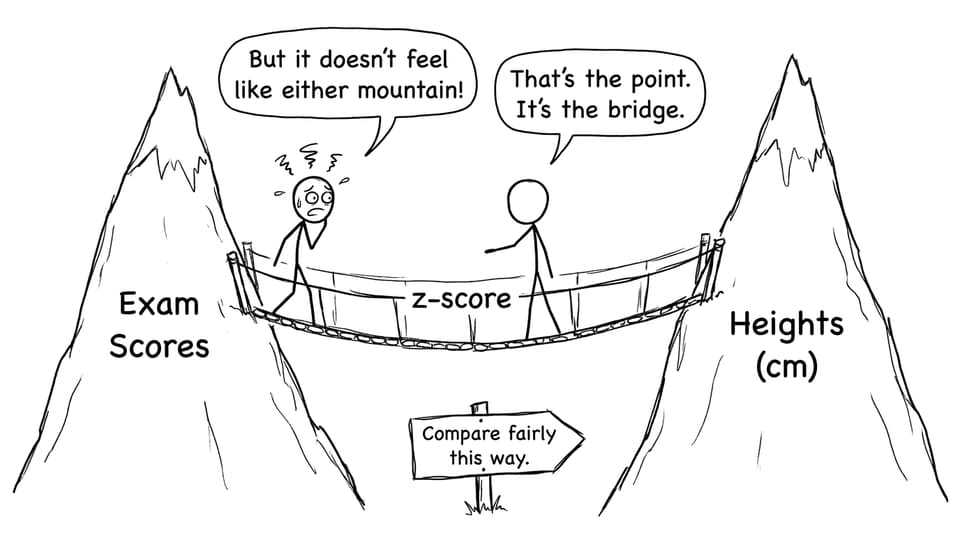
They make comparisons fair
Raw values lie when distributions are different. A 78 might be excellent in one test and ordinary in another. A “fast” time might be impressive in one race and average in another if everyone else is faster too.
IB Math likes z-scores because they turn messy comparisons into one question: “How unusual is this value relative to its own context?” That’s what standard deviations measure: rarity relative to the distribution.
They connect directly to probability
Once you standardise, you can use the standard normal model to reason about likelihood. That’s why z-scores sit right at the border between “statistics as description” and “statistics as decision-making.”
If normal distribution questions feel awkward, this companion read helps: Why Do Normal Distribution Calculations Feel So Unnatural in IB Maths.
Interpretation is where marks compound
In IB Math, writing down (z) is rarely the finish line. Examiners often reward the explanation as much as the calculation: what does the sign and magnitude imply about the value?
A large positive z-score suggests an unusually high value. A z-score near 0 suggests typical behaviour. A negative z-score suggests the value is below average, and whether it’s “unusual” depends on how far from 0 it is.
To train this properly, use a loop: learn the idea, then test it immediately. RevisionDojo makes that loop fast with the IB Math AI resources hub and the Statistics & Probability practice area for IB Math AA.
How to study z-scores efficiently with RevisionDojo
Use z-scores as a skill, not a chapter.
-
Start with Study Notes to get the meaning straight (mean, standard deviation, standardisation).
-
Drill focused sets in the Questionbank, especially questions that force interpretation.
-
Use AI Chat to ask, “What would be a 2-mark interpretation here?” and compare your wording.
-
Make Flashcards for interpretation sentence stems like: “Since (z) is positive, the value is above the mean…”
-
Run a timed section using Mock Exams and review with Grading tools.
-
In the final stretch, use Predicted Papers to practise standardisation under pressure.
If you’re building your overall plan, How to Score 7 in IB Math AI SL and How to Study for IB Mocks (Without Burning Out) fit well around z-score practice.
Closing: the abstraction is the advantage
Z-scores feel strange because they remove the comforting details. But in IB Math, that “floating” quality is exactly what makes them powerful: they let you compare fairly, reason about probability, and write explanations that earn marks.
If you want z-scores to stop being a formula and start being a tool, build a tight loop on RevisionDojo: Study Notes for meaning, Questionbank for repetition, AI Chat for better explanations, Flashcards for recall, and Mock Exams plus Predicted Papers for calm performance under time pressure.

