
The moment the number looks “wrong”
You’ve done everything “correct.” You lined up the method, punched it into your calculator, and waited for that comforting little outcome that looks like it belongs in a textbook.
Then IB Math hands you 47.382, or 0.1937, or a fraction that looks like it crawled out of a spreadsheet. And your brain does what brains love to do under pressure: it treats unfamiliarity as danger. Panic isn’t a math problem. It’s a meaning problem.
In IB Math, especially when questions involve modeling, statistics, regression, estimation, and technology, “nice” is often the exception. The exam isn’t testing whether numbers look pretty. It’s testing whether your thinking is stable when they don’t.
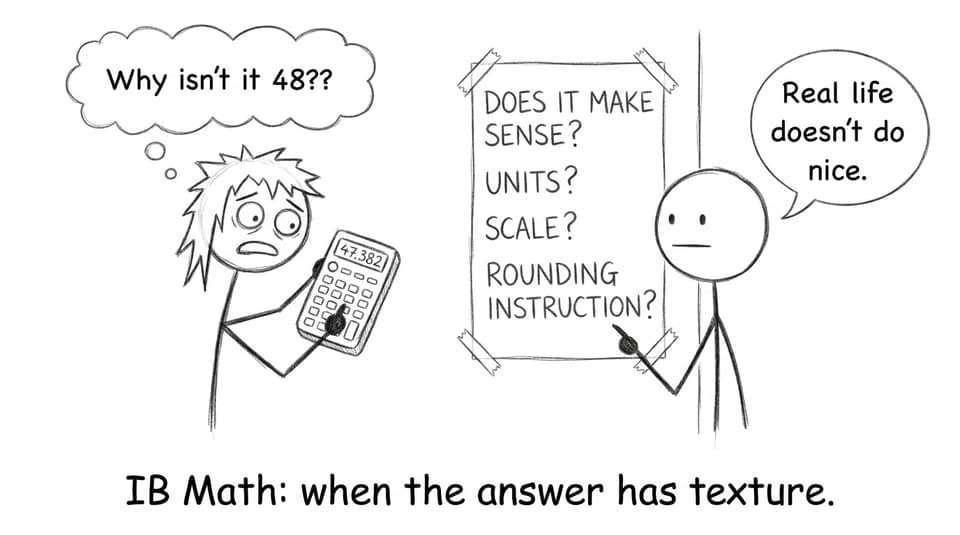
A quick checklist before you re-do everything
When an IB Math answer looks ugly, run this quick sense-check loop:
-
Scale: Is the magnitude reasonable for the context?
-
Units: Did you keep units consistent (and state them if needed)?
-
Direction: Does the sign/shape/trend match the situation?
-
Rounding instruction: Did the question ask for rounding, significant figures, or an exact form?
-
Method marks: Even if the final number is messy, did you show the steps that earn marks?
If those are consistent, the “ugly” answer is often the correct one.
Why students expect “nice” answers (and why IB Math doesn’t)
Most students were trained on earlier math where problems are designed to resolve cleanly. That training is helpful at first: it builds confidence and pattern recognition. But it also installs a quiet belief: tidy equals true.
IB Math breaks that belief on purpose. Real data rarely cooperates. Normal distributions don’t promise elegant cutoffs. Regression lines don’t land on round parameters. Financial models and probability estimates often end up as decimals because reality is granular.
If you’re in Applications and Interpretation, this is basically the point of the course: mathematics as a tool for interpreting the world, not polishing it.
If you want a solid overview of the two pathways (and why AI often produces “messier” outputs), read: Should I Take IB Math AA or AI? A Realistic Breakdown.
The hidden mark-loss: overchecking and second-guessing
The most expensive part of panic in IB Math is time.
When an answer looks unfamiliar, students often:
-
Re-enter calculations repeatedly
-
Change a correct method mid-solution
-
Chase a “nicer” number by rounding early
-
Forget to write the interpretation sentence that earns easy marks
And the irony is painful: the first result was often fine. The doubt is what creates the mistake.
This is where timed practice matters. Using a system like How to Use RevisionDojo to Prepare for IB Math Mock Exams helps you rehearse the emotional moment when the answer looks odd, so you don’t spend two minutes arguing with your calculator.
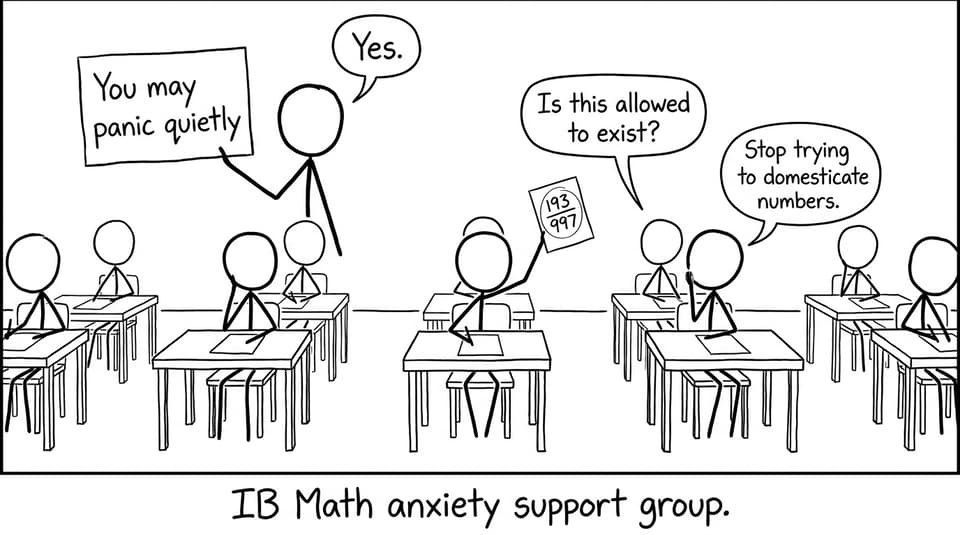
“Nice” isn’t the same as accurate
A clean-looking answer can be completely unjustified. A messy answer can be perfectly accurate.
In IB Math, accuracy is contextual. It depends on:
-
what the question asks (exact vs approximate)
-
what the data supports
-
how you communicate precision
A well-explained decimal that fits the scenario can be stronger than a forced simplification that ignores reality. Examiners reward reasoning and communication, not aesthetics.
If you want a practical way to train this, build short drills inside the IB Mathematics Applications & Interpretation Resources hub and practice questions that naturally produce non-tidy outputs. Then compare your final statement to the command term: “interpret,” “comment,” “justify,” “hence.”
How RevisionDojo helps you stay calm when answers look ugly
Confidence in IB Math is mostly repetition under realistic conditions.
RevisionDojo makes that repetition structured:
-
Questionbank: targeted practice that includes the kinds of messy outputs you’ll actually see
-
Study Notes: quick refreshers so you don’t confuse “unfamiliar” with “wrong”
-
Flashcards: precision habits (rounding rules, interpretation stems, calculator commands)
-
AI Chat: ask “Does this answer make sense?” and get a calm walkthrough of reasonableness checks
-
Grading tools: learn what method/communication marks look like when answers aren’t neat
-
Predicted Papers and Mock Exams: build stamina and reduce panic triggers
-
Coursework Library and Tutors: extra support when anxiety is really a missing-foundations issue
To practice with feedback (not just repetition), use: How to Use the Questionbank for Targeted Math Revision.
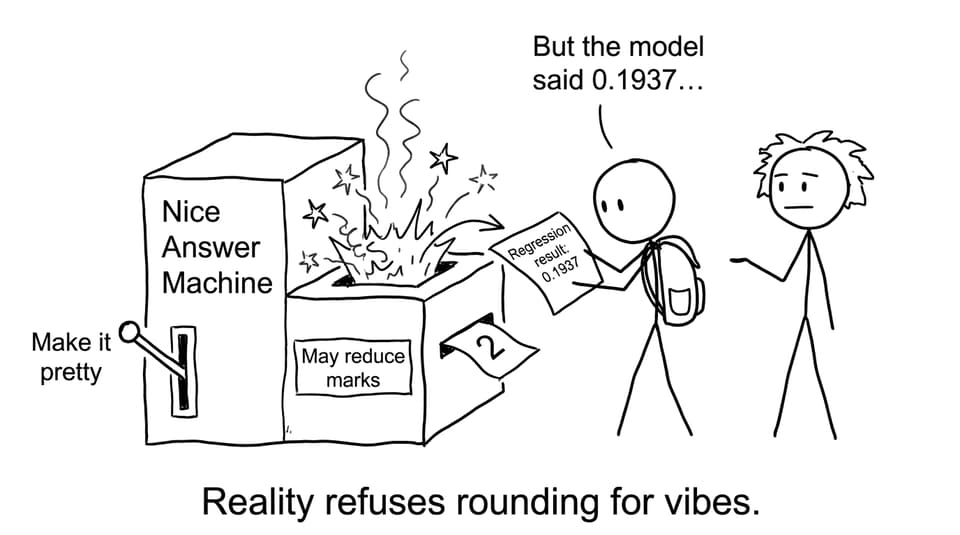
Final thought: stop trying to domesticate numbers
The fastest way to improve in IB Math isn’t to hunt for prettier answers. It’s to build trust in your process: sense-check, communicate clearly, and move on.
If you want that confidence to feel automatic, practice the exact moment that triggers panic using RevisionDojo’s Questionbank, Mock Exams, and AI Chat inside the IB Math AI hub or the IB Math AA hub. Messy answers don’t cost marks. Hesitation does.


