


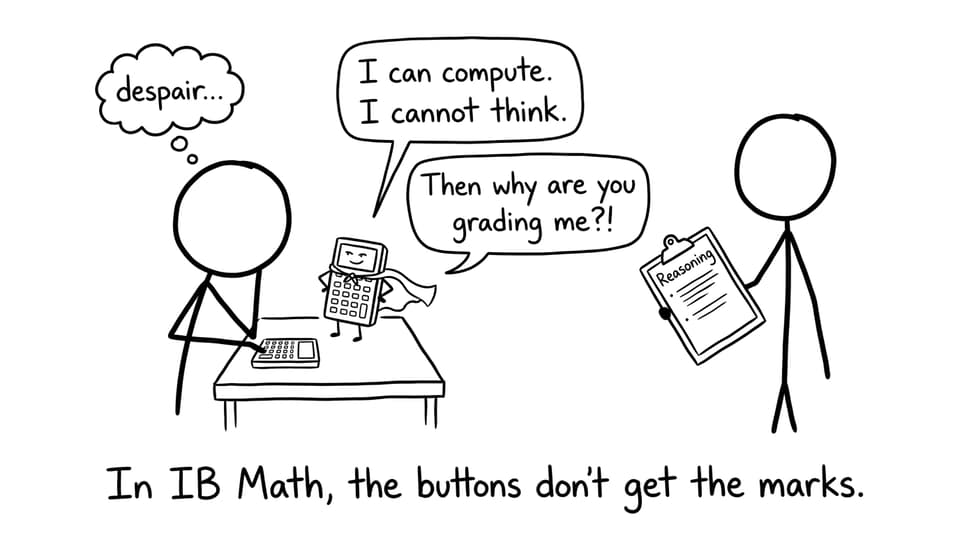
In the middle of an IB Math exam, your calculator can feel like a life raft. It gives you a number, a graph, a regression line, a probability. It feels decisive. But examiners don’t award marks for decisiveness, they award marks for judgement. And when technology becomes your decision-maker, it quietly starts costing you marks.
In IB Math (especially AI), technology is part of the course. Still, many students discover too late that “calculator-allowed” doesn’t mean “calculator-only.” If the working, interpretation, and evaluation are missing, the output is just a screenshot of thinking you didn’t do.
A quick checklist: using tech without losing IB Math marks
Use this as a fast filter before you commit to a calculator-heavy solution in IB Math:
-
Name what you’re doing (regression, normal model, inverse, solver, etc.).
-
State why it’s appropriate for the context.
-
Estimate or sketch first to sanity-check the output.
-
Interpret parameters (slope, intercept, mean, standard deviation) in words.
-
Evaluate limitations (outliers, domain restrictions, model fit).
If you can’t do at least three of these quickly, technology is probably running the show.
Why over-reliance on technology loses marks in IB Math AI
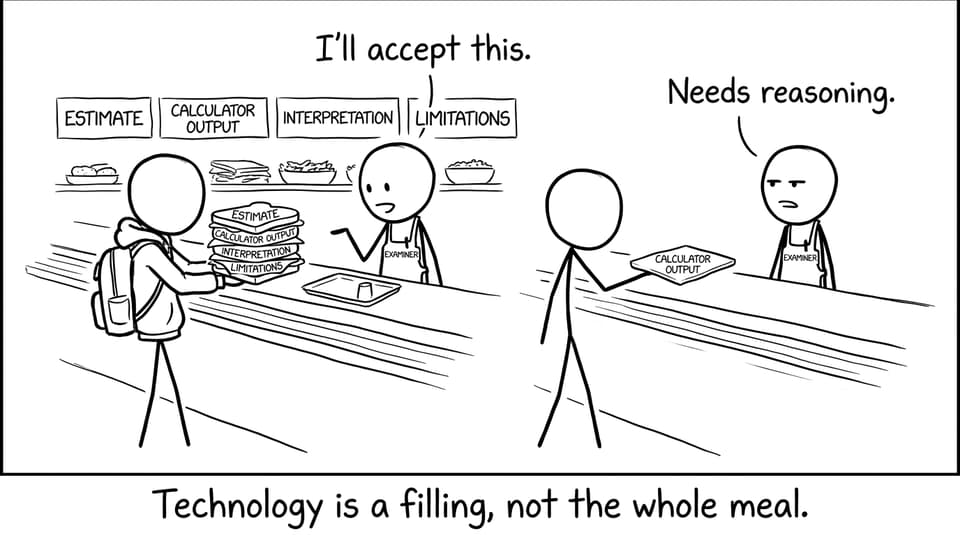
In IB Math, marks usually come in layers: method, reasoning, interpretation, communication. Technology can help with method. It can’t automatically earn the rest.
Calculator output without explanation looks like missing understanding
A regression equation, a z-score, or a p-value can be correct and still earn fewer marks if you don’t explain what it means. Examiners want to see that you understand the mathematical story behind the number.
This is why students sometimes feel “robbed” after an exam: the calculator gave the right value, but the response didn’t show the logic that connects that value to the question.
To train that habit, build short explanations into practice. For structured drills, the IB Mathematics Applications & Interpretation hub is a good starting point, then reinforce it with targeted practice in the Number and Algebra Questionbank or the Functions Questionbank.
Blind trust hides the exact mistakes examiners penalise
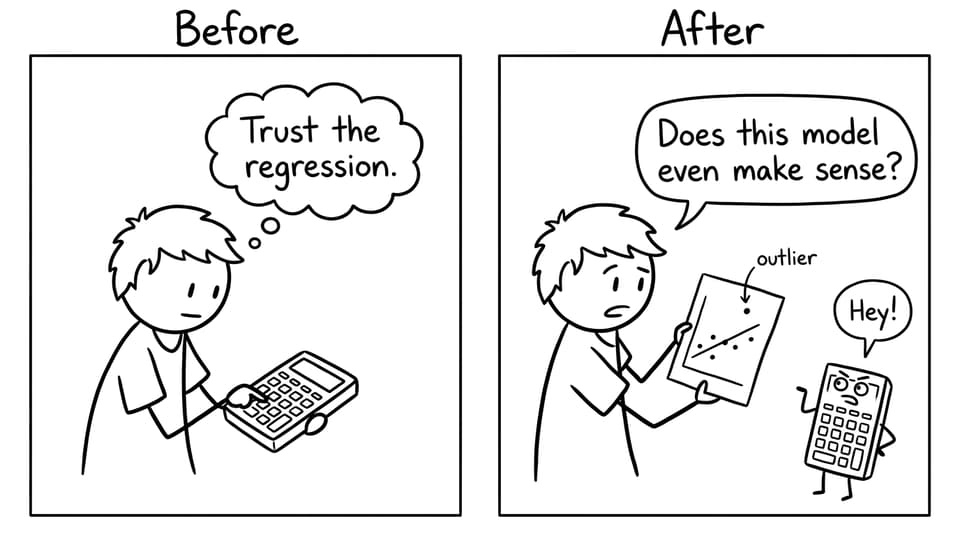
Technology always produces something. That’s the danger. If your model is inappropriate, your assumptions are shaky, or your input is wrong, the calculator still gives a neat answer.
In IB Math, you’re expected to notice when a regression is being forced, when normality is unreasonable, or when a probability result is nonsense in context. That “does this make sense?” moment is often where the marks are.
Tech can mask weak communication (and communication is graded)
In IB Math, you’re graded on mathematical communication: correct notation, clear steps, and properly stated conclusions.
If your response is just calculator results copied down, you often skip:
-
defining variables,
-
stating the model,
-
writing an equation before solving,
-
concluding with units and context.
A simple fix: write one “bridge sentence” after every calculator action. Example: “Using linear regression is reasonable because the scatterplot shows a roughly linear trend; therefore the model predicts…”.
How to use technology strategically (the RevisionDojo way)
The best students don’t avoid technology, they put it in its place.
A strong IB Math workflow looks like this:
-
Learn the concept quickly with RevisionDojo Notes for IB Math AI.
-
Drill the exact skill with the Questionbank strategy guide.
-
Simulate pressure using Mock Exam Builder guidance or the broader plan in IB Math mock exam preparation.
-
Use AI Chat to practice explaining an output in words (as if you’re teaching it).
-
Use Grading tools to see where method marks stop and reasoning marks begin.
RevisionDojo’s Questionbank, Study Notes, Flashcards, AI Chat, Grading tools, Predicted Papers, Mock Exams, Coursework Library, and Tutors are built for one outcome: answers that look like you’re in control, even when technology is involved.
Conclusion: In IB Math, thinking must come first
Over-reliance on technology in IB Math doesn’t fail because calculators are “bad.” It fails because exams reward understanding you can communicate. Use tech to support your reasoning, then prove you’re the one steering.
If you want answers that earn marks beyond the output, build your routine around RevisionDojo: start in the IB Math AI hub, practise with the Questionbank, tighten explanations with AI Chat, and pressure-test everything with Mock Exams and Predicted Papers. In IB Math, that combination is what turns calculator confidence into real exam marks.