


The night before is a liar (and IB students know it)
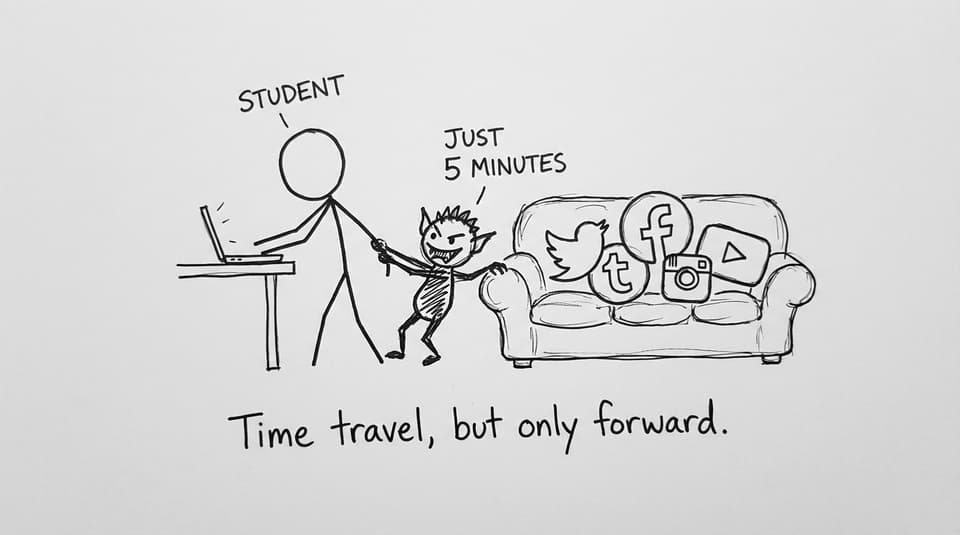
There's a specific kind of confidence that shows up at 11:47 p.m. It whispers: Tomorrow I'll be a new person. A person who plans, who starts early, who doesn't "just check" one video and lose 40 minutes.
If you're an IB student, you've probably met that voice. You've also met its cousin: the last-minute sprint that somehow works… until it doesn't. Because IB procrastination isn't a character flaw. It's usually a predictable response to pressure, uncertainty, and tasks that feel too big to touch.
This post is about why you procrastinate IB, and how to fix it fast, without needing a personality transplant. You'll leave with a short checklist, a few mental models, and a set of practical moves you can run today.
Quick checklist: fix IB procrastination in 15 minutes
If you want the fast version, do this in order:
- Shrink the task: choose one "starter step" you can finish in 10 minutes.
- Remove the fork in the road: decide what to do before you sit down.
- Make it test-like: do one timed question or one marked mini-task.
- Track momentum: write down the next action before you stop.
- Use tools that reduce friction: question banks, flashcards, and quick feedback loops.
You'll see these ideas repeated because they work for IB revision: make the next action obvious, small, and rewarding.
Why you procrastinate IB (it's not laziness)
Procrastination usually happens when the brain predicts pain and uncertainty and decides to "check something else" instead. With IB, that prediction is often accurate: the workload is broad, the standards are high, and the feedback can feel delayed.
Here are the most common drivers.
You're facing an identity threat, not a worksheet
A lot of IB tasks feel like they're judging you, not just your work. A Math AA question you can't start becomes "I'm bad at this." A History essay plan becomes "I don't have good ideas." So your brain avoids the task to avoid the story.
Fix: separate you from the attempt. Your job is not to be brilliant on command. Your job is to produce a first draft, a first try, a first messy solution.
You don't know what "done" looks like
"Revise Biology" is not a task. It's a vague threat. The more ambiguous the target, the more likely you are to procrastinate IB.
Fix: define a finish line that can be completed in one sitting: "Do 15 HL multiple-choice questions on enzymes, then review mistakes."
You're optimizing for comfort, not results
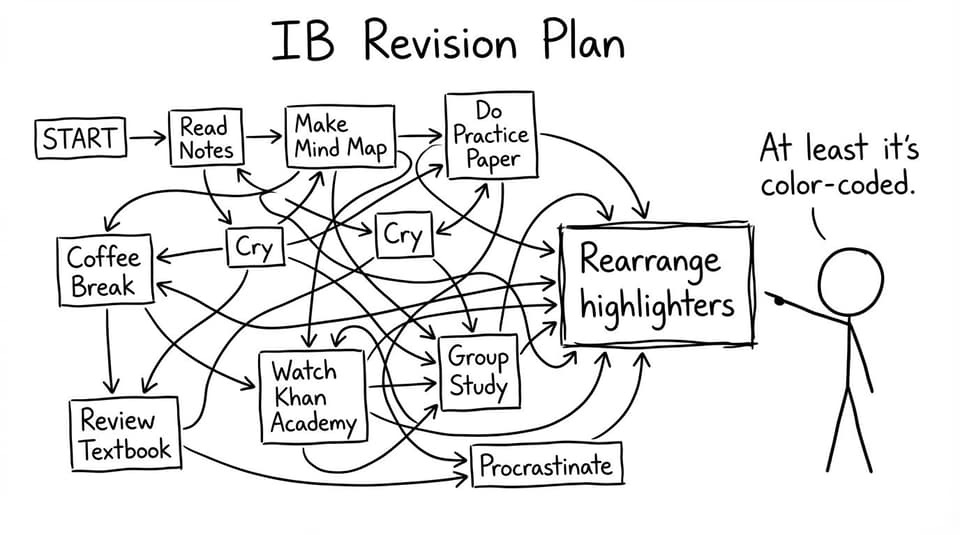
Many IB students procrastinate by doing "productive-looking" work: reformatting notes, rewriting definitions, organizing folders, highlighting headings. It feels safe because it avoids the moment of truth.
Fix: choose study actions that create feedback: questions, retrieval, timed writing, self-grading.
Your plan is too big to start
Big plans are motivating in theory and paralyzing in practice. "Finish all of Paper 2 content this weekend" is how you create the perfect conditions to procrastinate IB.
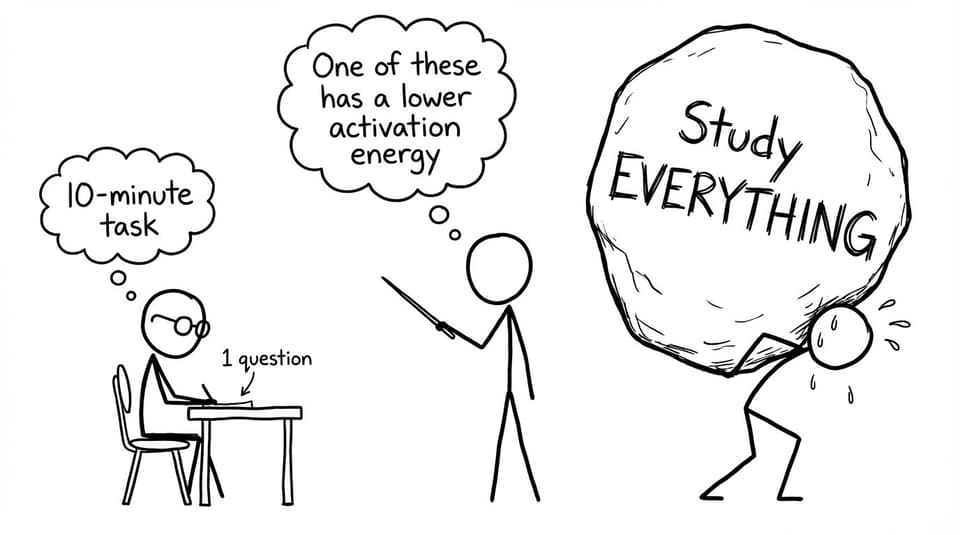
Fix: lower the activation energy. Start smaller than you think you need to.
The "activation energy" rule for IB: start absurdly small
In Chemistry, reactions often need a push before they run. Studying works the same way. The hardest part of IB revision is the first two minutes.
So you need a start that feels almost silly:
- open your notes to one subtopic
- do one question
- write one paragraph
- make five flashcards
Once you start, momentum often does what motivation couldn't.
How to fix IB procrastination fast: 7 moves that actually work
Decide the next action before you sit down
Most IB procrastination happens at the moment of choice: What should I do first? Your brain hates open tabs and open decisions.
Do this instead:
- On paper, write: "When I sit down, I will…"
- Fill in a single, concrete action: "Complete 10 questions on stoichiometry and review corrections."
If you need help choosing, use RevisionDojo features that reduce decision fatigue: a Questionbank for quick targeting, Study Notes for a clear topic boundary, and Flashcards for fast retrieval rounds.
Make the task test-shaped
The IB rewards performance under constraints: time, markschemes, command terms, structure. If your revision doesn't resemble that, it's easier to drift.
Fast fix:
- set a 12-minute timer
- do a mini set of questions
- grade immediately (even roughly)
RevisionDojo's Grading tools and AI Chat can shorten the feedback loop, which is one of the quickest ways to stop procrastinating IB.
Use the "two-window" method: learn, then prove
Split your session into two modes:
- Window 1 (learn): skim Study Notes or a worked example
- Window 2 (prove): close the notes and do retrieval or questions
Procrastination drops when your brain trusts there's a clear path from confusion to proof.
Stop negotiating with your phone
If your phone is within reach, your brain will bargain with it.
Fast fix:
- put it in another room
- use a single website blocker rule for 25 minutes
- start with a short sprint (10-15 minutes), then extend
This matters more for IB because sessions need depth: even a few interruptions can destroy the feeling of control that keeps you working.
Replace "motivation" with "momentum accounting"
At the end of each session, write two lines:
- What I finished (specific)
- What I start next (one step)
This creates continuity. Tomorrow's version of you won't need to "get motivated" to figure out what to do. They just continue.
Practice discomfort in tiny doses
Some IB tasks feel uncomfortable because they reveal gaps. That's not a reason to avoid them. It's a compass.
Try "discomfort reps":
- choose one weak subtopic
- do 5-10 questions
- review mistakes slowly
RevisionDojo's Mock Exams and Predicted Papers (for exam-style practice) can make this structured, so discomfort becomes training instead of panic.
Get external structure when you're stuck
If you're procrastinating IB because you're genuinely lost, you don't need more willpower. You need clarity.
Use:
- Tutors when a concept isn't clicking
- the Coursework Library when you need examples and standards
- AI Chat when you need a fast explanation and a plan
A simple IB anti-procrastination routine (weekly)
Here's a calm routine that fits real schedules:
Daily (30-60 minutes)
- 10 minutes: Flashcards (retrieval)
- 20-30 minutes: Questionbank set on one topic
- 10-20 minutes: Review mistakes and write a "next step"
Twice a week (60-90 minutes)
- timed writing (essay/response)
- self-grade with a rubric or grading support
Weekly (90-150 minutes)
- one mini mock: timed sections, then corrections
- update your "weak topics" list
This is how IB revision becomes less emotional. It turns into reps.
The real promise: IB gets easier when you stop waiting to feel ready
The most surprising thing about IB procrastination is that it often disappears after you start. Not because the work becomes fun, but because the fog lifts. Clarity replaces dread when you do one question, mark it, and see what's missing.
If you want a simple next step, make it this: open RevisionDojo and do one small, test-shaped task using the Questionbank, then lock in the feedback with Grading tools, Flashcards, and AI Chat where you're stuck. Add Mock Exams, Predicted Papers, and the Coursework Library as you build confidence. And if you need a human in your corner, use Tutors.
Start tiny. Start now. IB rewards the student who keeps showing up.