
The IB myth that keeps students stuck
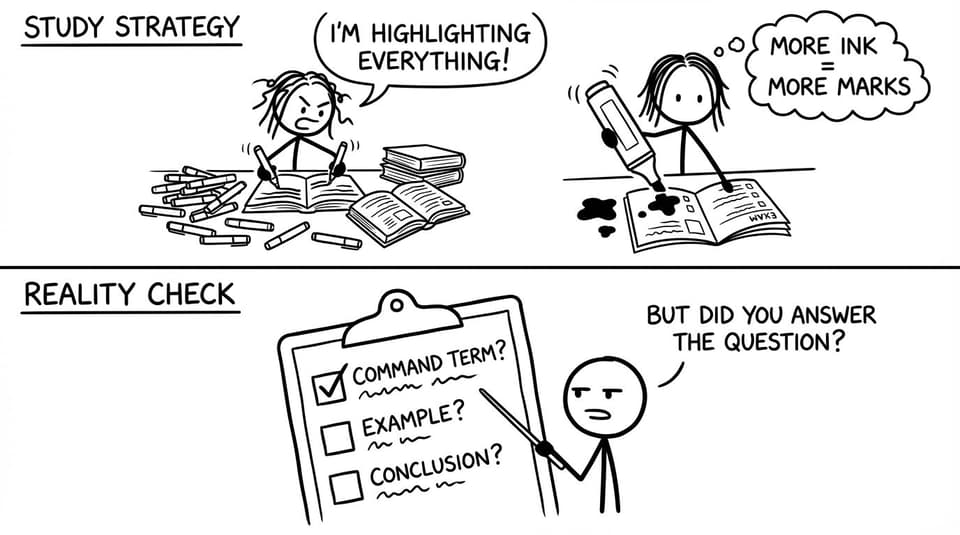
IB season does something strange to otherwise rational people. It makes smart students believe that more words equals more marks.
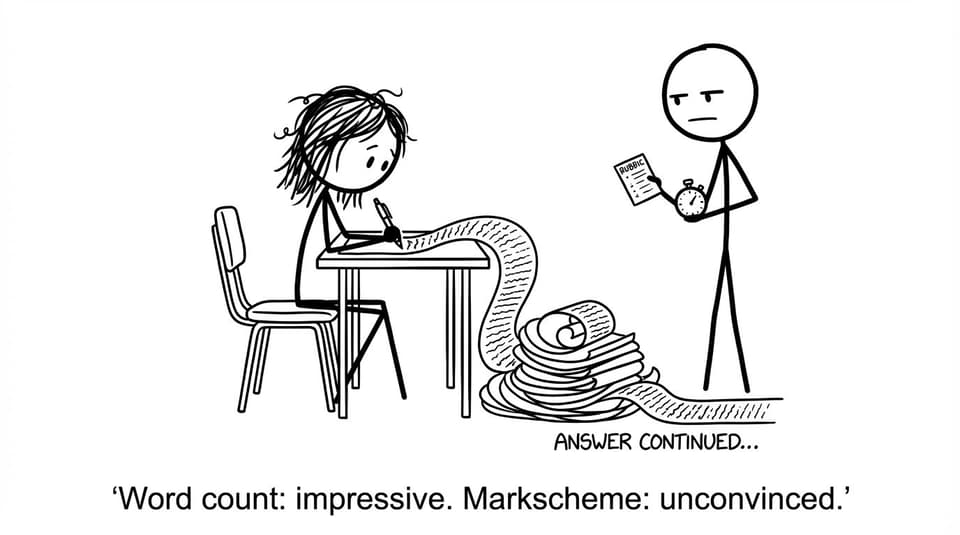
You can see it in the exam hall. A pen moving at sprint pace. A wrist that hurts by question three. A page filled edge-to-edge because silence feels dangerous. In the moment, writing more feels like control. Like insurance. Like you're proving you worked.
But IB marking doesn't work like that.
In most IB subjects, examiners aren't paid to be impressed by effort. They're paid to find specific things: definitions, correct steps, key points, justified evaluation, accurate units, relevant examples, and clear links to the question. The markscheme is a checklist, not a vibe.
So if you've ever walked out thinking, "I wrote so much, how did I not get a 7?" this article is for you. We'll unpack why writing more often scores the same (or worse), and what IB examiners actually reward.
A quick checklist: what gets marks in IB exams
Before we go deeper, here's a simple IB scoring checklist you can keep in your head:
- Did I answer the command term (state, outline, explain, evaluate, etc.)?
- Did I use subject-specific language accurately?
- Did I include the key points the markscheme expects?
- Did I apply the concept to the scenario (not just describe theory)?
- Did I show working where required (and make it readable)?
- Did I include evidence (data, quote, example, calculation, case study)?
- Did I link back to the question and conclude when needed?
If your extra writing doesn't add one of these, it's usually just… extra.
Why writing more feels safe (and why IB punishes it)
There's a reason students over-write in IB.
When you're uncertain, volume feels like a substitute for accuracy. If you're not sure which point is right, you write three versions and hope one lands. If you don't know how deep to go, you go everywhere.
The problem is that IB questions are designed to reward selective clarity. Examiners are trained to award marks for what is present and correct, not for what is enthusiastic. And long answers create three common risks:
You bury your correct point
The mark might be sitting in your second sentence, but it's surrounded by six sentences of waffle. Examiners try to be fair, but they're human. Clear answers get clearer marks.
You contradict yourself
In IB, one wrong claim doesn't always cancel a right one, but it can make your reasoning incoherent. Especially in evaluation questions, rambling often turns into self-sabotage.
You run out of time where marks are easier
Many IB papers are engineered so that later questions are higher-yield per minute (think structured parts, short calculations, or precise definitions). Spending 14 minutes on a 6-mark essay-style response can quietly delete 10 easy marks later.
The markscheme mindset: marks are "slots," not "aura"
The most useful mental model for IB is this:
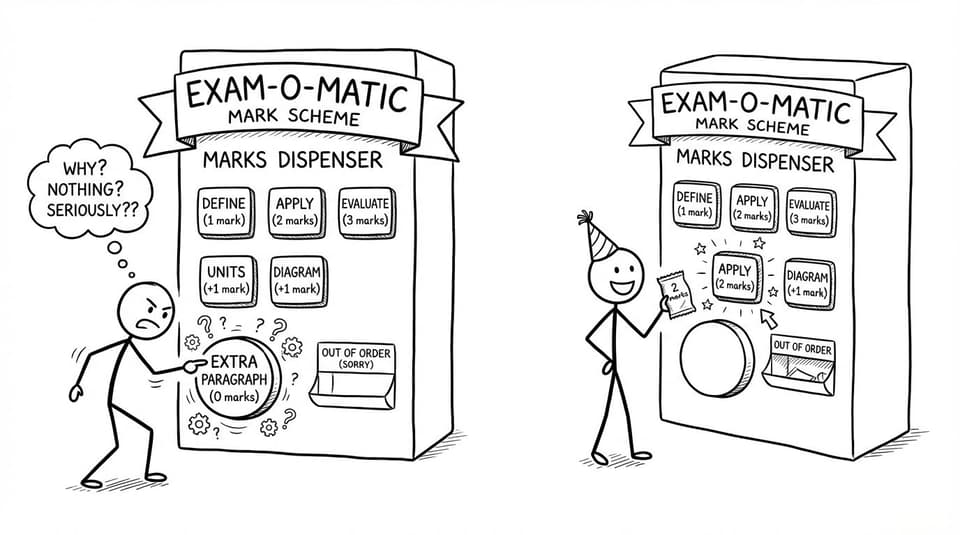
Marks are slots that get filled by specific elements.
A 4-mark question often has 4 identifiable "things" the examiner can tick. A 10-mark response might have bands, but even bands are anchored in concrete features: accurate knowledge, relevant examples, coherent argument, balance, and justified conclusion.
So the question becomes:
Does this sentence fill a slot?
If not, it's taking time away from a sentence that could.
This is exactly how RevisionDojo's tools can change your instincts: practicing with a Questionbank and checking responses against mark-focused feedback trains you to think in slots. Over time, you stop writing "more" and start writing "enough."
Command terms: the quiet reason students over-write in IB
A lot of over-writing in IB is really a command-term problem.
Students see a question and think, "I need to show everything I know." But the examiner is asking for a particular action.
State / Identify
One precise phrase can be full marks. Two paragraphs usually signal you're unsure.
Outline
A brief description. Not an essay.
Explain
Cause and effect, or step-by-step reasoning. This is where students often drift into a textbook dump. The best IB explanations stay chained to the question context.
Evaluate / Discuss
This is where writing more can help, but only if it's structured. Evaluation marks tend to come from balance, criteria, and a justified conclusion, not from adding a fifth weak argument.
If you want a practical habit: circle the command term before you write a single word. Treat it like a steering wheel.
"More writing" vs "more marking points": what high scorers do differently
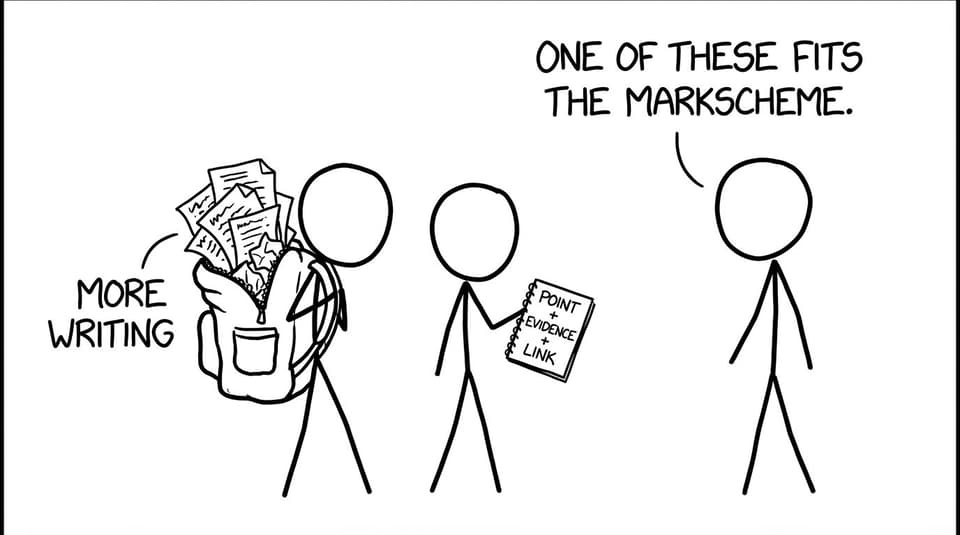
High scorers in IB often write less than you expect. Not because they're lazy. Because they're efficient.
They do three things consistently:
They front-load the answer
They put the mark-winning line early. Then they support it.
Example (generic):
- First sentence: clear claim/definition.
- Second: key reasoning.
- Third: relevant example or application.
- Final: link back to question.
This means even if time runs out, the core marks are already visible.
They label steps and make structure obvious
For sciences and math-heavy subjects, readable working is a mark magnet. For humanities, clear paragraph logic is the same thing.
A quick trick: use micro-signposting.
- "Point:"
- "Evidence:"
- "Therefore:"
It feels simple, but in IB marking, simple is often powerful.
They cut "throat-clearing" sentences
Sentences like "Since the beginning of time, humans have wondered…" don't earn IB marks. They burn them.
The hidden cost of writing more: cognitive overload
There's another reason writing more doesn't help in IB: it overloads you.
Long answers require more working memory: you must track what you've already said, avoid repeating yourself, keep your logic consistent, and still remember the question. Under exam stress, that's expensive.
Short, slot-filling answers reduce cognitive load. You stay accurate longer.
This is why RevisionDojo's Flashcards and Study Notes matter: when retrieval is quicker, you don't ramble to "find" the knowledge. You place it.
A practical strategy: write to the marks, then stop
Here's a method that works across IB subjects.
Step 1: Count the marks
Before you answer, look at the number. It's not perfect, but it's a map.
- 2 marks: usually 2 points, or 1 point + 1 development.
- 4 marks: usually 4 ticks, or 2 points well-developed.
- 8-10 marks: usually criteria/bands where structure and evaluation matter.
Step 2: Draft "slots" in your head
Think: "I need 3 key ideas + 1 example."
Step 3: Answer in clean chunks
Write in short paragraphs or lines. Make each chunk do a job.
Step 4: Stop when you've hit the job
This is the hardest part for IB students. Stopping feels like risk. But stopping is what gives you time to collect marks elsewhere.
If you want feedback that reinforces this habit, RevisionDojo's AI Chat is useful for asking: "Which sentences actually earned marks here?" It helps you see fluff as fluff.
How to practice this before exams (without guessing)
Over-writing is usually a practice problem, not a personality flaw. You practiced "study hard," but not "answer like an examiner."
Here are better reps:
Use timed micro-answers
Set 90 seconds for a 4-mark response. You're training decisiveness.
Self-mark with a checklist
After writing, highlight only the phrases that directly earn marks. If you can't justify a sentence, it's probably padding.
Compare your answer to top structure, not top length
If your only model is the longest student in class, you'll copy the wrong signal. Better models are clear, mark-aligned answers.
RevisionDojo's Grading tools, Mock Exams, and Predicted Papers are designed for this kind of practice: you see what the paper is really asking for, then train the exact response style that earns marks in IB.
Where RevisionDojo fits into this (and why it matters)
Most IB students don't need "more content." They need cleaner execution.
RevisionDojo is built around that idea:
- Questionbank practice builds markscheme instincts.
- Study Notes help you revise without drowning in pages.
- Flashcards make recall sharp so you don't ramble.
- AI Chat helps you refine phrasing to match command terms.
- Grading tools make feedback consistent, not random.
- Predicted Papers and Mock Exams simulate the pressure that triggers over-writing.
- The Coursework Library shows what "criteria-matched" work looks like.
- Tutors can spot the exact moment your writing stops earning marks and starts leaking time.
In other words: it's a system that rewards precision, which is the real currency in IB.
Writing less can feel like jumping without a net
The hardest part of IB exam technique is trusting that clarity beats volume.
Writing more feels like effort, and effort feels like safety. But IB marks don't measure effort. They measure alignment: with the command term, with the question, with the markscheme, with the skills the subject is assessing.
So the goal for your next paper isn't to write more. It's to write cleaner.
If you want a practical way to train that skill daily, build your routine around RevisionDojo: use the Questionbank for slot-based answers, the Flashcards and Study Notes for quick recall, and timed Mock Exams plus Predicted Papers to pressure-test your structure. That's how you turn "I wrote so much" into "I got the marks."