
Why Most Students Struggle in MYP (And How to Fix It)
The weirdest part about struggling in MYP is how often it happens to capable students.
You can be the kind of person who listens in class, takes neat notes, and genuinely tries, and still watch your MYP grades wobble. Not because you are lazy. Not because you are "not smart enough." But because MYP is built on a different game than most students expect. It rewards thinking, transfer, and reflection. And most students are trained to chase "right answers" instead.
If you are an IB student preparing for exams (or staring down MYP eAssessments and trying to feel calm about it), this matters. The habits you build in MYP are the habits that make DP feel survivable.
A quick MYP fix checklist (save this)
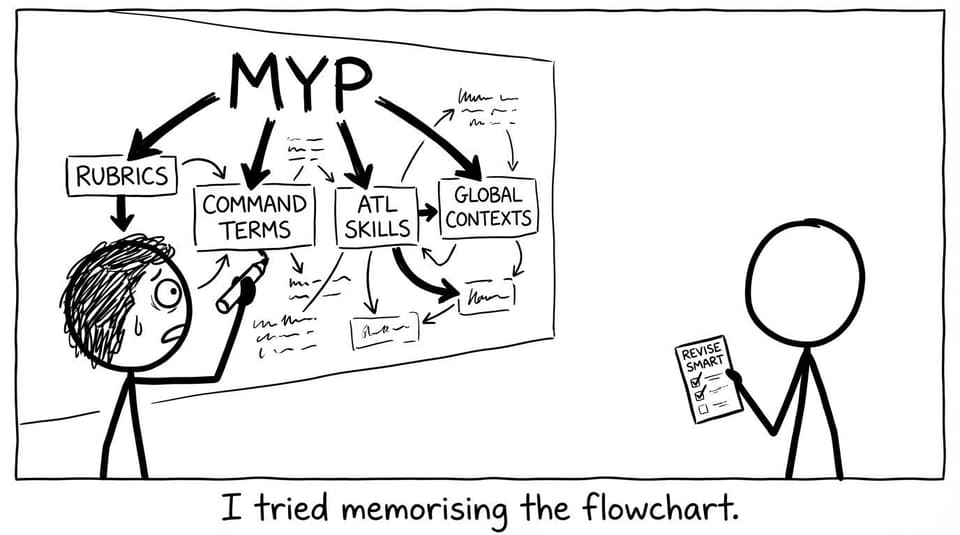
When students say MYP is "hard," they usually mean one of these is broken:
- You are revising content, but MYP is marking skills.
- You do tasks, but you are not aiming at criteria A-D.
- You read feedback, but you do not convert it into a repeatable system.
- You work a lot, but your work is not visible (clear structure, clear evidence, clear reflection).
- You "study," but you do not practice MYP-style questions under time.
This article shows how to fix each one.
The real reason MYP feels harder than it "should"
In MYP, you can know the topic and still lose marks.
That is the first emotional shock. In many school systems, knowledge is the main currency: learn it, repeat it, get the grade. In MYP, knowledge is necessary but not sufficient. The grade is usually decided by how well you:
- interpret the task
- select evidence
- explain reasoning
- communicate clearly
- reflect using the rubric language
That is why two students can study the same chapter and get different MYP results. One is studying for memory. The other is studying for performance.
If you want a deeper sense of how MYP revision actually works, keep this open as a companion: MYP Revision Guide: Study Tips for Success.
Where students typically struggle in MYP
They treat MYP like a content test
A lot of students revise as if MYP is trying to catch them out on definitions.
But MYP assessments are designed to reward application. A Science question might be less about recalling a definition and more about interpreting a graph. A Humanities task might be less about listing facts and more about evaluating a perspective. A Language task might be less about "good writing" and more about audience, purpose, and organization.
If you are in Sciences, this one shift alone can change everything: How to Revise for MYP Sciences Without Memorising Everything.
They ignore the rubric until the night before
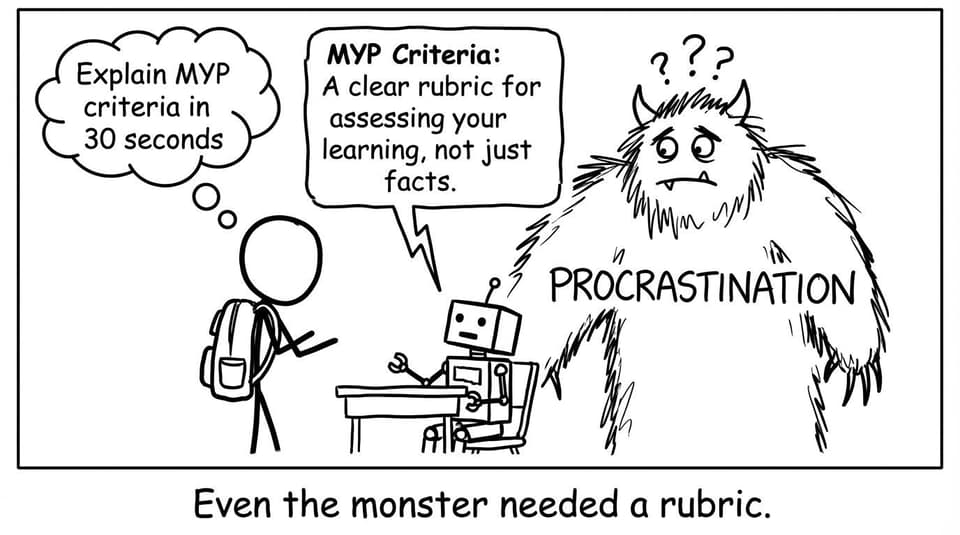
In MYP, the rubric is not paperwork. It is the map.
Most students glance at criteria A-D once, then try to do the task "well." But "well" is vague. The criteria are specific. They tell you what evidence earns top levels.
If your teacher gives you feedback like "more evaluation" or "link to the global context," that is not a personal critique. It is a translation: you missed strands in the MYP criteria.
A great way to understand what your school is trying to do with rubrics is here: Evaluation and Reporting in the MYP: Best Practices.
They confuse effort with evidence
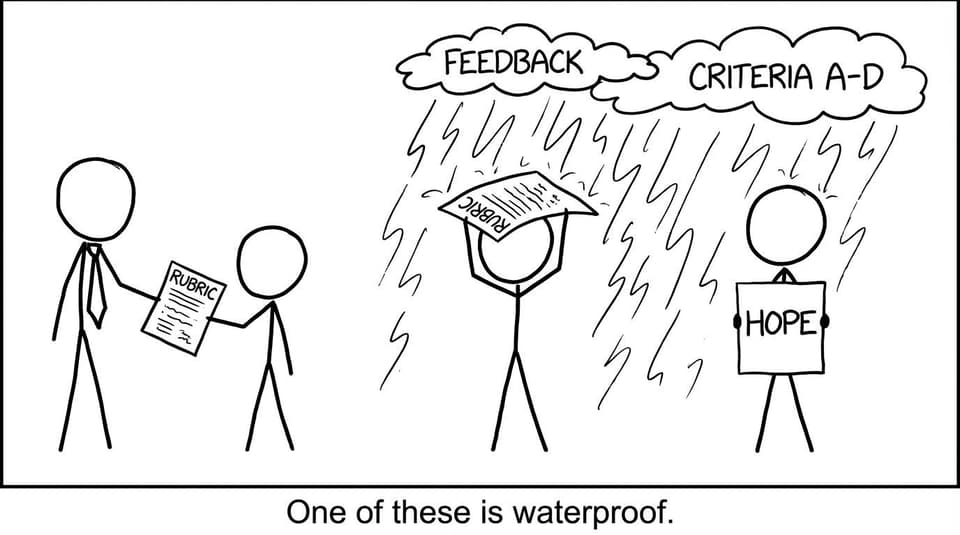
MYP is full of students who work hard in invisible ways.
They think deeply but do not show the steps. They have good ideas but do not structure them. They do research but do not cite it clearly. They revise but do not annotate changes.
In MYP, the marker can only award what is visible on the page or in the product. Your job is to make your thinking obvious.
They plan beautifully and practice poorly
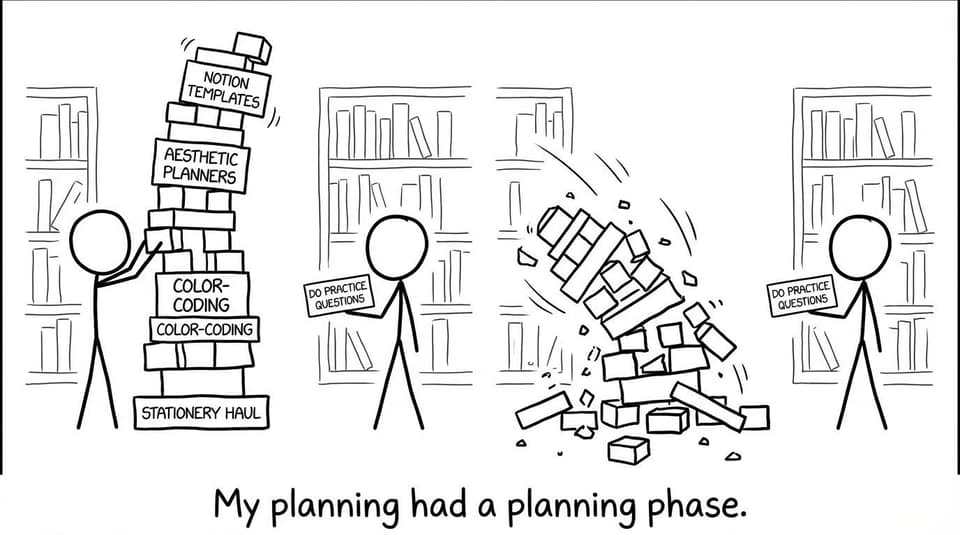
Some students build elaborate study systems that feel productive. Color-coded calendars. Aesthetic planners. Perfect templates.
But MYP improvement usually comes from practice loops: attempt, feedback, fix, re-attempt.
How to fix MYP struggles (the method that actually works)
Build a "criteria-first" mindset
Before you start any MYP task or revision session, ask:
- Which criterion am I being graded on?
- What does a 7-8 response look like in this subject?
- What evidence would prove I hit that level?
Then write your work to match the rubric, not to impress.
If you are preparing for digital exams, this becomes even more important because you have less time to "figure it out" mid-paper: Tips for Success in MYP eAssessments.
Convert feedback into a repeatable system
Feedback is only useful if it changes what you do next.
Here is a simple MYP feedback loop:
- Copy your teacher's feedback into a "Fix List."
- Translate each comment into an action.
- Create one micro-drill that forces that action.
- Re-do a similar question and check if you improved.
Example translations:
- "Too descriptive": add one sentence of cause/effect and one sentence of significance.
- "Limited evidence": include two specific data points or two sourced facts.
- "Not enough reflection": write 3-5 sentences that explicitly reference criterion language.
This is where RevisionDojo's tools quietly matter, because they are designed around loops, not vibes.
Practice like MYP assesses (not like textbooks teach)
To get better at MYP, you need to practice what MYP asks you to do.
That means:
- short, timed responses
- data interpretation
- structured paragraphs
- justification using evidence
- reflection tied to criteria
On RevisionDojo, students do this through the Questionbank (targeted practice), Mock Exams (time pressure), and Grading tools (fast feedback that tells you what to fix next). Start here: Questionbank.
Then tighten the loop with:
- Study Notes for quick clarification (so you do not spend an hour stuck)
- Flashcards for daily active recall (so content becomes usable)
Use AI like a coach, not a shortcut
Used well, AI gives you speed: explanations, examples, structure, and feedback.
Used badly, AI becomes a fog machine: lots of words, little ownership.
In MYP, ownership matters. You need to be able to reproduce the thinking under timed conditions.
A high-leverage routine is:
- Ask AI Chat to explain a concept in 3 levels (simple, exam-ready, top-level).
- Write your own answer.
- Use the AI to check it against the criterion descriptors.
- Rewrite once.
That is why RevisionDojo's AI Chat and Grading tools fit naturally into MYP improvement: they keep you in the practice loop instead of waiting for the next teacher comment.
Make MYP feel smaller with a weekly structure
Most MYP stress comes from mental clutter: too many subjects, too many tasks, no clear plan.
Try this weekly structure for exam prep:
- 2 sessions: targeted Questionbank practice (weak topics only)
- 2 sessions: writing practice (one criterion-focused task per subject)
- 2 sessions: flashcard review (short, daily if possible)
- 1 session: a mini mock (timed) and error log
If you keep an error log for a month, MYP stops being mysterious. You will see patterns. You will stop repeating the same mistakes.
How RevisionDojo supports MYP students (without adding noise)
At some point, most students do not need more resources. They need a system.
RevisionDojo is built like a system:
- Study Notes that reduce confusion quickly
- Flashcards that turn knowledge into usable recall
- Questionbank that builds the exact performance skills MYP rewards
- Mock Exams that make exam day feel familiar
- Predicted Papers and Grading tools that tighten feedback loops (especially when teachers are busy)
- Coursework Library that shows what strong work looks like
- Tutors when you need a human to spot what you cannot see yet
If you are new, start by exploring the MYP hub: Middle Years Program (MYP).
The quiet win: make MYP predictable
Most students struggle in MYP because it feels like trying to hit a moving target. But MYP becomes predictable when you build a loop: criteria-first planning, targeted practice, fast feedback, and repetition.
That is also the bridge into DP exam confidence.
If you want that loop in one place, RevisionDojo is built for it: use the Questionbank for daily practice, Study Notes to unblock confusion, Flashcards to keep recall sharp, AI Chat for quick coaching, and Mock Exams plus Predicted Papers to make performance feel normal.
When MYP stops being mysterious, it stops being scary. And that is usually when the grades follow.