
The moment your MYP topic stops being "fun"
It usually happens on a Tuesday.
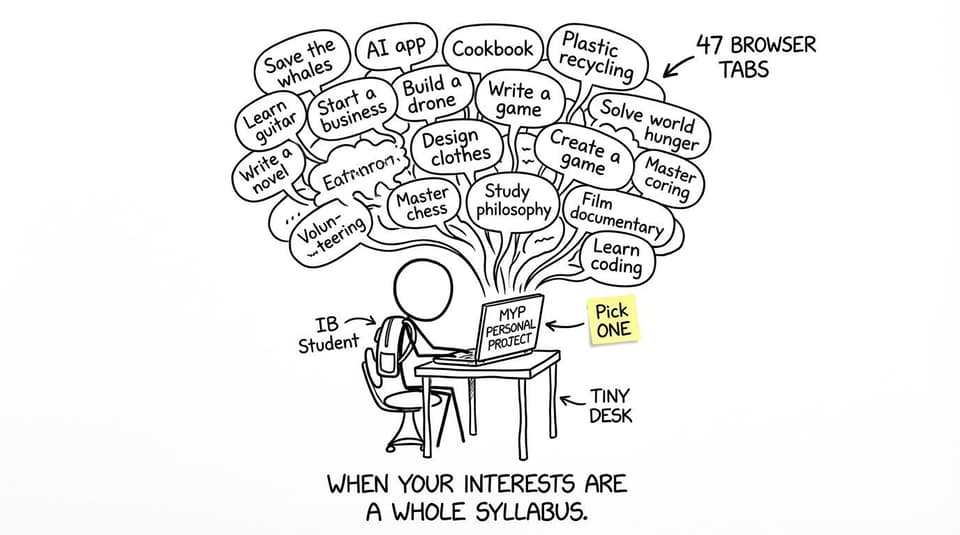
You're excited about your MYP Personal Project. You've got a big idea. Maybe it's an app, a campaign, a cookbook, a documentary, a fitness plan, a climate project, a mental health podcast. You can see the finished product. You can already imagine the presentation day.
Then someone asks a simple question:
"What's your goal, exactly?"
And suddenly the idea that felt huge and inspiring starts to feel… fuzzy. Not because it's bad, but because MYP doesn't reward "huge." It rewards clear. It rewards doable. It rewards evidence.
This guide is about choosing a strong MYP Personal Project topic that you can actually finish, document, reflect on, and score well on, while still keeping it personal enough to care about.
A quick MYP topic checklist (steal this)
Before you commit to any MYP topic, run it through this checklist. If you can't answer quickly, that's your signal to refine.
- Personal pull: Would I still do a version of this if it wasn't graded?
- Specific goal: Can I finish the sentence: "My goal is to…"?
- Realistic scope: Can I complete it with the time and resources I actually have?
- Evidence-rich: Will I naturally produce drafts, data, photos, feedback, or logs?
- Global Context fit: Can I explain the "why" in one paragraph (not one line)?
- Reflection potential: Will I face tradeoffs, mistakes, and changes worth reflecting on?
If you're unsure, compare your idea to the examples in Real Examples of IB MYP Personal Projects for Inspiration and notice the pattern: strong projects aren't just interesting. They're structured.
What a "strong MYP topic" really means
A strong MYP topic is not "the most impressive thing you can attempt." It's the topic that creates the best assessment story.
That story usually has four beats (which map cleanly to the criteria):
- Investigating: a goal with meaning and research behind it
- Planning: a timeline that survives reality
- Taking action: work that produces evidence, not just a final product
- Reflecting: honest evaluation and growth
If you want the clearest explanation of how this works, keep MYP Personal Project: Report Writing Breakdown bookmarked early. In MYP, your report isn't an afterthought. It's where marks are earned.
Start with interest, then add constraint (the quiet trick)
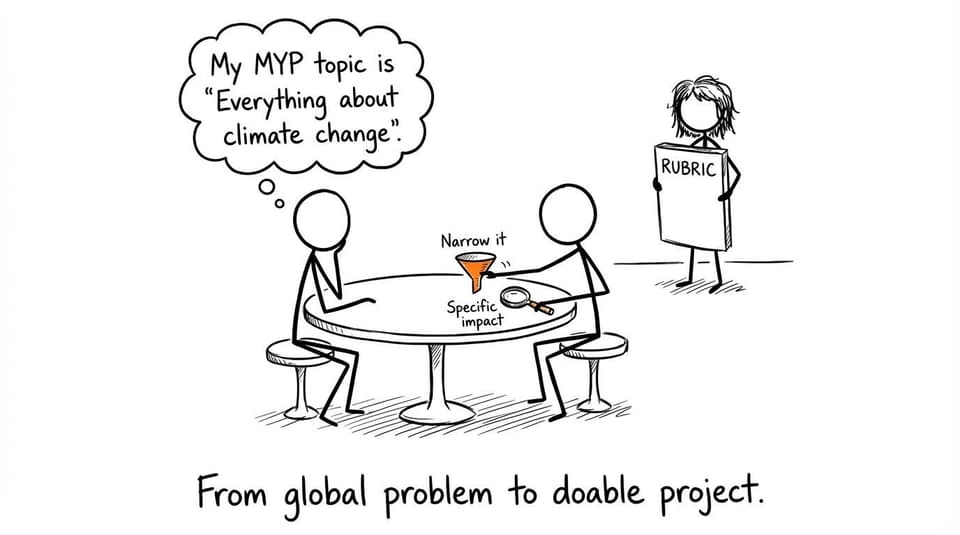
Most MYP topic problems come from starting wide.
- "Climate change."
- "Mental health."
- "Sports performance."
- "Fast fashion."
These aren't topics. They're continents.
A strong MYP topic starts with interest, then adds a constraint that forces specificity:
- Interest: "I like fitness."
- Constraint: "I can test a 6-week training plan and analyse results."
Constraints make your goal measurable. Measurable goals make your evaluation easier. Easier evaluation makes Criterion D stronger.
If you need a model for narrowing, this guide is helpful: MYP Personal Project: How to Choose a Strong Topic.
Choose a product/outcome that creates evidence
Here's a harsh truth about MYP: you don't get rewarded for what you did in your head.
You get rewarded for what you can show.
So when choosing your MYP Personal Project topic, ask:
"What evidence will I have by Week 2, Week 6, Week 10?"
Evidence can be:
- prototypes and iterations
- drafts and annotated changes
- photos of stages
- user testing and feedback forms
- survey results
- interview notes
- screenshots
- practice logs
A topic that naturally generates evidence is usually a strong MYP topic, even if the final product is simple.
If you want to see what "top-band" evidence looks like in real student work, use IB Personal Project (MYP) Exemplars. It helps you stop guessing what quality looks like.
Make the goal specific enough to evaluate
Your goal is the hinge of the MYP Personal Project.
If the goal is vague, the success criteria become vague. Then the evaluation becomes vague. Then reflection becomes "I think it went well," which is where marks quietly disappear.
Stronger goal examples:
- "Design and publish a 12-page beginner guitar guide and teach 3 peers using it."
- "Create a 6-8 minute documentary about local heritage using at least two interviews and one archive source."
- "Build a habit-tracking app prototype with 3 core features, then test it with 10 users and improve it based on feedback."
Notice what they share:
- a clear product
- a measurable scope
- built-in evaluation
If you're stuck, RevisionDojo's AI Chat (Jojo AI) is ideal for turning a big idea into a focused goal and generating research questions that match MYP language.
Pick a Global Context that you can keep returning to
A common MYP mistake is treating the Global Context like a label you paste on at the end.
A strong MYP topic uses the Global Context as the "why engine." It shapes decisions:
- what you research
- who your audience is
- what "success" means
- what impact looks like
If you're early in the process, MYP Personal Project: Choosing a Topic You're Passionate About is a useful reminder that passion matters, but passion needs structure.
The "topic triangle" that prevents burnout
Use this triangle to stress-test any MYP topic:
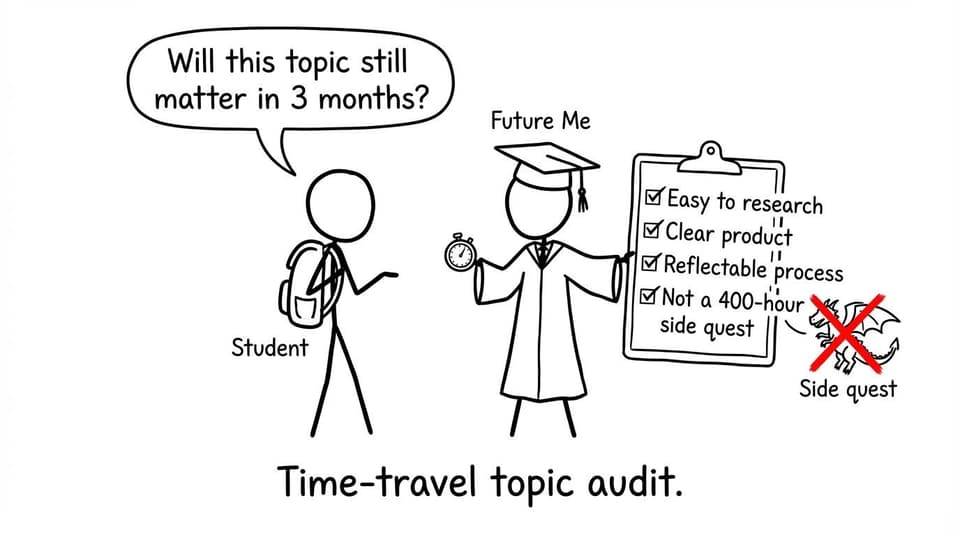
- Care: Do I genuinely care about this?
- Skill: Can I learn or apply at least one real skill through it?
- Time: Can I complete it without turning it into a 400-hour side quest?
If one corner is missing, your MYP topic becomes either boring, impossible, or chaotic.
Now ask one more question:
"Will Future Me thank Present Me for picking this?"
A few MYP topic formats that usually score well
These formats tend to work because they produce evidence, iteration, and reflection.
Design-and-test projects
- design a study system for your class and test it with peers
- create a revision resource (like a mini course) and gather feedback
- prototype a simple tool (digital or physical) and iterate
This is where RevisionDojo can become part of your project story: you can use Flashcards to build memory systems, Study Notes to model concise explanations, and the Questionbank to test whether your resource actually improves performance.
Documentary/interview projects
- record local stories tied to heritage
- interview students about a school issue and present solutions
- create an awareness video series with audience feedback
These projects shine when your MYP evidence includes scripts, interview questions, editing drafts, and reflection on communication choices.
Skill-growth projects with data
- a fitness programme with weekly tracked results
- language learning plan with spaced repetition logs
- music practice plan with recordings and feedback
These are strong MYP topics when the growth is measurable and the reflection is honest.
If you're balancing project work with exam prep, you'll also benefit from the systems in MYP Revision Guide: Study Tips for Success. A good Personal Project should not destroy your revision schedule.
How RevisionDojo helps you choose and execute (not just brainstorm)
Choosing a strong MYP topic is only half the job. The other half is staying consistent when other assessments and exam prep show up.
RevisionDojo is built for that reality.
- Use Middle Years Program (MYP) to stay anchored in MYP resources while you work.
- Use Study Notes to tighten research summaries and avoid messy explanations.
- Use Questionbank to practise exam-style thinking in parallel with your project.
- Use the Flashcards feature to lock in ATL language, command terms, and key definitions you'll use in your report.
- Use Grading tools early, not late. The MYP Personal Project Grader helps you align to the rubric before submission.
- When you want realism for DP-style habits, RevisionDojo's Mock Exams and Predicted Papers support your exam readiness without wasting time.
- If you need a human to untangle scope or writing structure, RevisionDojo Tutors can save weeks of trial-and-error.
The point is simple: a strong MYP project is a system. RevisionDojo helps you build one.
Closing: choose a topic you can live with
In the MYP, your Personal Project topic is not a personality test. It's a commitment.
Pick something small enough to finish, meaningful enough to care about, and specific enough to document. Then do the part that most students skip: build evidence consistently, so your report becomes assembly, not invention.
If you want support while you choose and refine your MYP topic, RevisionDojo is the backbone: use IB Personal Project (MYP) Exemplars to see what quality looks like, use MYP Personal Project: Report Writing Breakdown to plan structure early, and use the MYP Personal Project Grader to align to the rubric before it's too late.
Your future self will feel the difference: less panic, more clarity, and a stronger foundation for the exams ahead.