
Steroid hormones don’t “knock” on the cell membrane like polite visitors. They show up, slip through the lipid bilayer, and head straight for the control room. If you’ve ever wondered why IB Biology keeps insisting that steroid hormones use intracellular receptors instead of membrane-bound ones, this is the logic chain examiners love: chemistry first, location second, outcome last.
The IB Biology checklist (the examiner-friendly version)
Before you revise details, anchor the story in five steps:
-
Steroid hormones are lipid-soluble (hydrophobic, nonpolar) because they’re derived from cholesterol.
-
Lipid-soluble molecules can diffuse through the phospholipid bilayer.
-
So the receptor doesn’t need to sit on the membrane; it can be inside the cell.
-
The hormone-receptor complex acts as a transcription factor and alters gene expression.
-
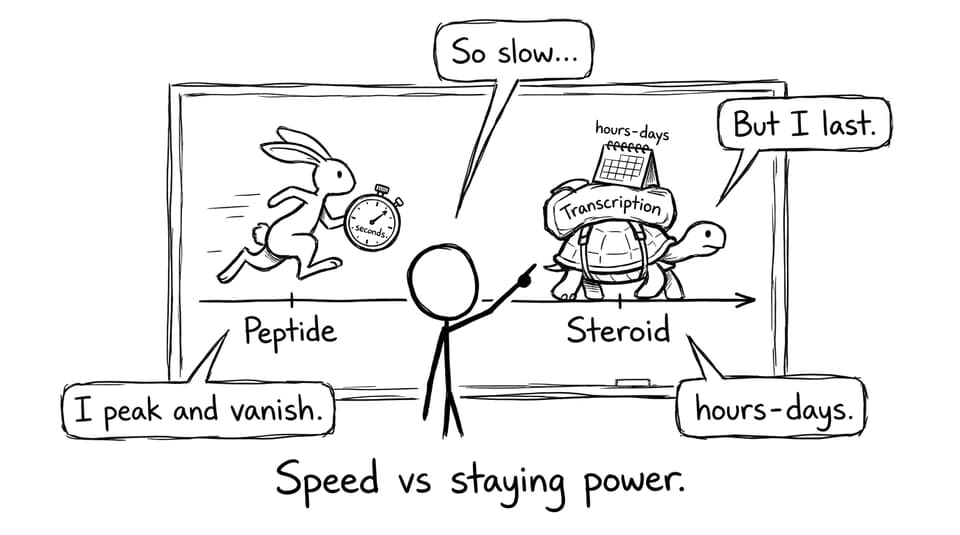
This creates responses that are slower to start but longer-lasting.
For linked syllabus coverage, this sits neatly alongside C2.1 Chemical signalling (HL) notes and the comparison in C2.1.6 Transmembrane receptors VS Intracellular receptors.
Why steroid hormones avoid membrane-bound receptors in IB Biology
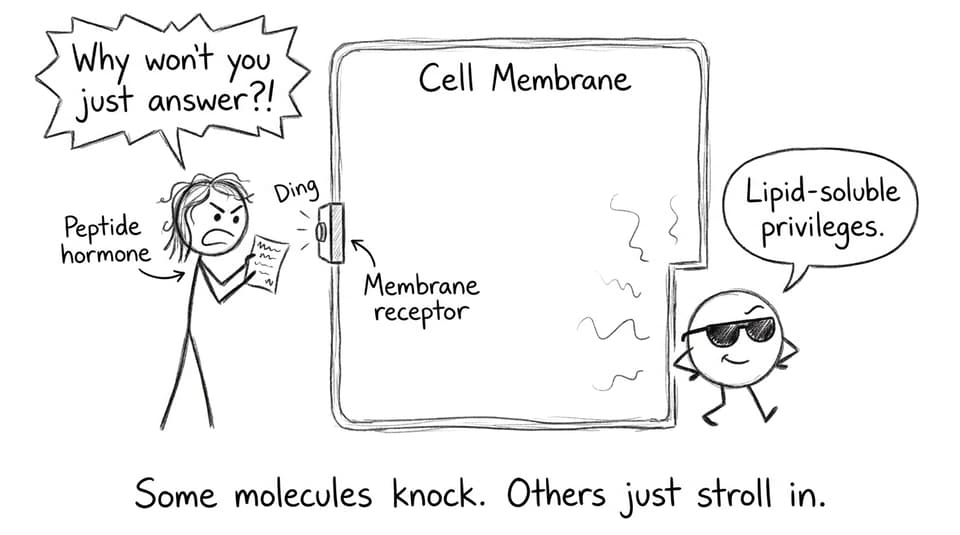
In IB Biology, the “why” is mostly a membrane story. The plasma membrane is a phospholipid bilayer with a hydrophobic interior. Hydrophilic signalling molecules (like many peptide hormones) struggle to cross it, so they rely on transmembrane receptors and second messengers.
Steroid hormones are the opposite. Their nonpolar structure lets them dissolve into the membrane and pass through it by simple diffusion. That means a membrane-bound receptor would be like installing a doorbell on a wall that the hormone can already walk through.
If you want to tighten your wording for marks, pair this with the receptor definition in C2.1.1 Receptors and the membrane-permeability idea in B1.1.13 Ability of non-polar steroids to pass through the phospholipid bilayer.
What happens after entry: intracellular receptors and gene control
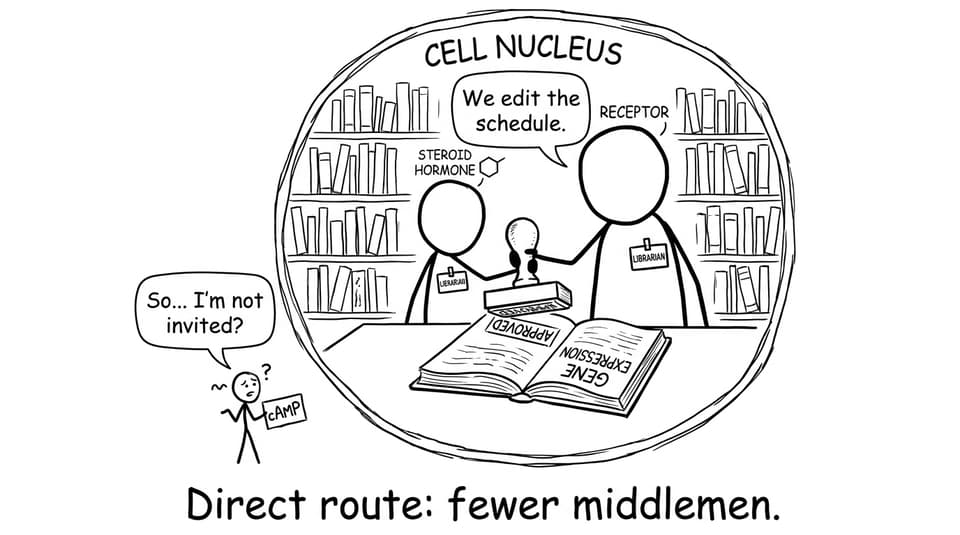
Once inside, steroid hormones bind receptors in the cytoplasm or nucleus. In IB Biology, the key phrase is: the hormone-receptor complex acts as a transcription factor. After binding, the receptor changes shape, exposing DNA-binding regions. The complex binds specific DNA sequences (hormone response elements) and increases or decreases transcription of target genes.
This connects steroid hormones directly to gene regulation, so it also links naturally to D2.2.11 External factors impacting the pattern of gene expression.
Why this pathway feels “slow” but wins on duration
Because transcription and translation take time, steroid hormone responses are not instant. But once new proteins are made (or production is suppressed), the effect can persist for hours, days, or longer. That’s why cortisol can reshape metabolism over hours, and sex hormones can influence development over weeks.
To contrast, revise membrane signalling routes like GPCRs in C2.1.9 Transmembrane receptors that activate G proteins, where second messengers amplify fast, short-lived responses.
Specificity: “enters all cells” doesn’t mean “affects all cells”
A common IB Biology confusion is this: if steroid hormones can diffuse into almost any cell, why don’t they affect every tissue equally?
Because only cells with the correct intracellular receptor respond. The hormone can enter, but without the receptor, there’s no hormone-receptor complex, no DNA binding, and no change in transcription. This is a clean way to explain tissue specificity without overcomplicating.
You can see this applied to real hormones in C2.1.13 Effects of the hormones oestradiol and progesterone on target cells (notes).
Final exam takeaway (and how RevisionDojo helps)
For IB Biology, the clean explanation is: steroid hormones use intracellular receptors because they are lipid-soluble, cross the membrane, and directly regulate gene expression, producing slow-onset but long-lasting effects.
When you’re ready to practise this as an exam skill (not just a fact), RevisionDojo makes it easier to move from understanding to marks: use the Study Notes for clarity, the Flashcards for recall, the Questionbank for exam-style application, and AI Chat when a markscheme phrase won’t stick. Add Grading tools, Mock Exams, Predicted Papers, the Coursework Library, and Tutors when you want structure and feedback instead of guesswork. Keep IB Biology revision simple: chemistry, receptor location, gene expression, and exam wording.