
A hard truth: studying isn't always the same as scoring in IB
It happens quietly. You're an IB student who did the "right" things: made notes, highlighted chapters, watched videos, maybe even stayed up late doing one more topic because guilt feels like discipline. Then results come back and the gap appears: you studied, but the marks don't reflect it.
That gap isn't a character flaw. In IB, it's usually a systems flaw.
The Diploma Programme rewards a specific kind of work: targeted practice, clear command terms, structured answers, and relentless feedback loops. You can spend 100 hours "revising" and still train the wrong muscle.
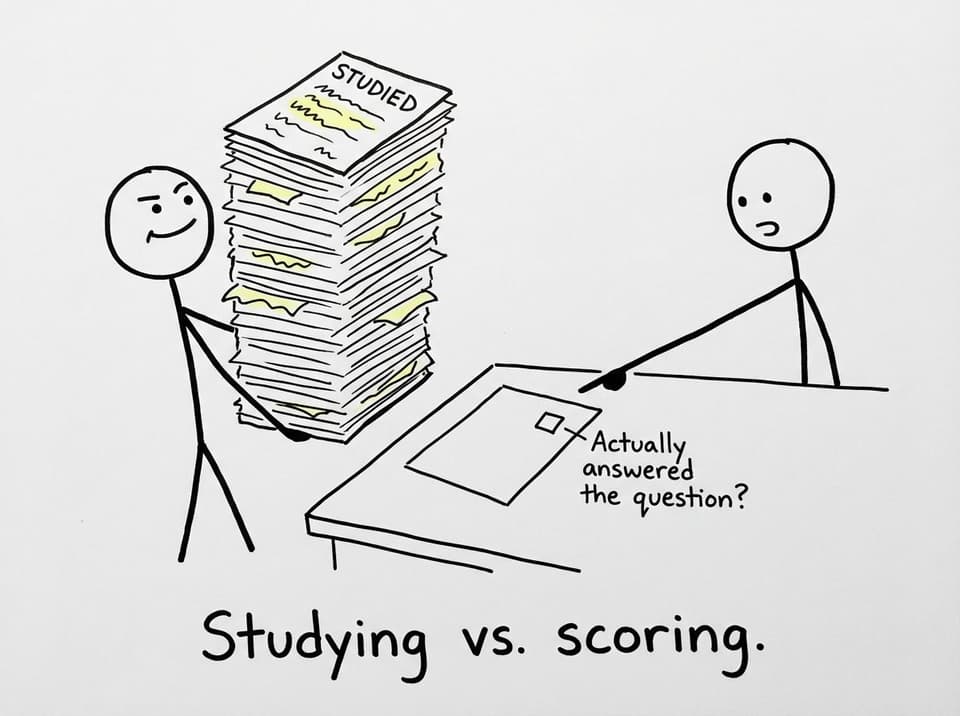
This article is a map of why some students fail IB even after studying, and what to do differently in the final stretch before exams.
Quick checklist: the most common reasons IB study doesn't convert to grades
Use this as a diagnostic. If you feel personally attacked by more than two, good, you've found your leverage.
- You confuse time spent with skill built (hours vs outcomes in IB)
- You avoid markscheme-style practice because it's uncomfortable
- You revise content but ignore command terms and assessment objectives
- You don't train exam writing under time pressure
- Your feedback is vague or delayed, so errors repeat
- You revise what you like, not what will be assessed
- Your study plan collapses under IAs, TOK, EE, and deadlines
- You treat weak topics as "later," then later becomes never
The hidden mismatch: "I studied" vs "I trained for IB questions"
In IB, the exam doesn't ask, "Have you read the chapter?" It asks, "Can you apply this concept in this format, using these command terms, under this time constraint?"
That's why one student can study less and score more: their study is shaped like the exam.
A useful mental model is this: content knowledge is the ingredient, but the exam tests the recipe. If you only stock ingredients, you still can't cook under pressure.
This is where RevisionDojo's approach (Questionbank + Study Notes + Flashcards + Mock Exams) aligns with how IB actually grades: repeated exposure to exam-style prompts, fast retrieval, and feedback-driven refinement.
Reason 1: You're doing "comfortable revision" (and IB punishes comfort)
Re-reading notes feels clean. Highlighting feels responsible. Rewriting a definition feels like progress.
But IB scoring is rarely improved by what feels easy.
Comfortable revision has two problems:
- It creates familiarity, not recall. You recognize the topic on the page, but can't pull it out in an exam.
- It avoids decision-making. Exams are decisions: which point first, which example, which equation, which evaluation.
The fix is uncomfortable work in small doses: daily question practice, short timed responses, and immediate correction.
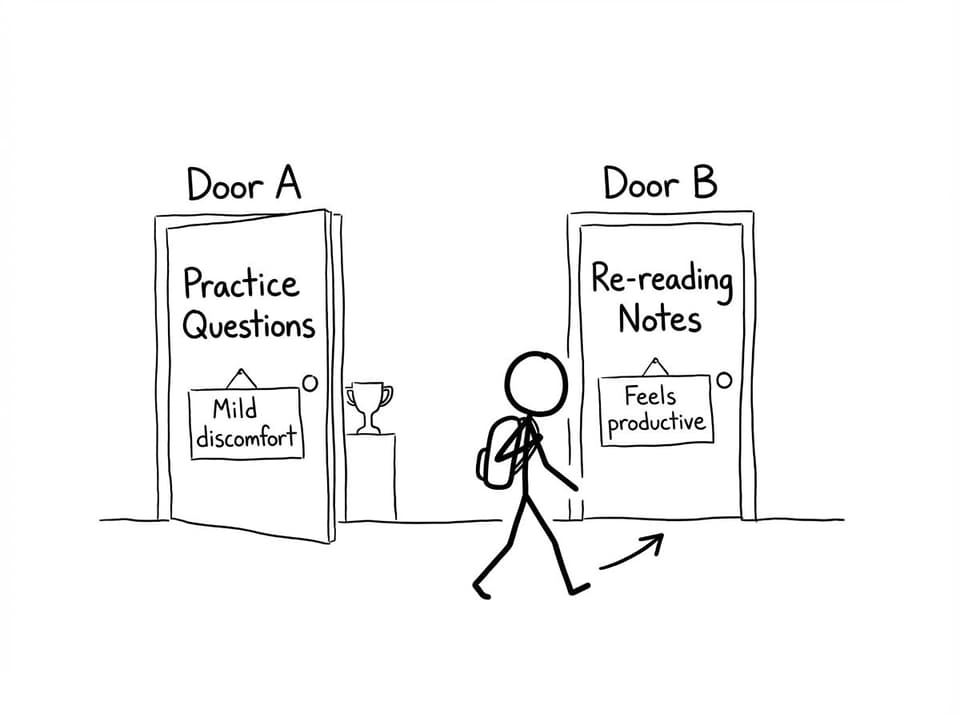
If you're using RevisionDojo, this is where the Questionbank becomes your honest friend: it shows you what you can actually do, not what you can recognize.
Reason 2: You don't speak "IB command term" fluently
Many IB students lose marks while being broadly correct. They write true things that don't answer the question in the required way.
That usually happens because command terms are a language, and you're half-speaking it.
- Define is not Explain.
- Explain is not Evaluate.
- Compare is not "tell me two separate mini-essays."
When you miss the command term, you might deliver a beautiful answer to a different question. The examiner can't award marks for what wasn't asked.
A practical fix:
- Make a one-page command term cheat sheet per subject.
- For each command term, write: "What does a full-mark answer look like?"
- Practice by rewriting your answers to match the command term exactly.
RevisionDojo's AI Chat can help here: paste your response and ask, "Did I satisfy the command term? What did I miss?" That single habit can rescue whole grade boundaries in IB.
Reason 3: You revise topics, but not the way IB assesses them
A surprising number of IB students revise like this:
- Topic A: notes
- Topic B: notes
- Topic C: video
But assessment is often:
- Topic A + Topic C combined
- Topic B applied to unfamiliar data
- Topic A evaluated with real-world limitations
If your revision never blends topics, the exam feels "unfair," when really it's just doing what IB always does.
The fix is mixed practice:
- After every topic session, do 5 mixed questions from earlier units.
- Once a week, do a short mixed set under time.
- Track which combinations break you.
RevisionDojo's Study Notes are useful for fast re-anchoring, but the lift comes from mixing questions in the Questionbank and checking patterns in your errors.
Reason 4: You don't practice under time, so you never learn pacing
Time pressure is not just a constraint; it's a skill.
In IB, many students know enough to pass but fail to finish. Or they finish but with thin, under-developed evaluation because they spent too long on earlier parts.
Pacing fixes that actually work:
- Write at least one timed mini-response daily (10-15 minutes).
- Use "first-pass scoring": answer what you can quickly, mark hard questions, return later.
- Build a template for common prompts (especially for essay-based IB subjects).
RevisionDojo's Mock Exams and Predicted Papers (exam-style sets) can make timed practice feel structured rather than chaotic. The goal is to make exam pace familiar, almost boring.
Reason 5: Your feedback loop is too slow (so mistakes repeat)
The most dangerous sentence in IB revision is: "I'll check it later."
Later often means:
- after you've practiced the same misconception ten more times
- after the feeling of the question has faded
- after your brain has already labeled the mistake as "not important"
Fast feedback changes everything. Ideally, you learn within minutes what your answer lacked: specificity, structure, key term, or evaluation.
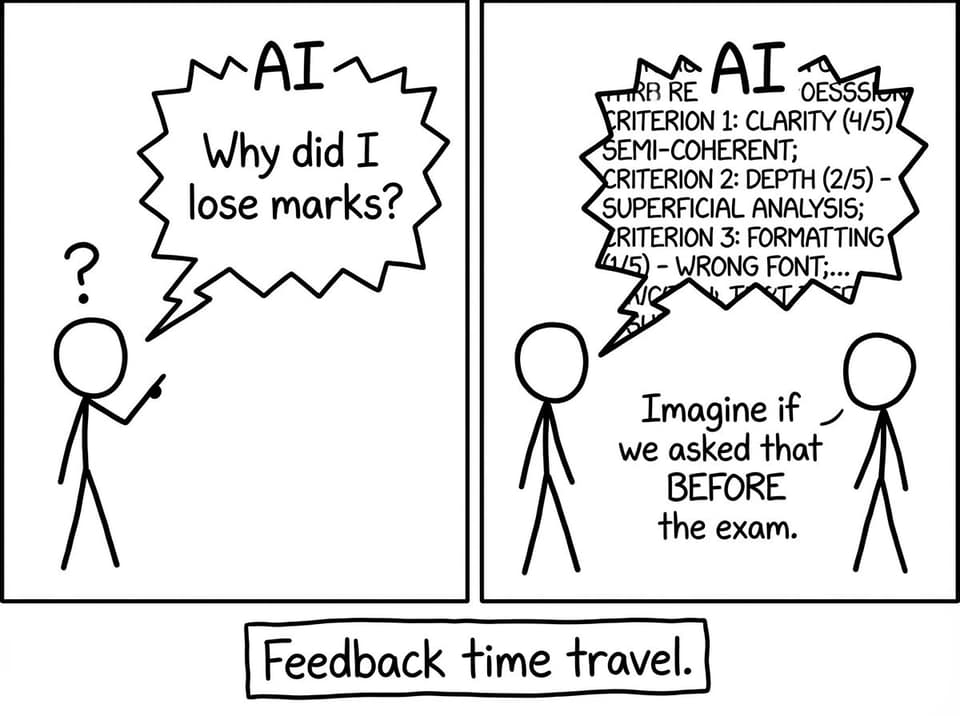
RevisionDojo's Grading tools and AI Chat are built for this moment: you submit, you get targeted feedback, you revise, you reattempt. That loop is how IB marks turn into habits.
Reason 6: You're "covering" content instead of closing gaps
Covering content is seductive because it feels linear. You can say, "I did Topic 3."
But IB exams don't care what you covered. They care what you can perform.
A better approach is gap-driven revision:
- Identify your top 3 recurring errors (not topics, but errors).
- Build a micro-plan: 20 minutes per day dedicated to those errors.
- Retest every 3 days until the error disappears.
This is where Flashcards shine, not as a cute aesthetic, but as a ruthless detector of what you can't retrieve on demand.
Reason 7: Your plan collapses under IA, TOK, and EE pressure
Many students fail IB not because they lack intelligence, but because they run out of calendar.
The Diploma Programme is a load-management challenge. IAs, TOK essays, and the EE can quietly drain the energy you thought belonged to exam prep. And when that happens, revision becomes reactive: "whatever I can do tonight."
A calmer system:
- Make two plans: an "ideal week" and a "survival week."
- On heavy deadline weeks, do only high-yield tasks: mixed questions + feedback + error log.
- Protect a small daily IB habit (30-45 minutes) so momentum doesn't die.
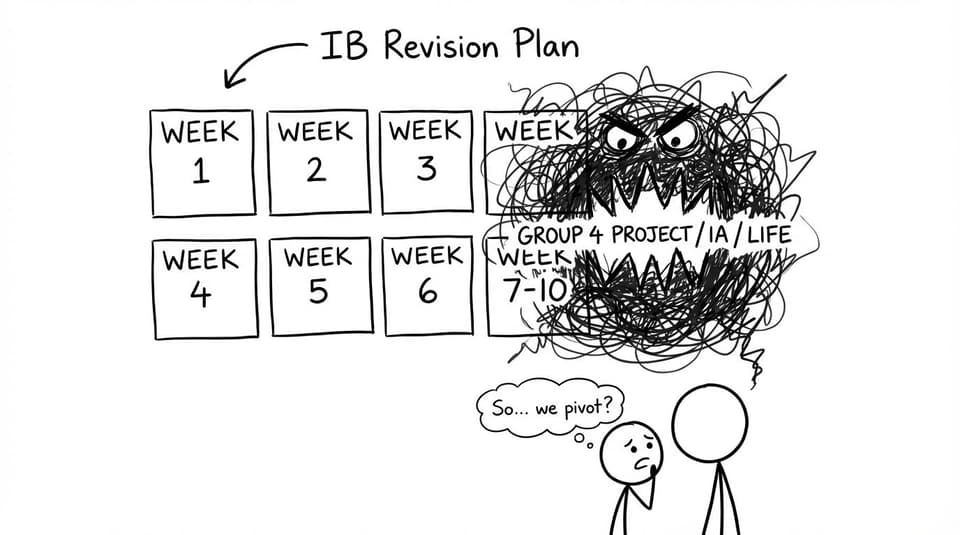
RevisionDojo's Coursework Library and Tutors can reduce that deadline stress by making coursework less guessy and more guided, so exam revision doesn't get sacrificed.
A smarter IB revision routine (simple, repeatable, realistic)
Here's a routine designed to convert study hours into IB marks.
Daily (60-90 minutes)
- 10 min: Flashcards (active recall)
- 25 min: Mixed Questionbank set (timed)
- 15 min: Marking + feedback (AI Chat or Grading tools)
- 10 min: Error log (one sentence: "I lost marks because…") + one reattempt
Weekly (2-3 hours total)
- 1x timed section from a Mock Exam
- 1x review session using Study Notes to patch weak concepts
- 1x targeted session: your top 2 errors only
This is the difference between "studying IB" and "training for IB."
Internal links
I couldn't fetch internal links because the web search tool returned a quota error. If you share RevisionDojo's sitemap or a backlink list PDF, I'll add 5-10 verified internal links with clean anchor text.
Closing: studying harder isn't always the answer in IB
If you're an IB student who studied and still feels behind, you're not broken. You're probably just training the wrong way.
The turning point is simple: stop measuring effort by hours, and start measuring it by evidence, including timed answers, corrected mistakes, and fewer repeated errors.
RevisionDojo is built for that shift. Use the Questionbank to face the real exam style, Study Notes to patch gaps quickly, Flashcards to make recall automatic, AI Chat and Grading tools to tighten feedback, and Mock Exams plus Predicted Papers to build stamina. If coursework pressure is draining your calendar, lean on the Coursework Library and Tutors so revision stays steady.
In IB, the students who win aren't always the ones who study the most. They're the ones who study in a way the examiner can recognize.


