


When you are deep into IB Biology revision, it is tempting to treat “starch and glycogen” as just two more keywords to memorise. But polysaccharides are not a random detail. They are a design choice life keeps repeating because they solve a quiet problem every cell faces: how do you store lots of energy without wrecking your own chemistry?
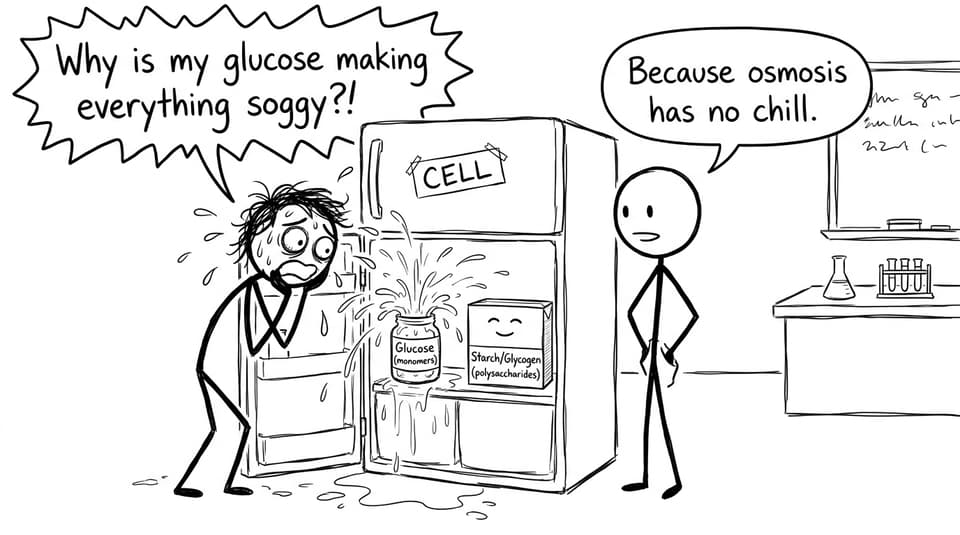
A cell that tried to stockpile energy as free glucose would feel it immediately. Water would rush in, reactions would become unpredictable, and the “savings account” would turn into a flood. In IB Biology, polysaccharides are the calm alternative: big, stable molecules that keep energy close, but not chaotic.
IB Biology checklist: what makes a good energy store?
Use this quick IB Biology checklist whenever an exam question asks why polysaccharides are good storage molecules:
-
Insoluble (so they do not affect water potential much)
-
Osmotically inactive (compared with many small soluble molecules)
-
Compact (coiled or branched structures pack tightly)
-
Chemically stable (less reactive than monosaccharides)
-
Easy to add/remove glucose (via condensation and hydrolysis)
For the syllabus-aligned version of this topic, see IB Biology Topic B1.1: Carbohydrates and Lipids.
Why polysaccharides are essential long-term energy storage molecules
They avoid osmotic disasters (a classic IB Biology point)
Glucose is small and soluble. If you stored thousands of glucose molecules separately, you would massively increase solute concentration in the cytoplasm. In IB Biology, that links directly to osmosis: water moves into the cell, changing water potential and risking damage.
Polysaccharides like starch and glycogen reduce this problem because they bundle many glucose units into one large molecule that is relatively insoluble. Fewer dissolved particles means less osmotic pressure. This is why starch granules can sit in plant cells without pulling in water and causing swelling.
If you want a plant-specific extension, What Does Starch Do for a Plant? connects this storage logic to real plant survival.
They are compact, so cells can store a lot without losing space
Polysaccharides store plenty of energy in the C-H bonds of glucose units, but their real advantage is geometry. Amylose forms a helix, and branched molecules fold into dense shapes. In IB Biology, compactness matters because cells have limited volume and need room for organelles, enzymes, and everything else.
Plants store starch in granules (often in chloroplasts and amyloplasts). Animals store glycogen mainly in liver and muscle cells. Both strategies allow large energy reserves without turning the cytoplasm into syrup.
For a detailed syllabus-aligned breakdown, use B1.1.5 Polysaccharides as energy storage compounds Notes.
Branching makes glucose release fast when it matters
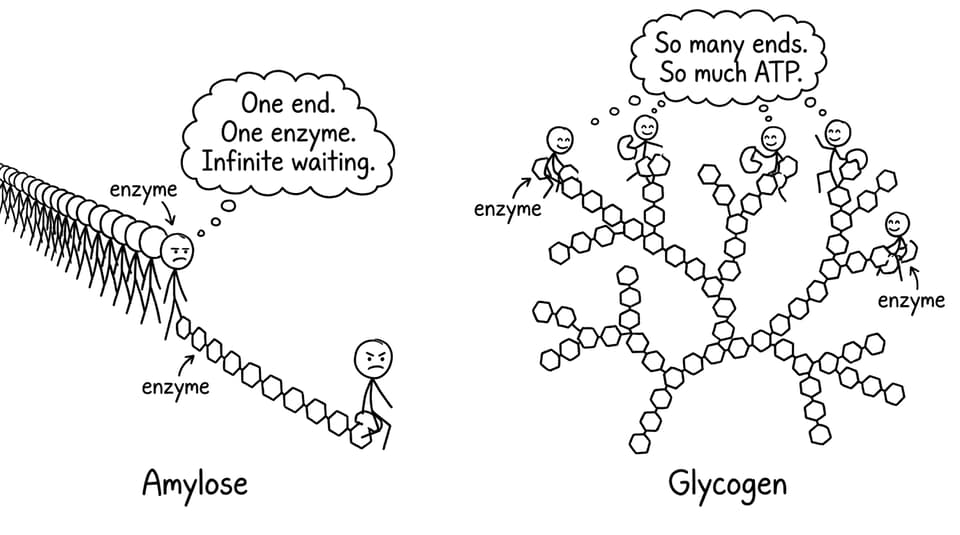
Glycogen is more highly branched than starch. That branching creates many “ends” where enzymes can work at the same time, releasing glucose quickly during high demand. In exam language: more branch points = more terminal ends = faster hydrolysis.
This is one of those IB Biology ideas that feels abstract until you picture a sprint: muscle cells need ATP fast. A highly branched polymer is like having many doors out of a building instead of one narrow exit.
To test this in exam style, try the B1.1 Carbohydrates and lipids Questionbank.
They are stable, so energy does not “leak” away chemically
Monosaccharides are more reactive than storage polymers. In IB Biology, the phrase you want is chemical stability: polysaccharides are less likely to diffuse away, interfere with reactions, or react unexpectedly.
That stability is part of why organisms can build reserves and keep them until needed. The cell is not just storing energy; it is storing it safely.
Polysaccharides vs lipids: the IB Biology comparison you must nail
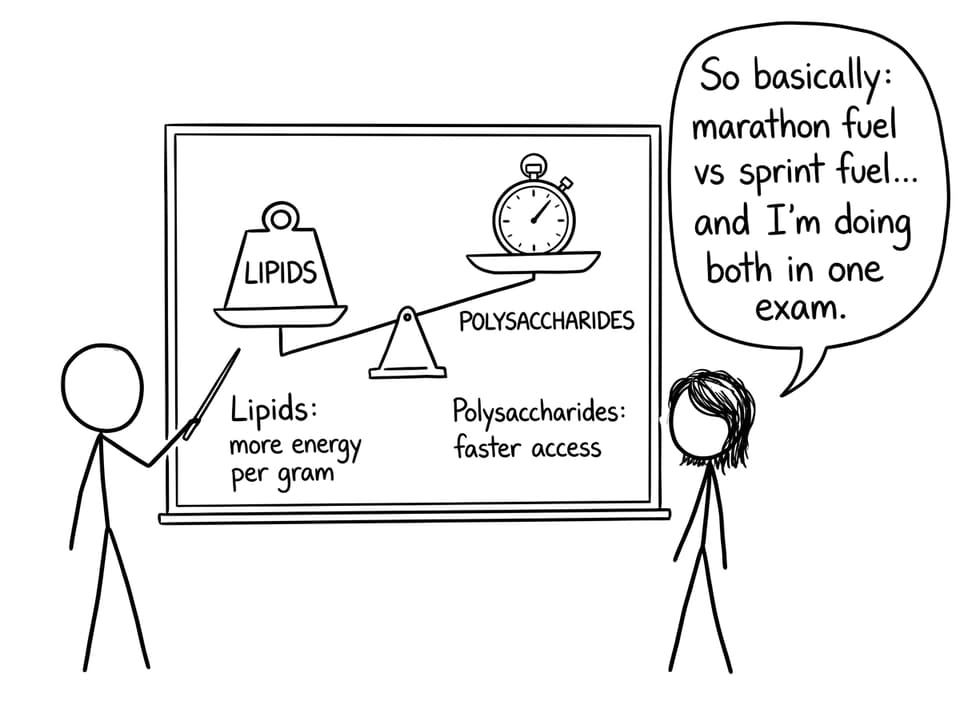
Lipids are more energy-dense per gram, but they are not as quickly mobilised as glycogen. Polysaccharides provide faster access to glucose for respiration, while lipids are excellent for longer-term, high-density storage.
In IB Biology, high-scoring answers often say both: lipids store more energy per gram, but polysaccharides are quicker and safer for short-to-medium term supply.
For a syllabus extension, C1.2.17 Differences between lipids and carbohydrates as respiratory substrates helps you connect storage to respiration.
How to revise this topic efficiently with RevisionDojo
A calm way to lock this into memory for IB Biology:
-
Use 2.3 Carbohydrates and Lipids Notes to build the concept map (structure, function, examples).
-
Drill definitions and key contrasts with B1.1 Carbohydrates and lipids Flashcards.
-
Turn understanding into marks using RevisionDojo’s Questionbank and Grading tools, then ask the AI Chat to explain any mistake patterns.
-
In the final stretch, use Study Notes, Cheatsheets, Predicted Papers, and Mock Exams to practise under time pressure.
-
If you need personalised correction, RevisionDojo Tutors can help you turn “I kind of get it” into consistent exam scoring.
If you want the full hub, start from IB Biology Resources.
Closing: the exam mark is really a story about safety
In IB Biology, polysaccharides are essential long-term energy storage molecules because they are a safe compromise: they store lots of glucose without dissolving, without pulling in water, and without becoming chemically messy. Then, when demand rises, branching (especially in glycogen) turns stored energy into usable glucose quickly.
If you want this topic to feel automatic under exam pressure, practise it the RevisionDojo way: start with Study Notes, reinforce with Flashcards, then convert understanding into marks using the Questionbank, AI Chat, Predicted Papers, and Mock Exams. Your future self, halfway through a tough IB Biology paper, will be grateful you built the concept once and tested it properly.