


In IB Biology, there’s a moment almost everyone has: you’re staring at a DNA diagram that looks calm and symmetrical, while your own understanding feels like a pile of loose pages sliding off the desk. The secret to DNA’s calm isn’t magic. It’s chemistry, specifically specifically, phosphodiester bonds. These covalent links don’t just connect nucleotides; they create a backbone that’s stable enough to store genetic information for years, yet readable enough for enzymes to copy and transcribe at speed.
If you can explain why phosphodiester bonds stabilize DNA and RNA, you’re not just memorising a definition. You’re learning the design logic that shows up across IB Biology exam questions.
The IB Biology checklist (what to say under pressure)
When an exam question asks about DNA/RNA stability, aim to hit these points clearly:
-
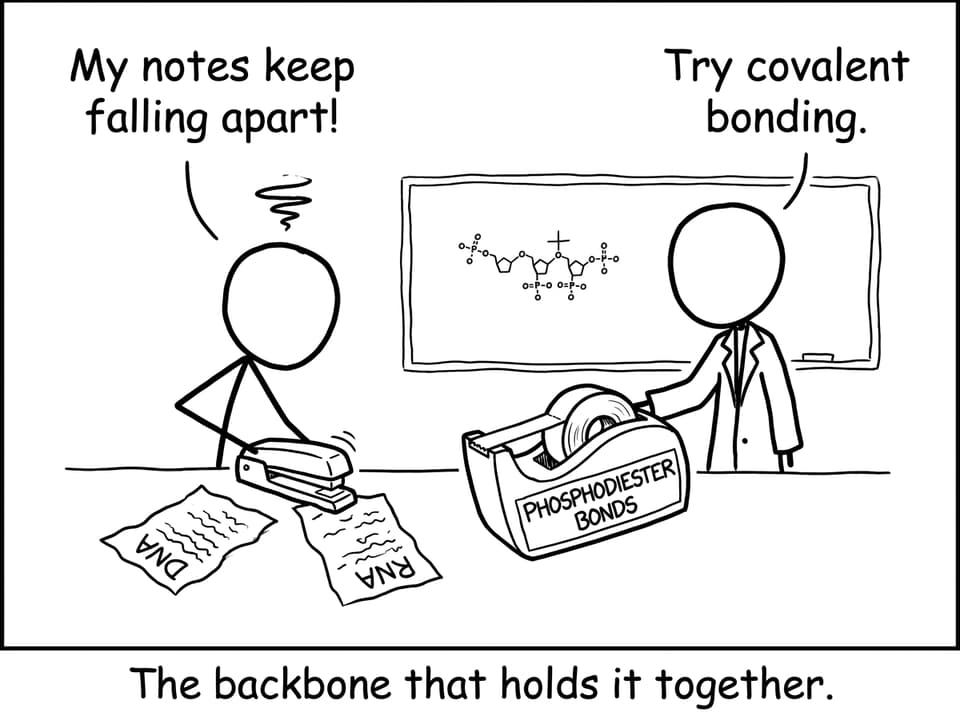
Phosphodiester bonds are covalent and form the sugar-phosphate backbone.
-
The bond forms between the phosphate and the 3' OH of the next sugar (a condensation reaction).
-
The backbone gives directionality: a 5' end and 3' end.
-
Negative phosphate charges help keep the backbone extended and bases positioned for pairing.
-
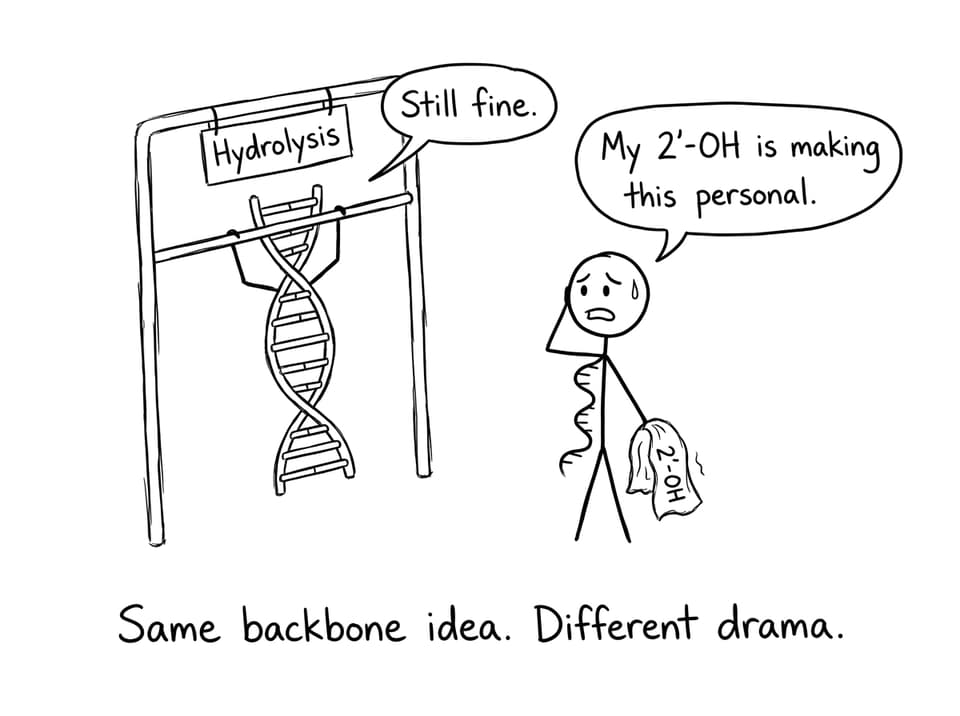
DNA is generally more stable than RNA because RNA has a 2' OH that increases reactivity.
If you want the syllabus-aligned version of these points, keep the RevisionDojo notes for A1.2 Nucleic acids open while you revise.
What phosphodiester bonds actually are (and where they form)
In IB Biology, it helps to picture nucleotides as having “connection points.” One nucleotide’s phosphate group links to the next nucleotide’s sugar at the 3' hydroxyl (3' OH). The result is a repeating sugar/phosphate/sugar/phosphate pattern.
That repeating pattern matters because it’s uniform. Enzymes love uniform. They can move along a predictable backbone without needing to “relearn” the structure every few atoms.
For a focused walkthrough tied to the new syllabus, see Sugar-phosphate bonding and the backbone and the supporting explainer on how nucleotides build DNA and RNA.
Why phosphodiester bonds stabilize DNA (covalent strength + chemical reliability)
Phosphodiester bonds are covalent bonds, which means they’re strong and don’t break easily under normal cellular conditions. This is the main stability argument: breaking the backbone requires significant energy, so the genetic message isn’t constantly at risk of snapping.
In IB Biology terms, this is why DNA can function as long-term information storage. You can mutate a base, mispair a base, or chemically modify a base, but if the backbone were fragile, the entire sequence could be lost in fragments. A stable backbone keeps the “sentence” intact, even when individual “letters” sometimes need correction.
IB Biology directionality: stability you can read
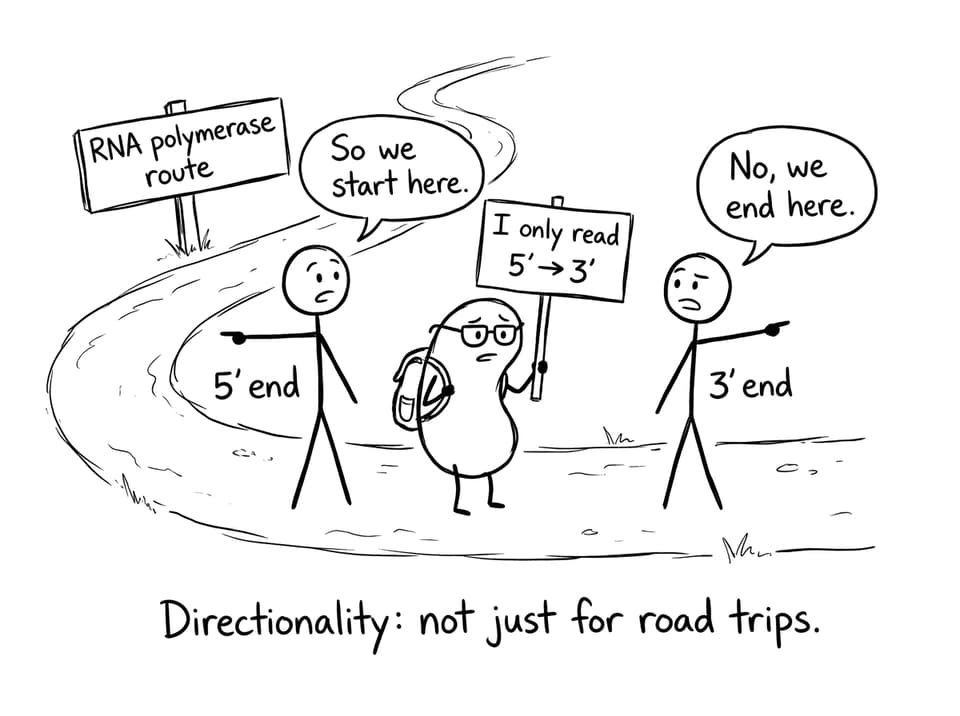
Phosphodiester bonds also give nucleic acids something surprisingly exam-relevant: directionality. Because the bonding pattern is consistent, strands have a 5' end and a 3' end. That’s not just vocabulary; it’s how polymerases know where they are and what to do next.
DNA synthesis (and RNA synthesis) proceeds 5' to 3', because nucleotides are added to the 3' end. If you need a clean explanation for HL-style questions, use Directionality of RNA and DNA (A1.2.11) and the deeper reasoning in Why DNA replicates only 5' to 3'.
The phosphate negative charge: stability through spacing
A detail students often forget in IB Biology: phosphate groups carry negative charges. Those charges repel each other. Oddly, repulsion can be stabilising here.
Because phosphate groups repel, the backbone tends to stay extended rather than collapsing into a tangled clump. That spacing helps keep the nitrogenous bases pointing outward in a way that supports complementary base pairing. In DNA, that pairing helps form the double helix; in RNA, it supports folding and interactions.
If you want broader context on how structure drives function, connect this to how RNA and DNA structures shape their functions and the core content in 2.6 Structure of DNA and RNA.
DNA vs RNA stability: same backbone idea, different risk level
Both DNA and RNA rely on phosphodiester bonds. So why is RNA usually less stable in cells?
The key IB Biology comparison is the sugar. RNA’s ribose has an extra 2' OH group. That small change makes RNA more chemically reactive and more prone to backbone cleavage (especially under alkaline conditions). DNA lacks that 2' OH, which makes its backbone less likely to self-destruct.
This difference helps explain biology at scale: DNA is the archive, RNA is the working copy. For quick revision on the contrast, use Differences between DNA and RNA (A1.2.7).
Bring it home: turn structure into exam marks with RevisionDojo
In IB Biology, phosphodiester bonds are one of those concepts that quietly connect everything: nucleotide structure, directionality, replication logic, and why DNA and RNA play different roles. If you can explain how phosphodiester bonds stabilize DNA and RNA, you can usually earn marks across multiple question styles.
To practise it the way exams demand, use RevisionDojo as your hub: the IB Biology revision notes for clean explanations, the A1.2 Nucleic acids Questionbank for exam-style drills, and the A1.2 flashcards for fast recall. When you’re ready to pressure-test your understanding, RevisionDojo’s Questionbank, Study Notes, Flashcards, AI Chat, Grading tools, Predicted Papers, Mock Exams, Coursework Library, and Tutors turn one small bond into a big confidence shift, exactly exactly what IB Biology revision should feel like.