


If you have ever walked into an IB Biology exam feeling prepared, then suddenly blanked on a “simple” metabolism question; there’s a good chance water was quietly sitting in the background of the markscheme.
Water feels too obvious to revise. It’s everywhere, so your brain treats it like wallpaper. But metabolic reactions do not happen in a dry, idealized diagram. They happen in a crowded, watery cell where enzymes, ions, substrates, and membranes all depend on water’s chemistry. In IB Biology, that “watery context” is often the difference between a 2-mark idea and a 6-mark explanation.
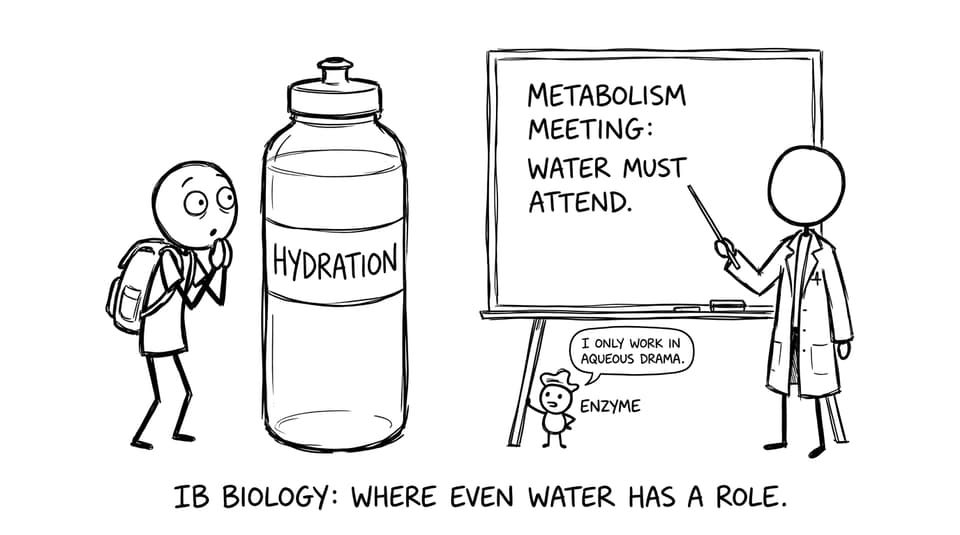
Quick IB Biology checklist: how water supports metabolism
Use this as your fast recall set for IB Biology short answers:
-
Water is a polar solvent that dissolves ions and polar molecules.
-
Water enables collisions between reactants and enzymes in solution.
-
Water is a reactant in hydrolysis and a product in condensation.
-
Water buffers temperature swings thanks to high specific heat capacity.
-
Water participates directly in major pathways (photosynthesis, respiration).
-
Water supports transport within cells and organisms.
For deeper syllabus-aligned coverage, pair this with A1.1 Water overview and IB Biology revision notes.
Water as a solvent: the medium that makes reactions possible
Metabolism is basically controlled chemistry. And chemistry needs a stage.
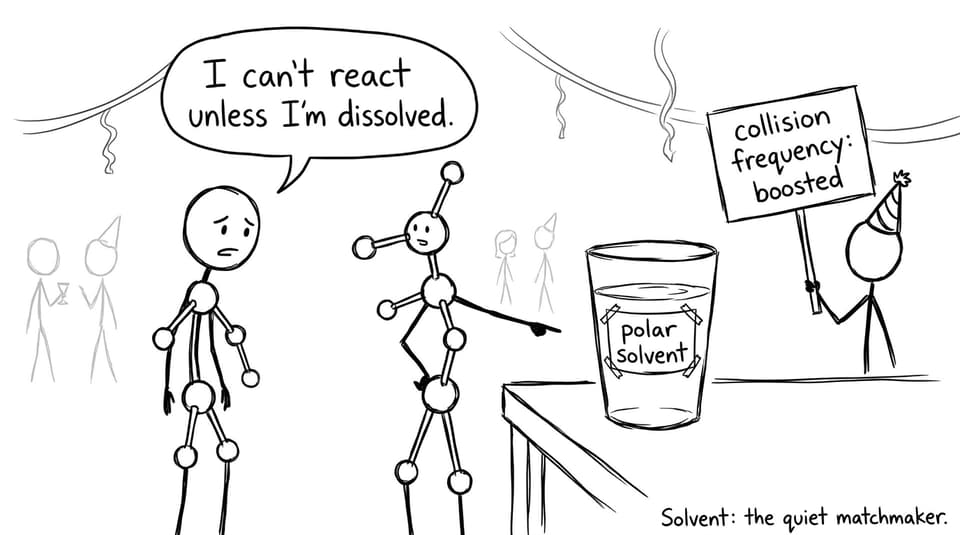
In cells, that stage is water. Because water is polar, it surrounds ions and polar molecules, pulling them apart and keeping them in solution. Once dissolved, these particles can move, collide, and interact with enzyme active sites. Without that, reaction rates crash because reactants cannot meet efficiently.
This shows up everywhere in IB Biology: enzyme-substrate binding, diffusion gradients, cytoplasm as a reaction environment, and transport in blood plasma or plant sap. If you want to review the precise wording the IB likes, see Water as the medium for life notes.
Water in hydrolysis and condensation: building and breaking life
Two reaction types are quietly everywhere in IB Biology, and both lean on water:
Hydrolysis (water is used)
Hydrolysis uses water to break covalent bonds in polymers. Think digestion of starch to glucose, or ATP hydrolysis releasing usable energy. If an exam asks why a polymer can be broken down quickly in cells, water as a hydrolysis reactant is part of the story.
Condensation (water is released)
Condensation reactions join monomers into polymers and produce water. This matters for forming peptides in proteins, phosphodiester bonds in DNA, and many anabolic pathways.
If you want extra practice explaining these mechanisms under exam timing, drill the relevant subtopics with the A1.1 Water Questionbank and then lock in definitions with A1.1 Water flashcards.
Water stabilizes temperature so enzymes can do their job
Metabolic reactions are enzyme-controlled, and enzymes are temperature-sensitive. Water’s high specific heat capacity means it can absorb a lot of heat before its temperature changes much. So your cytoplasm (and blood plasma, and tissue fluid) resists sudden temperature swings.
In practical terms, water helps maintain a steady internal environment where enzymes keep their shape and reaction rates stay predictable. In IB Biology, that connects “properties of water” to “homeostasis” and to enzyme denaturation curves.
To strengthen that link, revise enzymes with C1.1 Enzymes and metabolism and the focused explainer What are enzymes and how do they work?.
Water is a reactant and product in big metabolic pathways
Some of the most testable IB Biology pathways put water directly in the equations:
-
Photosynthesis: water is split during photolysis, providing electrons and releasing oxygen. See Photolysis notes.
-
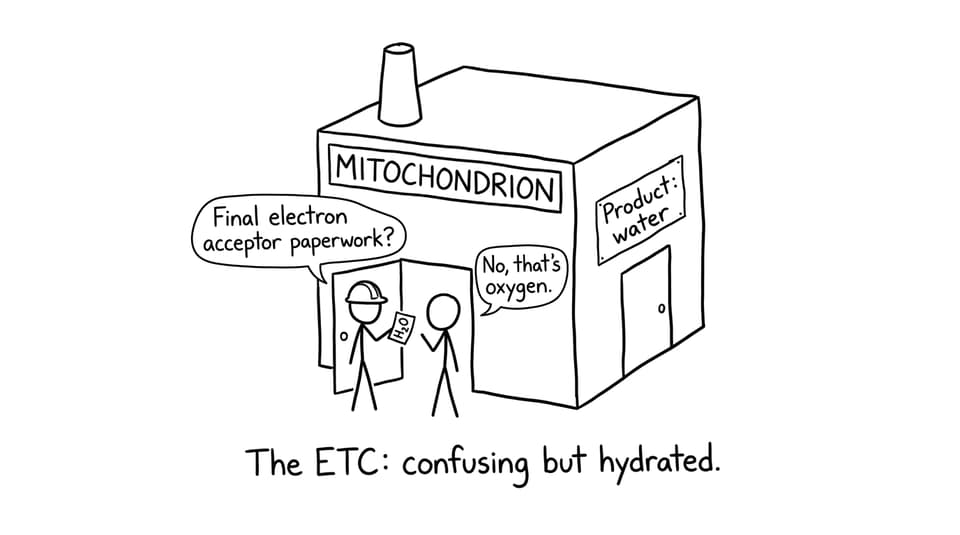
Aerobic respiration: water is formed at the end of the electron transport chain when electrons and protons combine with oxygen.
The exam trick here is clarity: water is not “just there.” It is either being used, being made, or shaping the conditions that allow the pathway to run.
Water supports transport: metabolism needs delivery systems
Even if a reaction is perfectly designed, it fails if the cell cannot move substances around.
Water enables transport at multiple scales: cytoplasm as a fluid medium, blood plasma carrying glucose and amino acids, and plant xylem pulling water (and dissolved minerals) upward via cohesion and adhesion. In IB Biology, transport questions often reward students who explicitly mention that dissolved substances must travel in an aqueous medium.
For plant movement detail at higher level, review Water potential and water movements in plant tissue (HL).
Bringing it home: water is the invisible “exam mechanism”
In IB Biology, water is rarely the headline, but it is often the reason. It dissolves, stabilizes, reacts, transports, and quietly keeps the cell workable enough for metabolism to run.
If you want to turn this into marks, build a simple routine in RevisionDojo: read the Study Notes, drill targeted Questionbank sets, reinforce with Flashcards, ask AI Chat for clearer wording, and test yourself with Mock Exams and Predicted Papers. Water may be everywhere, but your advantage is learning to explain exactly why it matters, the the way examiners reward.


