




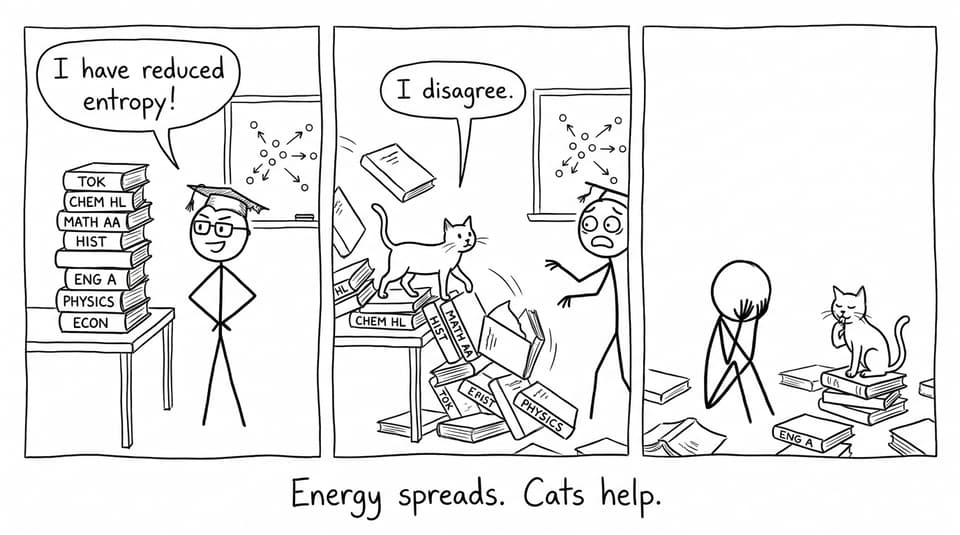
Entropy is the word that makes thermodynamics feel like philosophy. You stare at a neat, concentrated system (all the energy in one place), and physics calmly predicts it won’t stay that way. Not because the universe is messy in a moral sense, but because there are simply more ways for energy to be spread out than to remain tucked neatly in one corner. That’s the exam-friendly heart of entropy in IB Physics: it’s a way of counting possibilities.
Entropy in IB Physics: the one-sentence meaning
In IB Physics, entropy is best thought of as a measure of how widely energy is spread across the microscopic states (microstates) of a system.
A “macrostate” is what you can measure (pressure, temperature, volume). A “microstate” is the hidden detail: the exact arrangement and motion of every particle. The key insight is that many different microstates can look like the same macrostate.
When energy spreads more evenly, the number of compatible microstates increases. More microstates means higher entropy.
If you want the formal relationship for calculations, keep this close:
- Entropy change: (\Delta S = \frac{\Delta Q}{T}) (for reversible heat transfer)
You’ll see this directly in RevisionDojo’s Entropy and System Evolution notes.
A quick checklist for exam questions on entropy
When an IB Physics entropy question appears, run this mental checklist:
-
Is energy becoming more spread out (heat flowing, mixing, expansion)?
-
Does the situation allow more microstates afterward?
-
Is the process irreversible in real life?
-
Are you in an isolated system (system + surroundings)?
-
If you’re calculating, did you use Kelvin for (T)?
For broader thermodynamics context, RevisionDojo’s B.4 Thermodynamics topic hub helps you connect entropy to the rest of the unit.
Why “disorder” is a useful (but imperfect) shortcut
Teachers often say entropy is “disorder,” and that can work, ifif you translate “disorder” into something statistical:
-
Low entropy: few microstates available (energy concentrated, fewer arrangements)
-
High entropy: many microstates available (energy dispersed, many arrangements)
So the “disorder” isn’t about things looking chaotic. It’s about how many internal configurations the system could have while still matching what you observe.
A clean example you can use in IB Physics explanations: if thermal energy is concentrated in one region, there are fewer ways to assign particle energies. If that energy spreads through the whole system, there are vastly more ways to distribute it.
Energy spreading explains irreversibility
The second law becomes less mysterious if you treat it like a statement about odds.
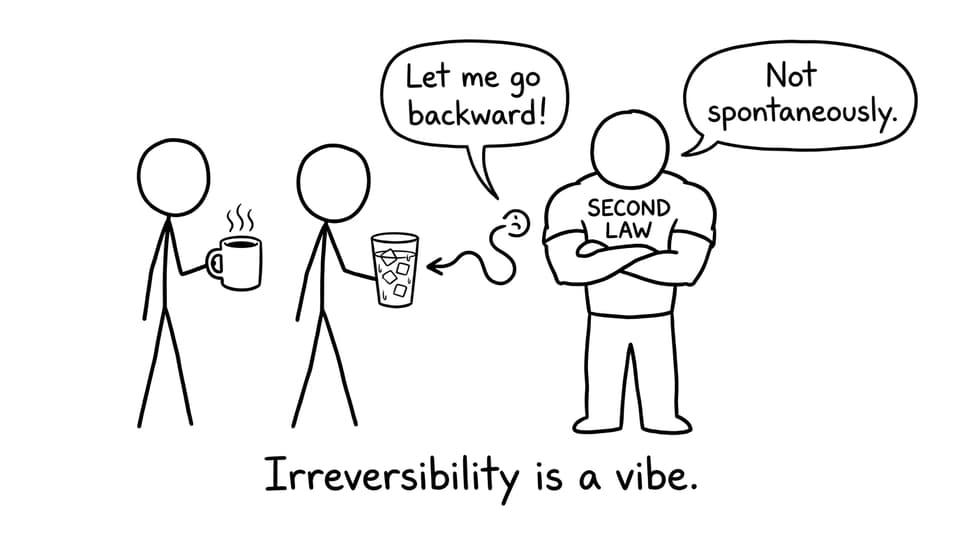
Heat flows from hot to cold because the end state (more even energy distribution) corresponds to far more microstates. The reverse (cold to hot, with no external work) would require the system to “choose” one of a tiny set of special, low-entropy arrangements. It’s not forbidden by energy conservation, butit’s just statistically crushed.
To tie this into the syllabus cleanly, pair entropy with the first law (\Delta U = Q - W). RevisionDojo’s First Law of Thermodynamics notes are a solid refresher before you tackle entropy-heavy explanations.
Entropy and “useful” energy (why engines have limits)
A subtle but high-value IB Physics point: as entropy increases, energy becomes harder to turn into organized work.
When energy is concentrated (low entropy), you can drive change: run an engine, lift a mass, push charge through a circuit. When energy is spread thinly and evenly (high entropy), there’s less “room” for a process to extract useful work.
This is why heat engines hit a ceiling in efficiency: some energy must be dumped to a colder reservoir, spreading energy and increasing total entropy. If you’re revising cycles and processes, link this to RevisionDojo’s Thermodynamic Processes and Heat Engines notes.
How to revise entropy with RevisionDojo (fast and calm)
Entropy gets easier when you practice the same idea in multiple formats:
-
Use the IB Physics B.4 Thermodynamics Questionbank to see how exam questions phrase microstates, irreversibility, and (\Delta S).
-
Reinforce definitions with B.4 Thermodynamics Flashcards.
-
When you forget a formula under pressure, the IB Physics Data Booklet page is the quickest way to re-anchor your memory.
RevisionDojo also supports the real exam workflow: build practice sets in the Questionbank, check your understanding with Study Notes, and use AI Chat to interrogate your own explanations until they sound like markscheme language.

Closing: the exam-ready intuition
If you remember one story for IB Physics, let it be this: entropy rises because energy has more ways to be spread out than to stay concentrated. “Disorder” is just the nickname we give to that overwhelming growth in microscopic possibilities.
If you want this to feel automatic before exams, use RevisionDojo’s B.4 notes, flashcards, and Questionbank to practice stating entropy in microstates language, then check your explanations with AI Chat and mark them with the Grading tools. That’s how thermodynamics turns from a scary chapter into reliable marks in IB Physics.