


Cash flow is the quiet force behind every "successful" business story. You can have rising sales, a healthy profit figure, and glowing headlines, and still be one late customer payment away from panic. That’s the trap IB Business Management students need to understand: profit is a measurement, but cash flow is survival.

Cash flow vs profit (the IB Business Management confusion)
In IB Business Management, profit tells you whether revenue exceeds costs over a period. Cash flow tells you whether real money is actually moving into (inflows) and out of (outflows) the bank account.
A business can sell a lot on credit, record revenue, and report profit, while still waiting weeks (or months) to receive cash. Meanwhile, wages, rent, utilities, suppliers, and loan repayments want cash now. RevisionDojo breaks this difference down clearly in Difference Between Profit and Cash Flow.
Why cash flow is so important, even for profitable businesses
Cash flow matters because it decides what happens on ordinary Tuesdays.
Day-to-day payments don’t accept “profit”
Suppliers, employees, and landlords rarely care that your income statement looks good. They care about payment timing. If a business can’t pay on time, it risks stock shortages, staff dissatisfaction, and operational disruption. This is why cash flow is often discussed alongside liquidity in IB Business Management; see Profitability and Liquidity Ratio Analysis.
Surprises require instant liquidity
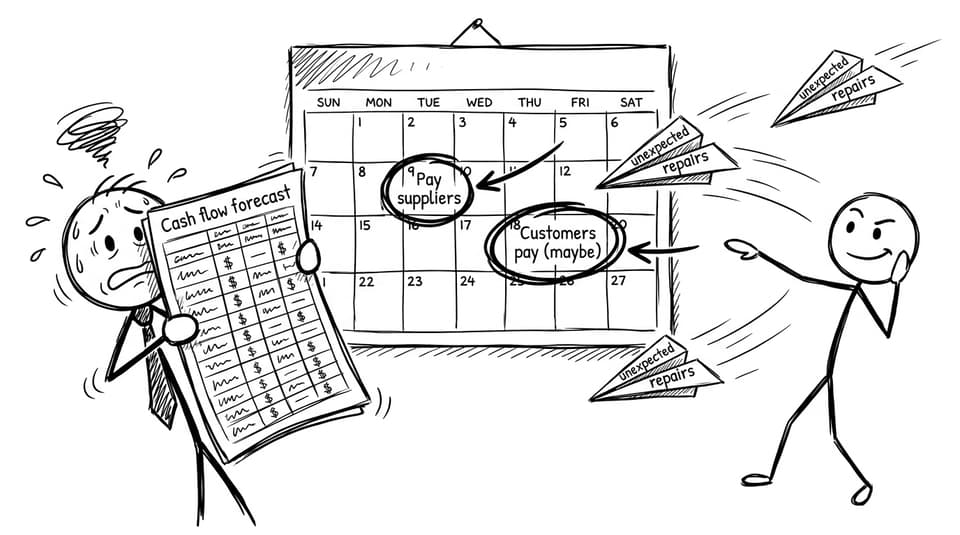
Equipment breaks. A key input price spikes. An urgent repair shows up at the worst time. Cash flow acts like a buffer that buys time and options. Without it, even profitable firms may be forced into emergency borrowing or damaging cost cuts.
Planning decisions depend on cash flow forecasts
Growth decisions (new staff, expansion, marketing spend, new equipment) are timing decisions. A manager may believe an investment is “worth it,” but still delay it because the cash position can’t support it this month.
That’s why IB Business Management emphasizes the tool itself: the cash flow forecast. If you need a crisp, exam-ready explanation, use Cash Flow Forecasts Notes, then practise the same skill under pressure in the Cash Flow Questionbank.
Relationships with suppliers and lenders are built on timing
Strong cash flow protects credibility. Paying bills on time can unlock better trade credit terms and improve access to finance. Weak cash flow can damage reputation, disrupt supply chains, and push a business toward costly short-term loans.
Seasonal dips can bankrupt “successful” firms
Some businesses earn unevenly across the year. Profit might look fine averaged across twelve months, but a short cash squeeze in a low season can trigger insolvency. This is why cash flow management is a core survival skill in IB Business Management.

Quick exam checklist: how to spot a cash flow problem
-
High credit sales but slow receivables (customers paying late)
-
Rapid growth creating higher working capital needs
-
Large one-off payments (equipment, tax, inventory build-up)
-
Seasonal demand swings
-
Overtrading (sales rising faster than cash capacity)
For strategies you can use in evaluation paragraphs, revise Strategies for Dealing with Cash Flow Problems.
How RevisionDojo helps you master cash flow in IB Business Management
If cash flow questions feel simple until the numbers appear, you’re normal. RevisionDojo is built for that exact gap between understanding and exam performance: use the Study Notes for clarity, Flashcards for definitions, and the Questionbank for repetition with feedback. When you want to check a step or test an explanation, the AI Chat can walk you through your reasoning. And when you’re ready to simulate exam pressure, build timed practice with Mock Exams and use Grading tools to refine structure and evaluation.
To study the full finance unit efficiently, bookmark IB Business Management Resources and the main 3.7 Cash Flow Hub.
Conclusion: cash flow is the story behind the numbers
In IB Business Management, profit tells you what should be happening; cash flow tells you what is happening right now. That’s why cash flow matters even for profitable businesses: it protects operations, choices, relationships, and resilience when timing turns against you.
If you want to turn that understanding into marks, revise the cash flow notes, drill exam-style practice in the Questionbank, and use RevisionDojo’s Flashcards, AI Chat, Mock Exams, and Grading tools to make your answers sharper and faster.


