

Hydration is one of those topics that feels too simple to matter...until it costs you a goal, a personal best, or a clean 6-marker.
In IB SEHS, hydration is never just “drink water.” It’s a chain reaction: fluid loss changes sweat rate, blood volume, heart workload, and focus. The story is quiet but predictable. You start fine. You sweat. You forget to sip. Then performance drops and you can’t quite explain why. That’s exactly the kind of cause-and-effect the IB loves.
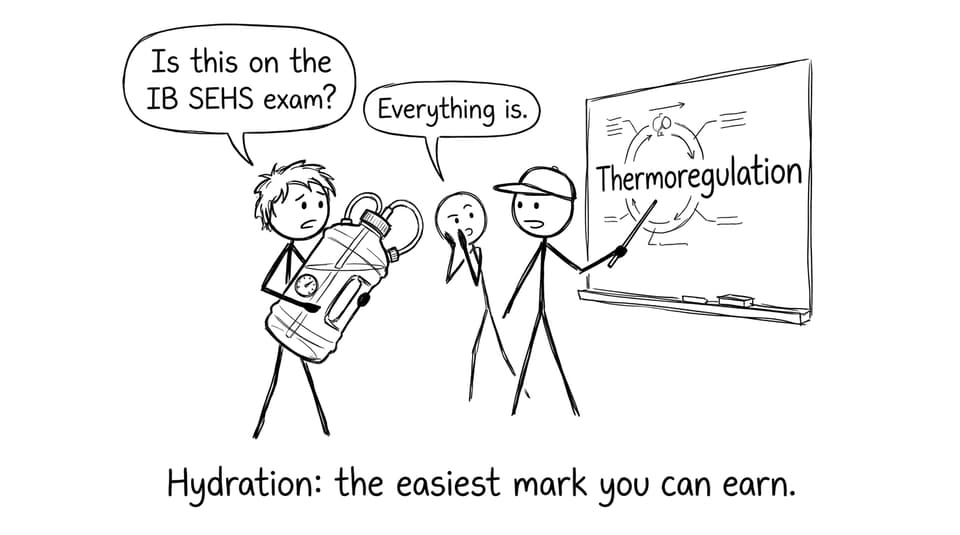
IB SEHS quick checklist: what hydration actually does
Use this as your exam-ready scaffold (and as a training reminder):
-
Supports thermoregulation via sweating and heat loss
-
Maintains blood plasma volume (key for cardiovascular delivery)
-
Helps transport nutrients and oxygen to working muscles
-
Aids waste removal and normal cell function
-
Protects coordination, decision-making, and concentration
For the syllabus-aligned version, revise A.2 Hydration and nutrition on RevisionDojo: A.2 Hydration and nutrition and the deeper subtopic A.2.1 Water and electrolyte balance.
Why hydration matters in IB SEHS: thermoregulation under pressure
The body is trying to keep internal conditions stable (homeostasis), even when exercise turns up the heat. In IB SEHS, the clean explanation is that working muscles generate heat and the body dumps that heat mainly through sweating and skin blood flow.
When you’re well hydrated, you can sustain sweat production and keep heat loss efficient. When dehydration begins, sweat rate can fall and core temperature rises, increasing perceived effort and reducing exercise tolerance.
If you want a strong, applied explanation (especially for extended responses), pair hydration with homeostasis and temperature control: A.1.2 Maintaining homeostasis Notes and Hydration and Thermoregulation in Athletes.
Dehydration and sports performance: the cardiovascular squeeze
Here’s the part students often describe vaguely. In IB SEHS, you score higher when you link dehydration to a measurable mechanism.
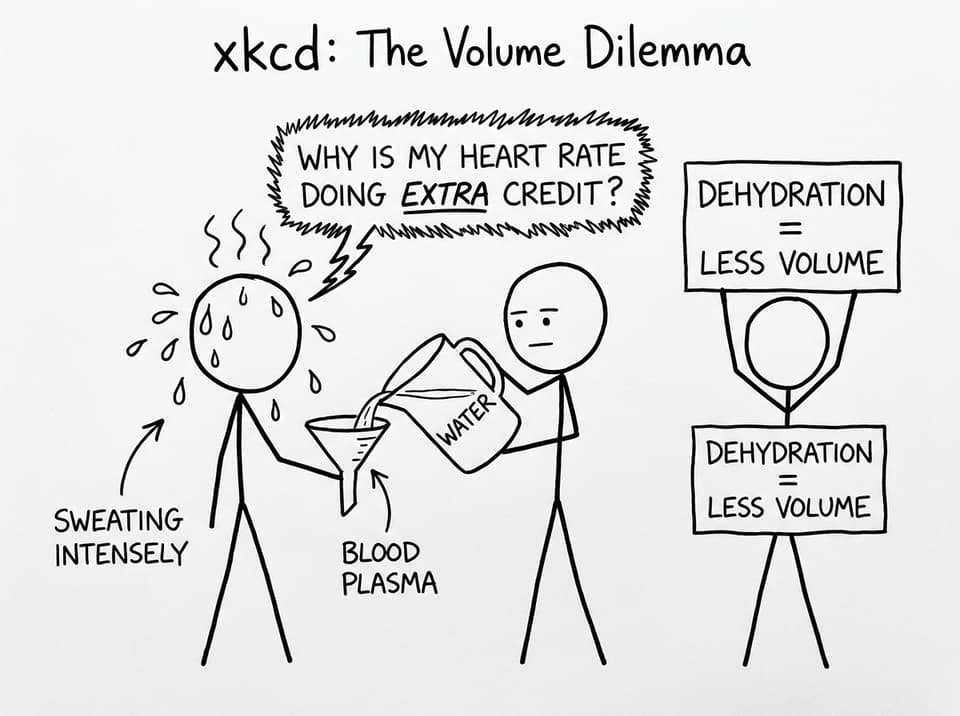
As you lose fluid through sweat, blood volume (and plasma volume) decreases. With less circulating volume, stroke volume tends to drop, so heart rate rises to maintain cardiac output. Meanwhile, the body is also trying to send blood to the skin for cooling. Working muscles and skin start competing for the same limited supply.
Practical performance outcomes you can state clearly:
-
Faster fatigue and reduced endurance capacity
-
Higher heart rate at the same workload
-
Lower power output at high intensity
-
Reduced concentration, coordination, and decision-making
How to write this in IB SEHS exam style (without waffle)
Try this simple structure for a 4-6 marker:
Define hydration/dehydration briefly. Then link to thermoregulation (sweat/evaporation). Then link to cardiovascular strain (reduced plasma volume to reduced stroke volume to increased HR). Finally apply to a sport scenario (e.g., prolonged match in heat, repeated sprints, humid environment).
To practise with mark-scheme language, use the RevisionDojo Questionbank: A.2 Hydration and nutrition Questionbank and A.2.1 Water and electrolyte balance Questionbank.
Hydration connects to fatigue, recovery, and injury risk
Hydration rarely appears alone in IB SEHS. It’s woven into fatigue, recovery, and injury prevention.
If you’re dehydrated, fatigue arrives earlier, technique degrades, and small errors become bigger ones (bad landing mechanics, late tackles, sloppy footwork). That’s why hydration fits naturally with:
-
Fatigue and recovery content: Notes for A.3.3 Fatigue and recovery (HL)
-
Broader fatigue causes: 9.1.4 Causes of fatigue Notes
-
Preventing breakdown: Injury Prevention Strategies in Sport
Conclusion: make hydration your quiet advantage in IB SEHS
Hydration is essential for sports performance because it protects the two systems you rely on most when exercise gets hard: cooling and circulation. In IB SEHS, that’s a gift: it’s a simple topic that can earn complex marks when you explain the mechanisms clearly.
If you want to turn hydration into dependable exam points, build your explanations with RevisionDojo’s Study Notes, drill them in the Questionbank, lock in definitions with Flashcards, and refine your wording using AI Chat and the platform’s grading tools. Start here: A.2 Hydration and nutrition.