

Momentum and Impulse in Sport
Momentum and impulse are key concepts in IB Sports, Exercise and Health Science (SEHS) that explain how forces affect motion over time. These ideas are especially useful for analysing collisions, striking actions, and changes in speed during sport. While force explains why motion changes, momentum and impulse explain how quickly and how effectively those changes occur.
Understanding these concepts helps students explain performance outcomes and injury risk in dynamic sporting situations.
What Is Momentum?
Momentum refers to the quantity of motion an object or athlete has. It depends on two factors:
- Mass
- Velocity (speed and direction)
In sport, an athlete with greater mass or higher speed has greater momentum. For example, a fast-moving rugby player has more momentum than a slower or lighter player.
In IB SEHS exams, students should link momentum to both mass and velocity rather than describing it as speed alone.
Momentum in Sporting Situations
Momentum is important in many sports, particularly those involving collisions or rapid changes in movement.
Examples include:
- A sprinter building momentum during acceleration
- A goalkeeper stopping a fast-moving ball
- A player being tackled in contact sports
Greater momentum makes it harder to stop or change an object’s motion, which is why technique and force application are so important.
What Is Impulse?
Impulse refers to the change in momentum that occurs when a force is applied over a period of time. It depends on:
- The size of the force applied
- The time over which the force acts
In simple terms, applying a force for a longer time produces a greater change in momentum.
In IB SEHS, impulse is often described as force × time, even when no calculations are required.
Applying Impulse in Sport
Impulse is commonly used to explain how athletes maximise or reduce changes in momentum.
Examples include:
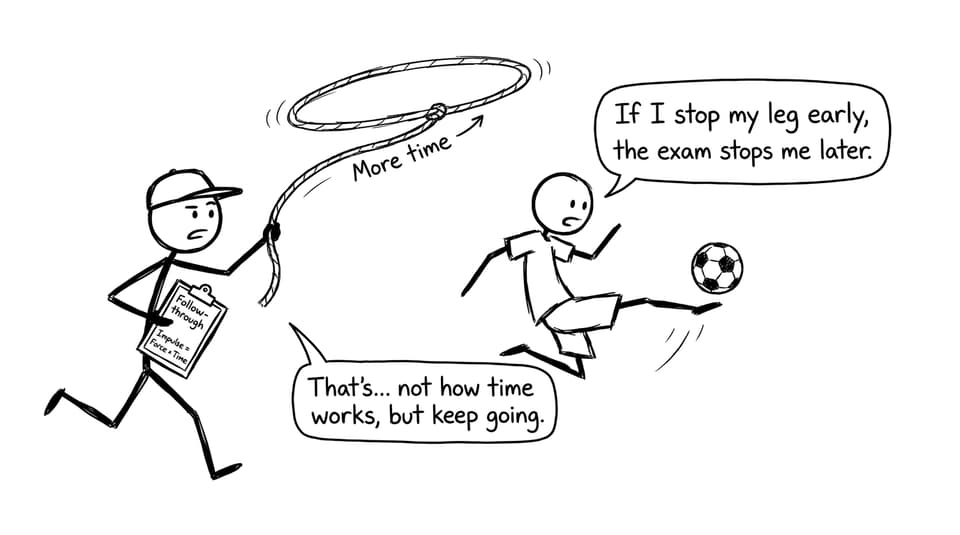
- Following through when kicking or throwing to increase impulse
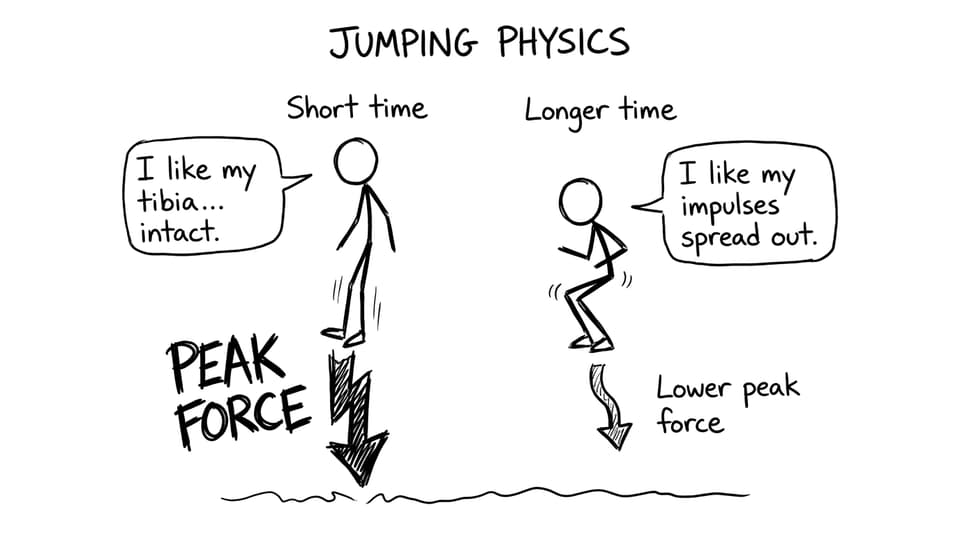
- Bending knees when landing to increase time and reduce force
- Using soft hands when catching to slow an object over time
These techniques improve performance and reduce injury risk by controlling how force is applied.
Momentum, Impulse, and Injury Prevention
Impulse is particularly important for injury prevention. Increasing the time over which force is applied reduces peak force on the body.
This explains why:
- Gymnasts bend joints when landing
- Athletes roll after falling
- Protective equipment increases stopping time
In IB SEHS, linking impulse to injury prevention is a common exam requirement.
Exam Relevance for IB SEHS
Momentum and impulse questions often require applied explanations rather than definitions. High-mark answers clearly describe how force, time, and motion interact in sporting contexts.
Avoid stating formulas without explanation or application.
RevisionDojo Call to Action
If momentum and impulse feel abstract or difficult to apply, RevisionDojo helps IB SEHS students master forces and motion with clear explanations and exam-style practice. It is the most effective way to turn physics concepts into confident exam answers.
Frequently Asked Questions (FAQs)
What is momentum in IB SEHS?
Momentum is the quantity of motion an object has and depends on its mass and velocity.
How does impulse affect performance?
Impulse determines how much momentum changes when a force is applied over time, influencing speed, control, and safety.
How are momentum and impulse tested in IB SEHS exams?
Students are often asked to apply these concepts to collisions, striking actions, or injury prevention scenarios.