Electronegativity feels like it should rise as you go down a group. More protons, stronger nucleus, right?
Then you look at fluorine vs iodine and the whole story flips. Suddenly the bigger atom seems less “hungry” for electrons, not more. In IB Chemistry, that confusion is a gift: examiners love trends that can be explained by simple forces you can actually picture.
What electronegativity means in IB Chemistry
In IB Chemistry, electronegativity is the ability of an atom to attract the shared pair of electrons in a covalent bond. It is not a direct measurement in the Data Booklet sense; it is a model (often the Pauling scale) that helps you predict:
-
bond polarity
-
molecular polarity
-
bond type as a continuum
-
reactivity patterns across the periodic table
If you want a quick refresher that matches the syllabus language, read Electronegativity Explained Simply for IB Chemistry.
Quick exam checklist: the “down a group” explanation
When a question asks why electronegativity decreases down a group, a high-scoring IB Chemistry answer usually hits these points:
-
atomic radius increases (bonding electrons are farther from the nucleus)
-
shielding increases (inner shells block nuclear attraction)
-
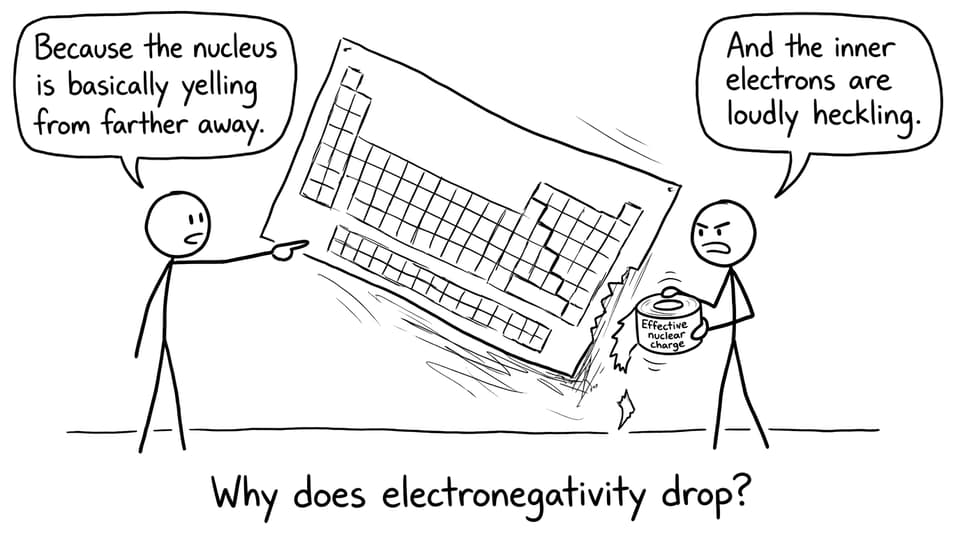
effective nuclear charge felt by valence electrons decreases
-
orbitals become more diffuse, so overlap can be weaker
To practise writing this in exam style, use the IB Chemistry 3.2 Periodic Trends Questionbank.
Why electronegativity decreases down a group
Atomic radius increases, so the nucleus pulls from farther away
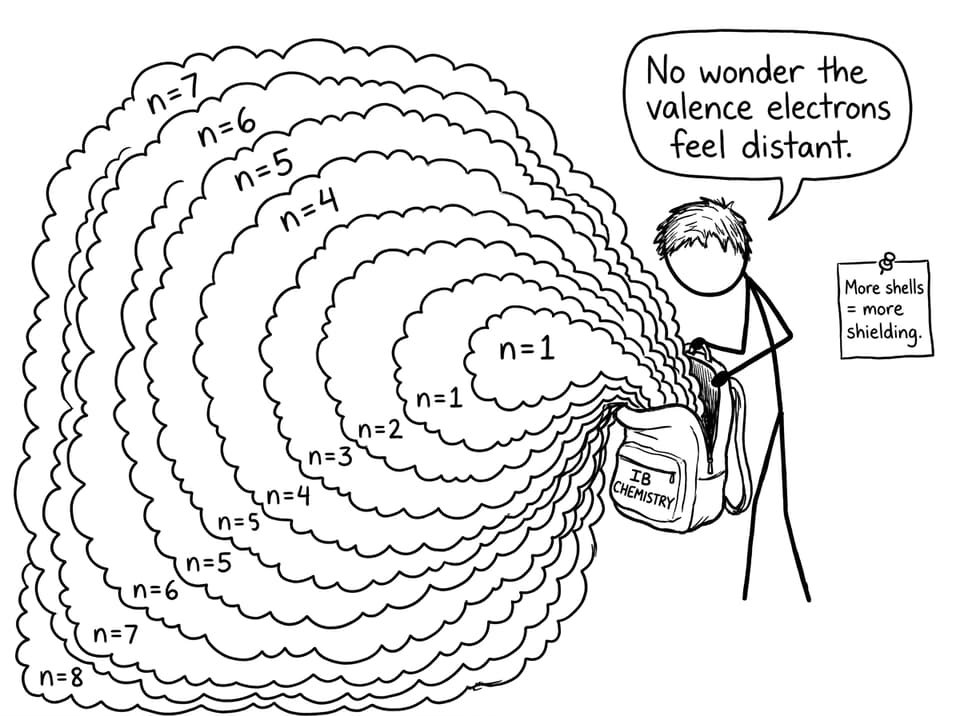
Down a group, each element gains an extra electron shell. That means the bonding electrons (and any electron density being attracted) sit, on average, further from the nucleus.
Electrostatic attraction drops with distance. So even if the nucleus has more protons, its pull is spread across a larger space. In IB Chemistry, you can phrase this as: increased atomic radius reduces attraction between the nucleus and the bonding pair.
If atomic size is still fuzzy, this pairs well with What Is the Periodic Trend for Atomic Radius?.
Shielding increases, reducing effective nuclear charge
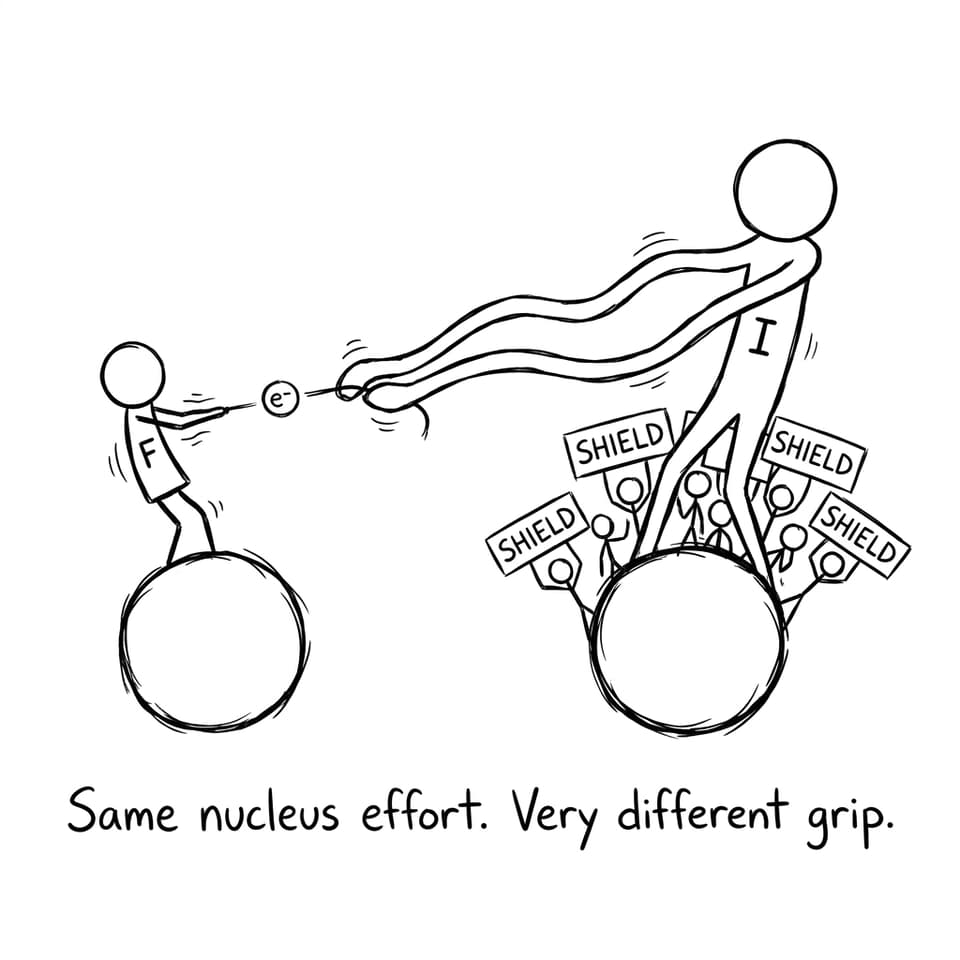
Every step down a group adds a full inner shell (or more). Those inner electrons repel and shield the outer electrons from the full attractive force of the nucleus.
So yes, nuclear charge increases, but shielding increases a lot too. The result is lower effective nuclear charge felt by the valence shell, so the atom is less able to pull bonding electrons toward itself. This is the central “why” behind the trend in IB Chemistry.
For a broader periodicity hub you can revise from, use IB Chemistry 3.2 Periodic Trends.
Orbitals get more diffuse, so overlap can weaken
Lower down a group, valence electrons occupy higher-energy orbitals. These orbitals are more spread out (diffuse), which can reduce effective overlap with another atom’s orbital.
Less overlap often means the shared electron density is not held as tightly toward one nucleus. In IB Chemistry, that helps connect a trend question to bonding language, not just “bigger atom” language.
If you want to connect electronegativity directly to polarity marks, read Electronegativity and Bond Polarity Explained and then IB Chemistry S2.2.5 Bond Polarity Notes.
Why this trend matters for bonding and reactivity
This is not trivia. In IB Chemistry, decreasing electronegativity down a group shapes real predictions:
-
Halogens become weaker oxidizing agents down the group (harder to attract an electron).
-
Metals become more metallic down a group (easier to lose electrons, lower attraction).
-
Bond polarity patterns shift when you swap one element for a heavier one in the same group.
To connect trends to real reaction behaviour, review Reactivity of elements based on periodic trends.
Wrap-up: how to turn this into marks fast
When you see “Why does electronegativity decrease down a group?” in IB Chemistry, aim for a calm chain of logic: bigger atom, more shielding, lower effective nuclear charge, weaker attraction for bonding electrons.
If you want this to feel intuitive rather than memorized, RevisionDojo is built for exactly that: revise the concept with Study Notes, then drill it with the Questionbank, lock it in with Flashcards, and use AI Chat plus Grading tools to polish exam phrasing. When you are ready to pressure-test your understanding, build Mock Exams and use Predicted Papers to practise timing. And if you want a human to review your reasoning, the Tutors and Coursework Library are there to support you.
Keep the trend simple. Keep the wording precise. That is how IB Chemistry rewards you.

