
Atomic radius feels like it should be simple. Bigger atomic number, more electrons, bigger atom. Then you look at period 2 and watch lithium start large, then shrink step-by-step until neon, and your brain quietly asks: “Am I the problem?”
In IB Chemistry, that moment is a gift. Atomic radius is one of the first trends that turns the periodic table from a poster into a story about forces: attraction, shielding, and how far the nucleus can “reach” through layers of electrons. Once that story clicks, a lot of other IB Chemistry topics (bonding, electronegativity, ionization energy, reactivity) stop feeling like separate facts and start behaving like one system.
Atomic radius trend (the exam-ready takeaway)
If you only memorise one thing for IB Chemistry, make it this:
-
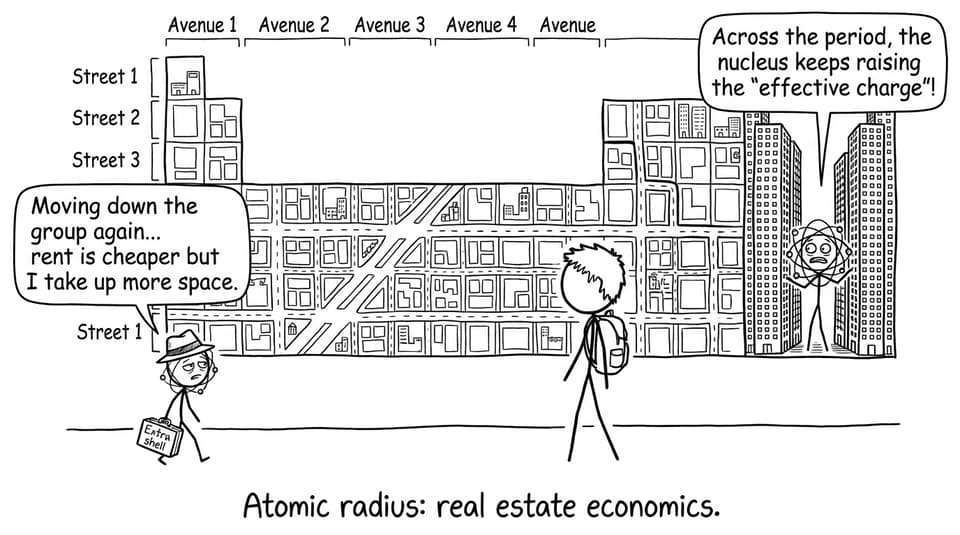
Across a period (left to right): atomic radius decreases
-
Down a group (top to bottom): atomic radius increases
Then, attach the “why” to those two lines:
-
Across a period: effective nuclear charge increases while shielding changes little
-
Down a group: new shells and more shielding outweigh increased nuclear charge
If you want a clean syllabus-aligned place to practise these explanations, the IB Chemistry 3.2 Periodic Trends Questionbank is built for exactly the kind of short, mark-efficient reasoning IB examiners reward.
What does “atomic radius” actually mean in IB Chemistry?
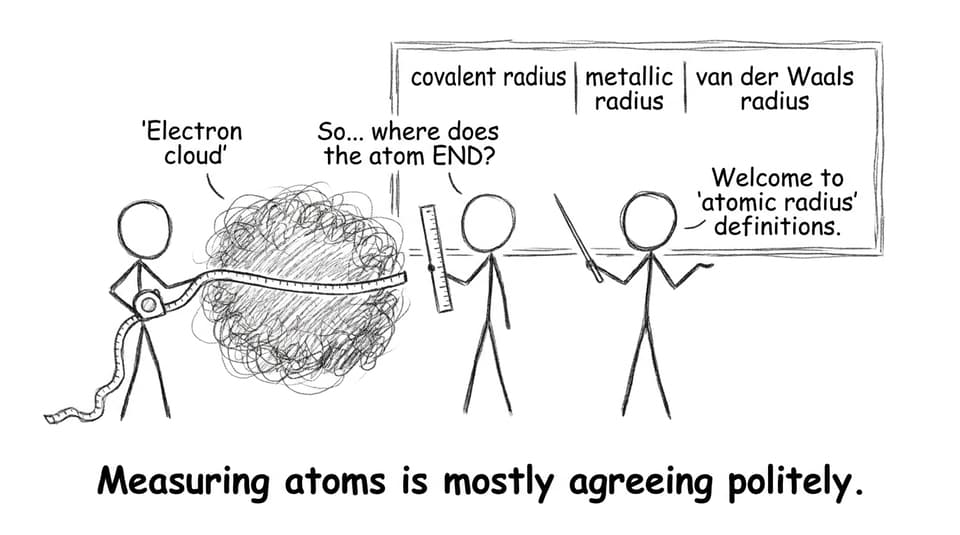
In real life, atoms don’t have neat edges. Electrons live in probability clouds, so “radius” depends on how you choose to measure it. In IB Chemistry, you may see references to different definitions (covalent radius, metallic radius, van der Waals radius), but for periodic trends questions, the skill is usually comparative: which atom is bigger and why.
A useful support when you’re writing definitions under time pressure is the IB Chemistry Key Definitions glossary. It keeps wording tight enough for marks.
Why atomic radius decreases across a period
Moving left to right across a period, three things happen in a predictable pattern:
Nuclear charge increases
Each element has one more proton than the previous one. More protons means stronger attraction between nucleus and electrons.
Electrons are added to the same energy level
Across a period, the valence electrons are filling the same principal shell (same main energy level). That means the average distance of the outer shell doesn’t jump outward.
Shielding stays nearly constant
Because you are not adding a new inner shell, the “blocking” effect from inner electrons doesn’t increase much. So the outer electrons feel a stronger pull overall.
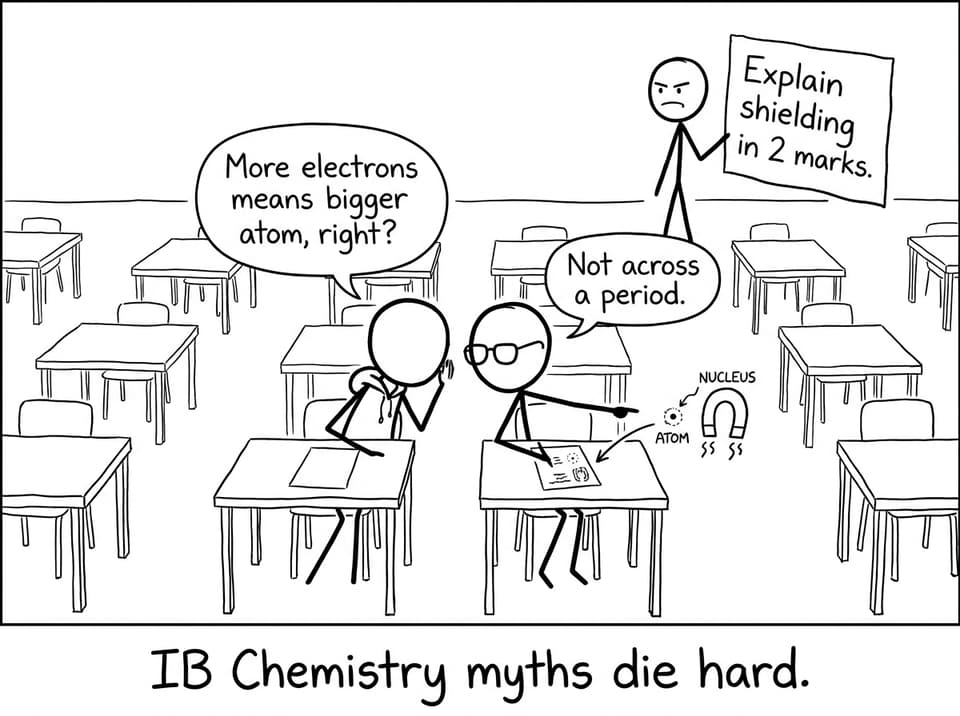
Put together, effective nuclear charge (Zeff) rises across the period, tugging the electron cloud inward. Result: smaller atomic radius.
For a deeper, step-by-step explanation you can mirror in long responses, see Why Atomic Radius Decreases Across a Period.
IB Chemistry exam phrasing you can reuse
When asked to “explain” the trend, a high-scoring structure is:
-
Nuclear charge increases across the period (more protons)
-
Electrons are added to the same shell so shielding is almost unchanged
-
Effective nuclear charge increases
-
Stronger attraction pulls electrons closer
-
Atomic radius decreases
That chain is short, logical, and very IB Chemistry-friendly.
Why atomic radius increases down a group
Down a group, the nucleus also gains protons. So why does the atom get bigger?
New shells are added
Each step down adds a new principal energy level. The valence electrons are now, on average, farther from the nucleus.
Shielding increases a lot
Inner electrons in the new shells repel and shield the valence electrons, reducing the pull felt from the nucleus.
So even though nuclear charge increases, the combination of greater distance and greater shielding dominates. Result: larger atomic radius.
If you want a focused explanation for “down a group” questions, use IB Chemistry: Why Atomic Radius Increases Down a Group.
The hidden engine behind the trend: shielding and Zeff
Many IB Chemistry students revise trends as separate flashcards: radius, electronegativity, ionization energy. But there’s a calmer way to think.
Imagine the nucleus as a signal trying to reach the outer electrons.
-
Across a period, the signal gets stronger (more protons) and the walls don’t get thicker (little extra shielding).
-
Down a group, the signal gets stronger, but the walls get much thicker (more inner shells), and the receiver is farther away.
That perspective is especially useful when a question mixes trends together. For example, “Explain why electronegativity decreases down group 17” becomes easier if you already believe the nucleus can’t “reach” as well.
For more on how shielding changes chemical behaviour across topics, read IB Chemistry: Electron Shielding and Chemical Behavior.
A quick application checklist (how marks show up)
Here’s where atomic radius quietly appears in IB Chemistry assessment-style thinking:
-
Bonding explanations (smaller atoms often form shorter, stronger bonds)
-
Ionic vs atomic size comparisons (cations smaller, anions larger)
-
Reactivity trends (especially group 1 metals and group 17 halogens)
-
Data booklet interpretation (spotting patterns, justifying anomalies)
-
Multi-trend questions (radius linked to ionization energy/electronegativity)
To practise using the periodic table like a tool, not a decoration, use How to Use the IB Periodic Table in Exams and Revision.
And if you want a structured home base for everything atomic structure and periodicity in IB Chemistry, start from IB Chemistry Atomic Structure.
How to revise atomic radius efficiently (RevisionDojo method)
Atomic radius is not learned by rereading. It’s learned by explaining it cleanly, then proving you can apply it.
A simple loop that works well for IB Chemistry:
-
Read the relevant Study Notes inside IB Chemistry Resources
-
Do a short targeted set in the IB Chemistry 3.2 Periodic Trends Questionbank
-
Turn your two most common mistakes into Flashcards (one idea per card)
-
Use AI Chat to clarify what you still can’t explain in one paragraph
-
Finish with a timed mixed set or a Mock Exam block to build speed and calm
If your broader study routine feels scattered, How to Study for IB Exams: Step-by-Step Guide is a good reset.
Closing: make the periodic table feel predictable
The periodic trend for atomic radius is not a trivia fact in IB Chemistry. It’s a habit of reasoning: nuclear charge vs shielding, distance vs attraction, and the quiet power of effective nuclear charge. When you can explain why radius decreases across a period and increases down a group, you’re not just ready for one question type. You’re building the logic that supports bonding, reactivity, and several other trend questions.
If you want to turn that logic into exam performance, RevisionDojo is designed for the full cycle: Study Notes for clarity, Flashcards for recall, a Questionbank for exam-style practice, AI Chat for fast explanations, Grading tools and the Coursework Library for coursework stress, plus Predicted Papers, Mock Exams, and Tutors when you need a sharper edge. Start with periodic trends today, then keep looping until IB Chemistry starts to feel predictable.