

A small number that quietly steals marks in IB Math
In IB Math, there’s a moment that happens every exam season: a student compares two data sets, sees a smaller standard deviation, and writes “therefore it is better.” It feels neat. It feels safe. It’s also where interpretation marks quietly disappear.
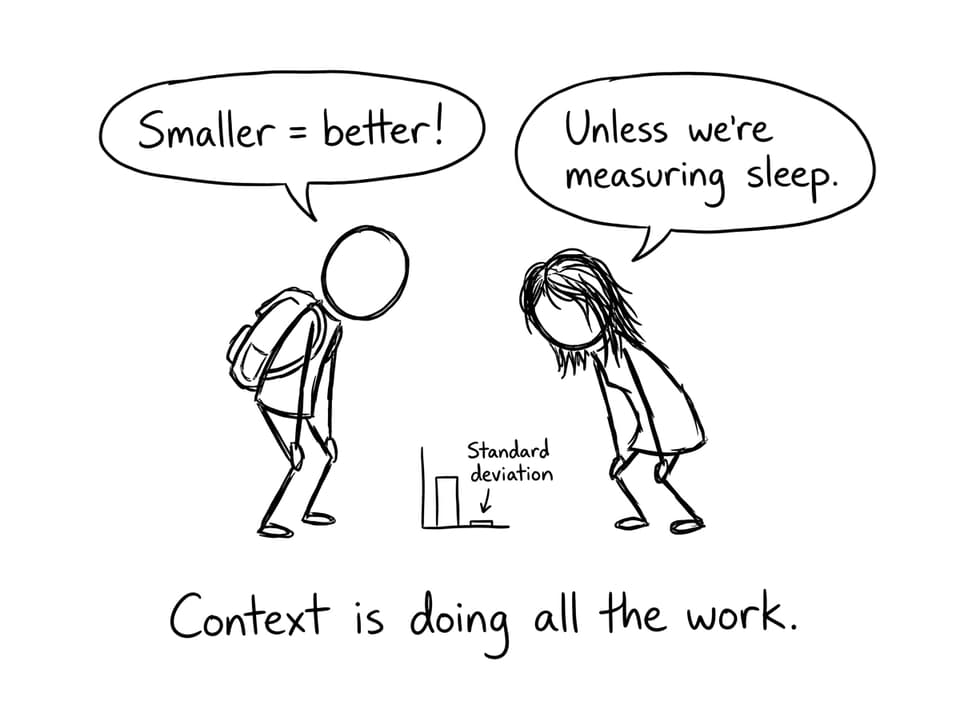
Standard deviation is a measure of variability, not a trophy. It tells you how tightly values cluster around the mean. It does not tell you whether the outcomes are good, desirable, or useful. In IB Math, “better” is never a default. It’s always a judgement, and judgement requires context.
Quick checklist: how to talk about standard deviation in IB Math
Use this mini-checklist whenever you compare distributions in IB Math:
-
State what the standard deviation says: more/less spread.
-
Compare it with the mean (and sometimes median/IQR).
-
Decide whether consistency helps or harms in this context.
-
Use cautious language: “more consistent,” “more predictable,” “less variable.”
-
Finish with a context-based conclusion (not a ranking).
For extra practice on these exact skills, work through Statistics & Probability resources in the IB Math AA hub and the IB Math AI hub.
What a low standard deviation really means (and what it doesn’t)
A low standard deviation means data points sit close to the mean. In plain language: results are consistent.
That consistency can be wonderful when you need reliability. But in IB Math, you must separate two ideas:
-
Consistency (low spread)
-
Desirability (high/low mean, good/bad outcomes)
A data set can be consistently awful. Another can be slightly messy but mostly strong. The exam wants you to notice the difference.
If you want a clean refresher on the definitions and interpretation language, pair your revision with Statistics & Probability notes for IB Math AA.
Why “lower is better” is such a tempting trap in IB Math
In many classroom examples, low variability is presented like a win: tighter manufacturing tolerances, repeatable experiments, stable processes. Students internalise a shortcut: “smaller SD = better.”
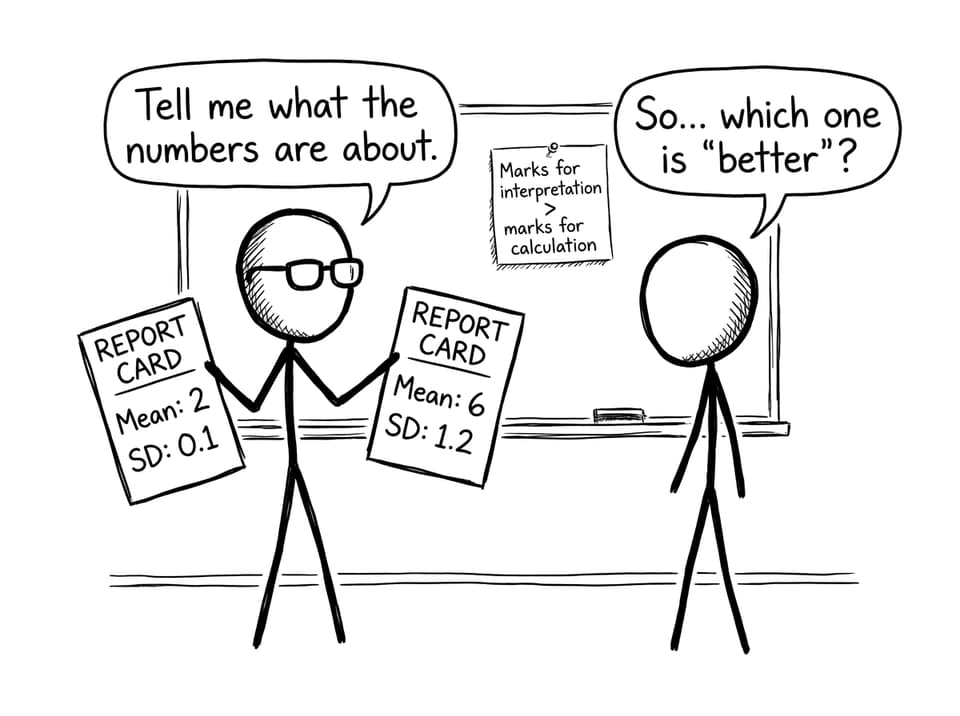
But IB Math (especially Applications & Interpretation) is designed to test decision-making, not slogan-writing. This is the same reason interpretation often earns more marks than calculation: the calculator can find SD instantly; only you can explain what it means. If this is a frequent pain point, read Why interpretation is graded more than calculation in IB Math statistics.
When low standard deviation actually is “better”
Low standard deviation is genuinely valuable when the goal is reliability and the mean is already acceptable.
Examples that fit examiner logic in IB Math:
-
Quality control: products should match a target size or mass.
-
Medicine dosage outcomes: less variation can mean fewer risky extremes.
-
Repeated measurements: tighter clustering can imply a more precise method.
In your write-up, the key is to name the benefit: lower spread means more predictable outcomes, which matters because...
To drill this with exam-style prompts, use targeted sets from RevisionDojo’s Questionbank and topic practice like Mean and standard deviation (SL 4.3) questions.
When low standard deviation is not “better” (and may be worse)
Low spread can mislead you when the mean is undesirable. A class scoring consistently low on a test can have a small standard deviation. That doesn’t make the performance “better.” It just makes it consistently poor.
Low spread can also be unhelpful when variation is the point. If a company wants innovation, a uniform set of outcomes might signal stagnation. If you’re comparing two study methods, a slightly higher spread with a higher mean could be preferable, depending on what “success” means.
In IB Math, you can protect marks by writing: “Data set A is more consistent (lower SD), but since the mean is lower, this consistency may not be desirable in this context.”
If you want to broaden your comparison language beyond SD, revise measures like IQR too: Why IQR can matter more than range in IB statistics.

Exam writing formula for IB Math: a sentence template that works
Try this three-part structure:
-
Compare: “A has a lower standard deviation than B.”
-
Interpret: “So A’s values are more tightly clustered around the mean (more consistent).”
-
Judge in context: “This is beneficial/not beneficial because... (reference mean, risk, reliability, purpose).”
For IB Math AI students using tech-heavy questions, this workflow also pairs well with How to interpret data in IB Math AI using technology.
The takeaway: IB Math rewards judgement, not slogans
In IB Math, a low standard deviation is a description, not a medal. Sometimes consistency is exactly what you want. Other times it’s just a tighter cluster around a disappointing mean. The difference is context, and context is where exam marks live.
If you want to turn this into reliable exam performance, make RevisionDojo your practice loop: revise with Study Notes, lock in language with Flashcards, train decisions with the Questionbank, get unstuck fast with AI Chat, and pressure-test your timing with Mock Exams and Predicted Papers. When your explanations start sounding like calm, justified judgement, IB Math questions stop feeling like traps and start feeling like signals you know how to read.