

If you’ve ever finished an IB Math Topic 4 statistics question feeling proud of your perfectly punched calculator output, then opened the markscheme and felt…betrayed, you’re not alone.
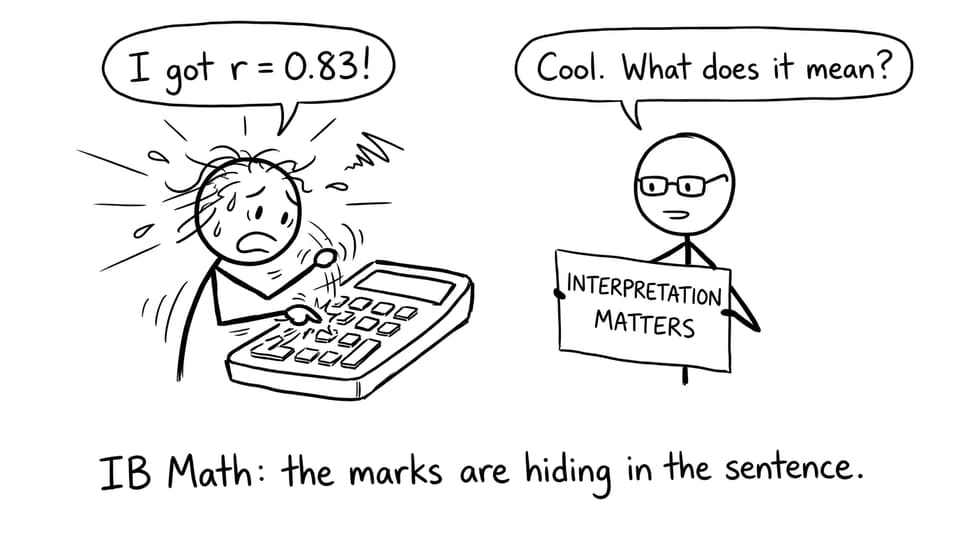
In the moment, it feels like math should reward the hard part: the regression equation, the correlation coefficient, the standard deviation. But in IB Math, especially Statistics, the grade often hides in the quieter skill: explaining what your result means and what it doesn’t mean.
The real reason IB Math rewards interpretation
Statistics in IB Math isn’t treated like a factory that produces numbers. It’s treated like a language that describes reality. Numbers are just the vocabulary. Interpretation is the sentence.
Examiners are looking for evidence that you can:
-
connect results to context (units, variables, scenario)
-
judge strength and reliability (sample size, outliers, bias)
-
communicate cautiously (no overclaims)
If you want a clean syllabus-aligned place to practise these ideas, start with AI Statistics and Probability notes and questions.
Quick checklist: what to write after every calculation
Before you move on, add 1–3 lines that do the following:
-
State what the value shows in context
-
Describe strength (e.g., weak/moderate/strong) where relevant
-
Mention at least one limitation (outliers, small sample, correlation not causation)
-
Use cautious phrasing: “suggests,” “may indicate,” “in this sample”
This is the exact habit that turns “2/6 even though I calculated everything” into full marks in IB Math.
Why calculation marks are smaller (and why that’s fair)
A good way to see this: calculation is easier to outsource.
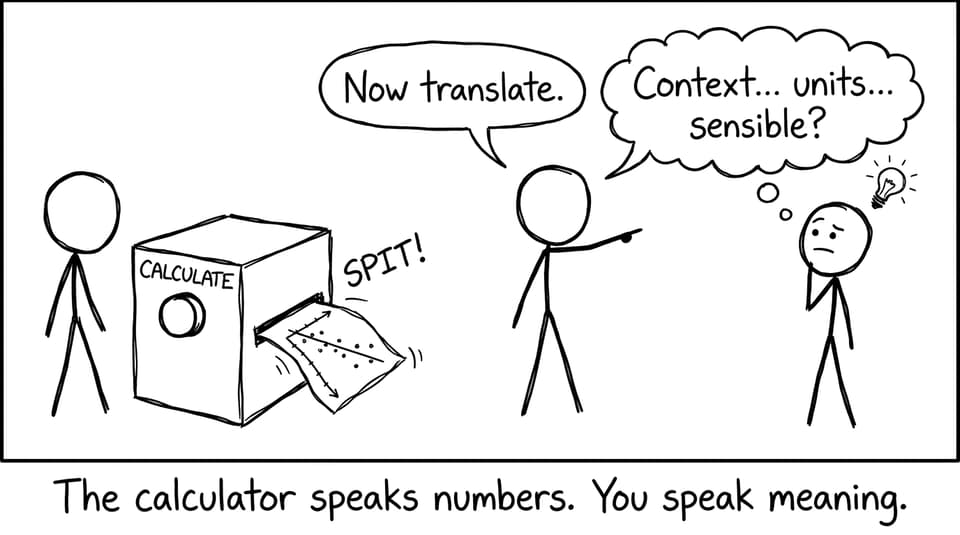
Your GDC can compute Pearson’s r instantly. It can fit a regression line in seconds. In modern data work, that’s normal. So IB Math shifts assessment toward the part technology can’t do well: judgement.
That’s also why RevisionDojo leans into understanding-first tools: the Statistics and Probability Questionbank gives you exam-style prompts where the “explain” marks are the whole game, and solutions model the wording that earns credit.
Where interpretation dominates in IB Math Topic 4
Interpretation tends to carry the most weight in:
Correlation and regression in IB Math
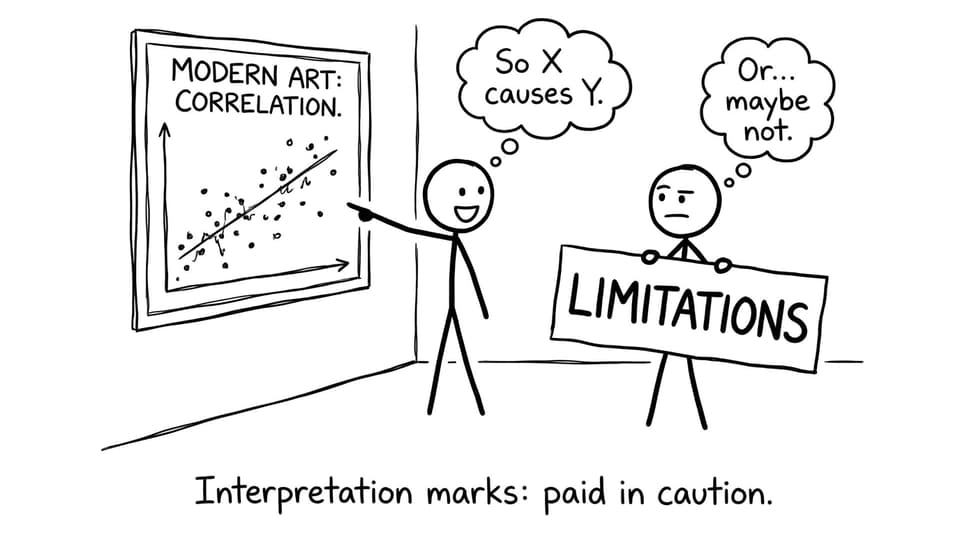
A correlation coefficient without commentary is basically a phone number without a name.
In Paper-style questions, you’re expected to interpret:
-
direction (positive/negative)
-
strength (how close to 1 in magnitude)
-
what it suggests about the relationship in context
-
what it cannot prove (especially causation)
To train this precisely, practise with SL 4.4 Correlation of Data and then test yourself in the matching Correlation Questionbank set.
Averages, spread, and outliers in IB Math
The mean is easy to compute. The choice of mean is harder.
A classic examiner move is giving data where the mean is distorted by an outlier and waiting to see if you notice. If you want a crisp reminder of how to talk about that, read Why the mean is sensitive to extreme values.
Reliability and sampling in IB Math
Sometimes the best interpretation mark is a single line: “The sample may be biased, so conclusions might not generalise.”
RevisionDojo’s SL 4.1 Introduction to Statistics notes are especially useful here because they give the exact vocabulary IB expects (population, sample, bias, reliability).
How to write like an examiner wants (without writing a paragraph)
In IB Math, interpretation isn’t “opinion.” It’s structured reasoning.
A strong template is:
“This value suggests __ (relationship/typical value) __ in the context of __. However, because __ (limitation) __, the conclusion should be treated with caution.”
If you’re revising fast, pair that with the AI Data Booklet so your formulas and definitions stay sharp under pressure.
Conclusion: where your next IB Math marks are hiding
In Topic 4, IB Math isn’t trying to trick you. It’s trying to measure the skill that actually matters: turning outputs into judgement. The calculator gives numbers. You supply meaning, caution, and context.
If you want a single system to practise this the right way, RevisionDojo is built for it: use Study Notes to learn the language of interpretation, the Questionbank to rehearse exam-style prompts, Flashcards for definitions, AI Chat for instant feedback on your wording, and Grading tools, Predicted Papers, and Mock Exams to pressure-test your explanations before the real exam. When interpretation is worth more than calculation, your preparation should be too.