
A global hub is rarely an accident
On a map, a global hub can look like a simple dot: a city name in bold, a port symbol, a flight path spiderweb. In real life, it feels like a place where time moves faster: emails land instantly, money circulates hourly, and a delayed train somehow becomes international news.
In IB Geography, global hubs sit at the heart of Power, Places and Networks: they are the places where flows (trade, finance, information, people) concentrate, amplify, and sometimes collide. The exam question is quietly human: why do some places become global hubs while others stay peripheral?
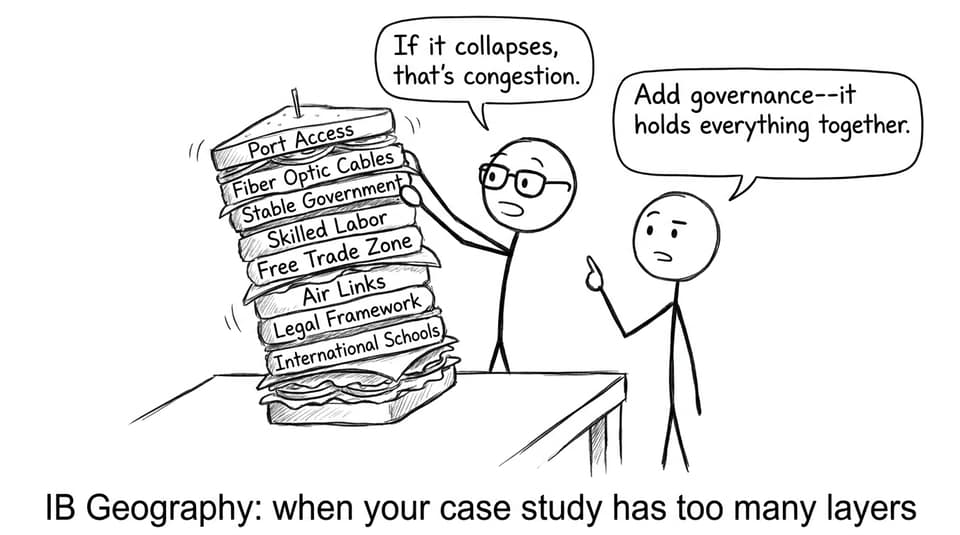
IB Geography quick checklist: the hub recipe
Use this mini-checklist to build any exam answer fast in IB Geography:
-
Strategic location (coasts, chokepoints, corridors, gateways)
-
Transport connectivity (ports, airports, rail, logistics)
-
Digital connectivity (data centers, fiber routes, telecom reliability)
-
Economic specialization (high-value services, command and control)
-
Agglomeration economies (clusters, skilled labor pools, suppliers)
-
Governance and stability (rules, trust, predictability)
-
Costs and consequences (inequality, congestion, environmental pressure)
To revise the wider unit, keep the core concepts close via IB Geography Power, Places and Networks and the matching Power, Places and Networks Notes.
Strategic location: geography still matters
A hub often starts as an advantage you can’t easily copy. Deep-water access, a coastal site on major shipping lanes, or a position along a continental corridor lowers transport time and cost. In IB Geography, this is where you link site and situation to flows: better access means more interactions, and more interactions attract more investment.
A simple evaluation line you can use: location creates initial advantage, but connectivity and governance decide whether it lasts.
Connectivity: ports, planes, and bandwidth
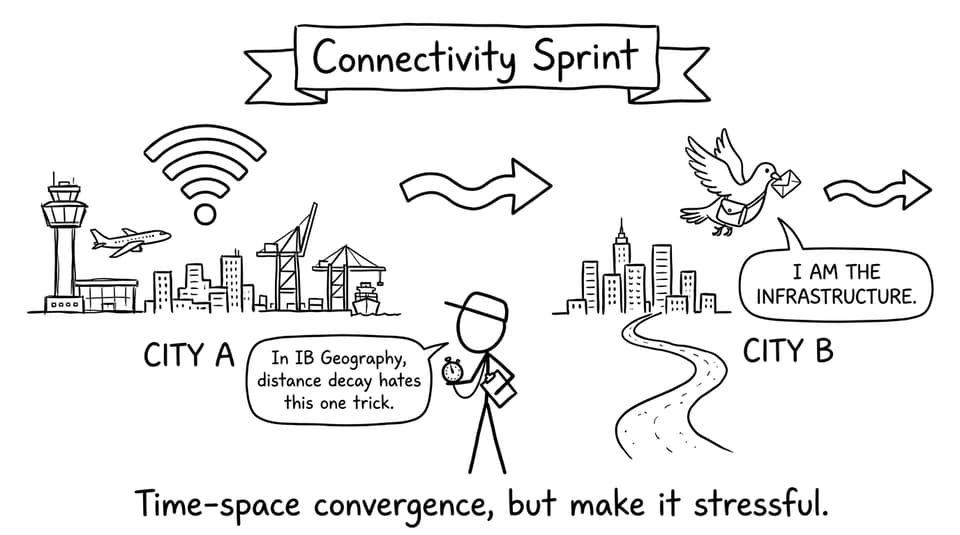
Global hubs are not just “well connected”; they are built to reduce friction. Airports with global networks, efficient ports, intermodal rail, and reliable logistics make flows predictable. Digital networks matter just as much: fast, redundant connections allow finance, media, and services to operate in real time.
If you want a clean way to phrase this in IB Geography, borrow the language of time-space convergence and distance decay from Technological Innovation and the “Shrinking World”.
Economic clustering: why success pulls in more success
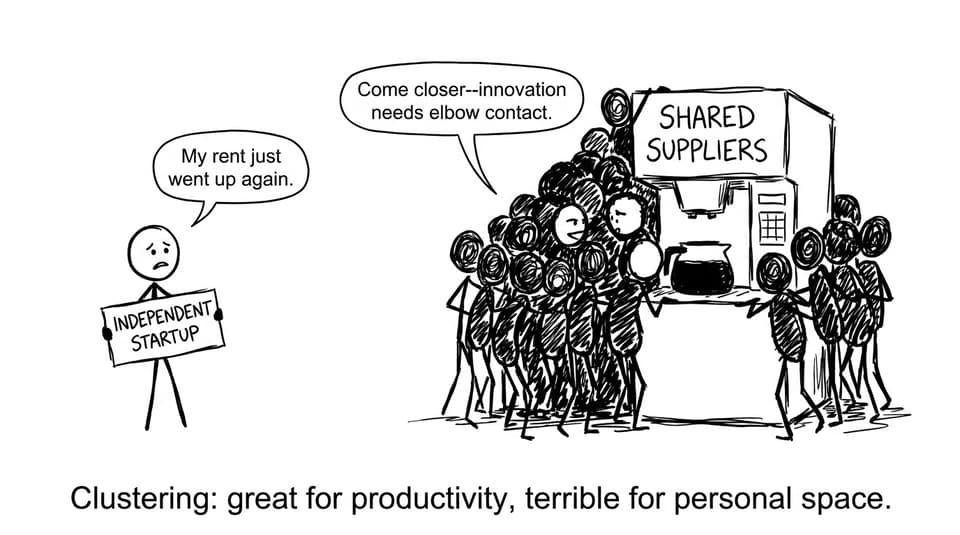
Once firms start concentrating, the place becomes useful in a new way. Suppliers move closer. Skilled workers follow opportunity. Knowledge spreads through proximity and competition. These are agglomeration economies, and they explain why hubs can keep growing even when they become expensive.
In your IB Geography answers, make the chain explicit: connectivity attracts firms -> firms cluster -> productivity rises -> hub influence expands. Then add a counterpoint: clustering also raises land values and social polarization.
Governance and soft power: trust is infrastructure
Businesses don’t only choose roads and runways. They choose rules. Political stability, credible legal systems, transparent regulation, and openness to international markets reduce risk. That “boring” reliability becomes a magnet.
And then there’s soft power: universities, media, culture, and diverse communities that make a hub legible to the world. For related globalization framing, see To What Extent Does Globalisation Benefit All Countries? and How Does Globalisation Impact Local Cultures?.
Exam tip: turn this into a 9/9 structure fast
When you practice in IB Geography, use:
-
Point: A factor (e.g., strategic location).
-
Evidence/example: A realistic feature (port access, flight networks, fiber cables).
-
Explanation: Link to flows, network centrality, and power.
-
Evaluation: Costs, vulnerability to shocks, uneven development.
RevisionDojo helps you drill this structure with IB Geography Resources, targeted Global networks and flows Questionbank practice, and quick recall via Geography Flashcards and Power, Places and Networks Flashcards.
Closing: make the map feel like a story
Places become global hubs when advantages stack: geography enables access, connectivity multiplies flows, clustering compounds opportunity, and governance turns uncertainty into trust. That’s the heart of IB Geography here: networks are built, then they build back.
If you want this topic to feel automatic in the exam, revise it the way hubs grow: one connection at a time. Use RevisionDojo’s Questionbank, Study Notes, Flashcards, AI Chat, Mock Exams, Predicted Papers, Grading tools, Coursework Library, and Tutors to turn “global hubs” into a confident, exam-ready explanation in IB Geography.