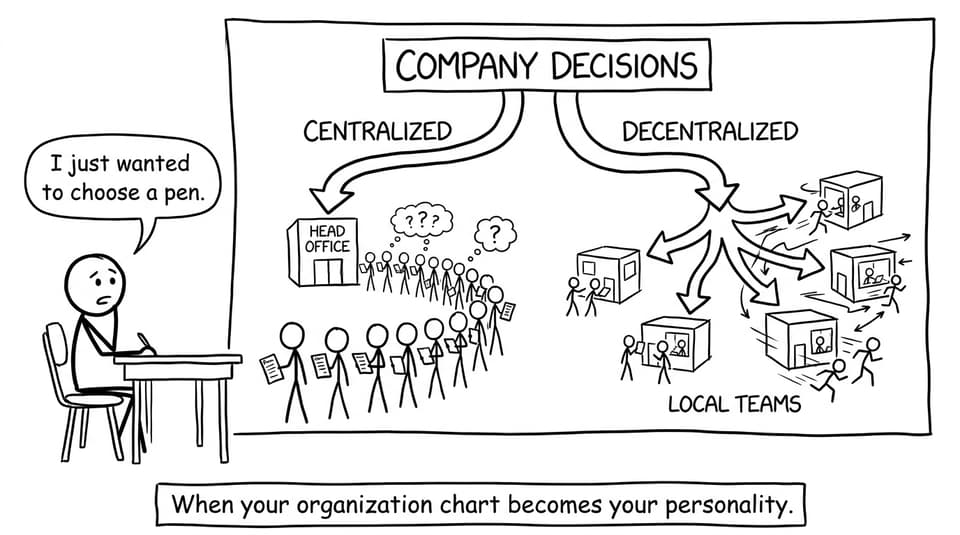
A coffee shop chain rolls out a new menu. In one version of the story, every store waits for head office approval before changing a single sign. In the other, local managers tweak prices by neighborhood and test new drinks on Tuesday. Same goal, totally different design.
In IB Business Management, that design choice is called centralized vs decentralized decision-making. And exam questions love it because it’s never “one is good, one is bad”; it’s about fit.
IB Business Management quick checklist: what pushes firms to centralize?
Use this mini-checklist when a case study asks why a business might centralize decision-making:
-
High risk or strict regulation (mistakes are expensive)
-
Need for consistent quality/brand across locations
-
Senior expertise is scarce (specialists at the top)
-
Efficiency and cost control are priorities
-
A tall hierarchy slows communication but strengthens oversight
If you need clean definitions for exam wording, keep the IB Business Management glossary open while you revise.
Why centralization works (and when it hurts)
Centralization means key decisions stay near senior management. In IB Business Management, you can frame the benefit as control: common policies, unified strategy, and fewer “random” decisions across departments.
A centralized business is often stronger at compliance, budgeting discipline, and protecting the brand. It also matches situations where knowledge is concentrated at the top.
But the trade-off is speed. Information travels up and down a hierarchy, and delay becomes a hidden cost. If the market changes quickly, a centralized system can feel like trying to steer a bus using email.
For the syllabus link, this sits right inside 2.2 Organizational structure and connects neatly to organization charts like tall vs flat structures.
Why decentralization helps agility (and when it fragments)
Decentralization pushes authority downward. Local or junior managers can make decisions closer to customers, staff, and real-time problems. In IB Business Management, that’s your angle for responsiveness and innovation.
It also links to motivation: when people feel trusted, they often take ownership, suggest improvements, and move faster without waiting for permission.
The downside is consistency. Different teams can interpret strategy differently, creating uneven quality or a confused brand image. Decentralized firms often need strong communication systems to avoid “five mini-companies inside one logo.”
To revise structure types that often pair with decentralization, see Notes: Types of organization charts (2.2.2).
The hybrid model: what most real businesses actually do
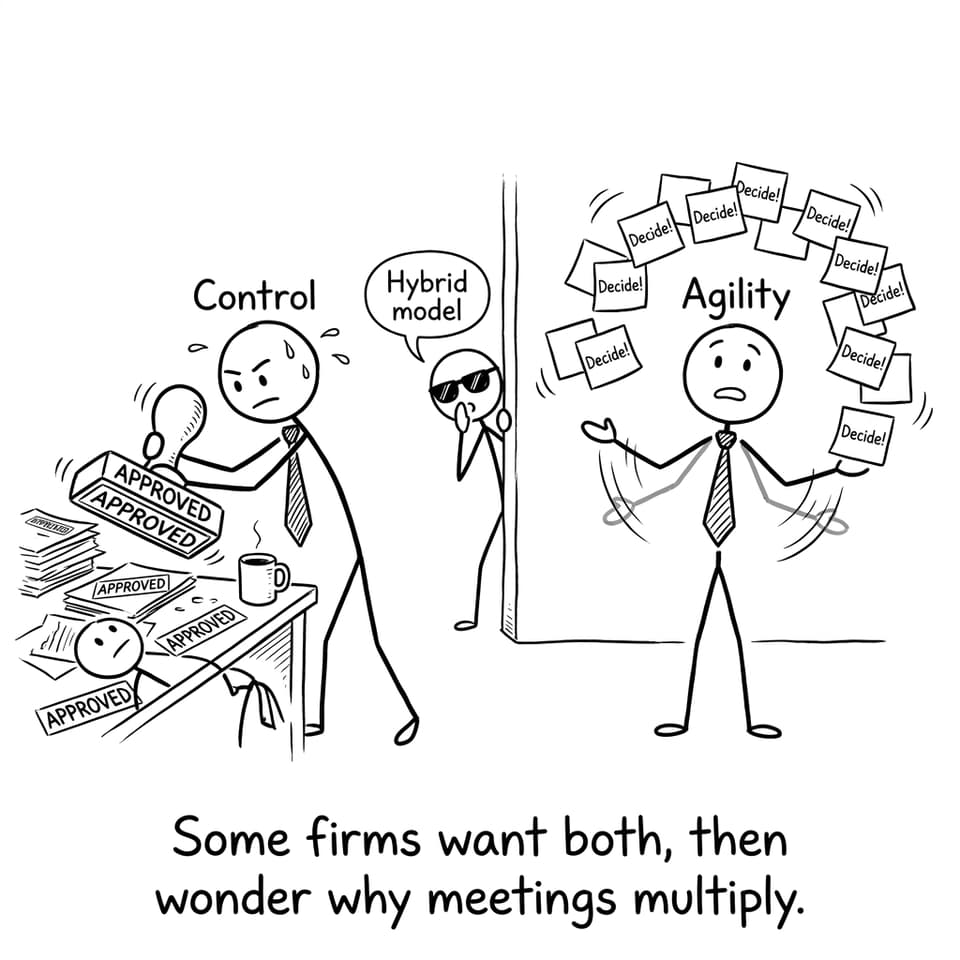
Many firms centralize “big” decisions (mission, finance limits, long-term strategy) and decentralize “local” decisions (staffing shifts, regional marketing, small process changes). This hybrid model is often the most realistic exam answer because it balances control with agility.
If you want a clean way to justify a switch in structure, connect it to environment and growth using Notes: Appropriateness of organizational structures (2.2.3).
Exam tip: how to score application marks fast
When you see centralization/decentralization in a case, do this:
-
State the choice (centralized/decentralized/hybrid).
-
Apply to the firm (size, locations, product risk, pace of change).
-
Give one advantage + one disadvantage linked to the case.
-
Conclude with a condition (“effective if…”, “less suitable when…”).
For practice, use the 2.2 Organizational structure Questionbank and check recall with the matching 2.2 Organizational structure Flashcards.
Conclusion: make the structure match the strategy
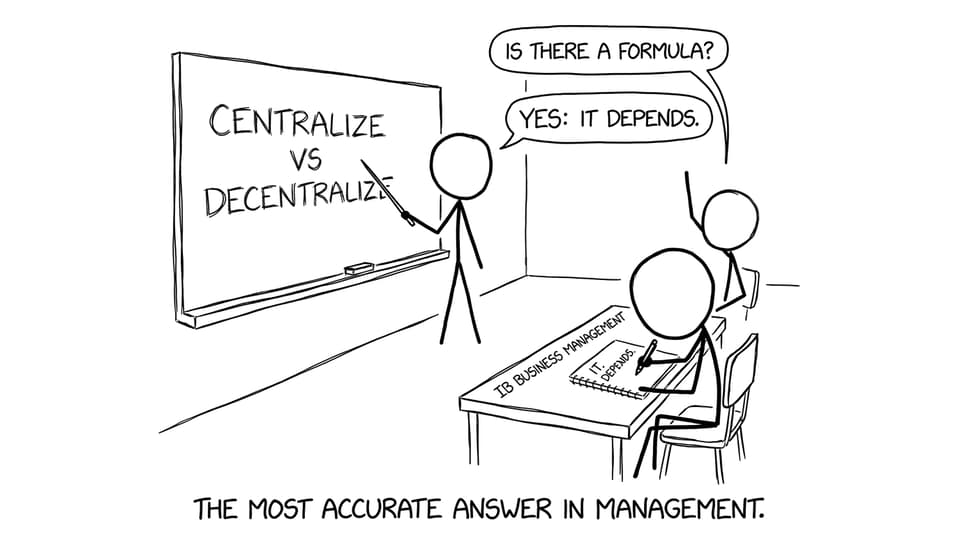
Centralization buys control. Decentralization buys speed. In IB Business Management, your best answers show how a company’s size, culture, risk level, and environment determine the right balance.
When you’re ready to practise this like the exam demands, RevisionDojo helps you close the loop: Study Notes for clarity, Flashcards for recall, Questionbank for application, AI Chat to challenge your reasoning, and Grading tools to tighten your structure. Explore the full IB Business Management hub and turn this topic into easy marks.

