

When “home” starts to feel too small
In IB Business Management, multinational companies can feel like a big, distant concept, until you notice how many everyday brands quietly outgrew their home market. A business doesn’t wake up one morning and decide to “go global” for fun. It usually happens when the local market starts to feel like a room with a low ceiling: sales flatten, competitors copy, costs rise, and growth begins to depend on a bigger map.
For exam success in IB Business Management, it helps to treat multinational expansion as a set of strategic motives (and trade-offs) you can apply to any case study.

Quick checklist: the five reasons companies go multinational
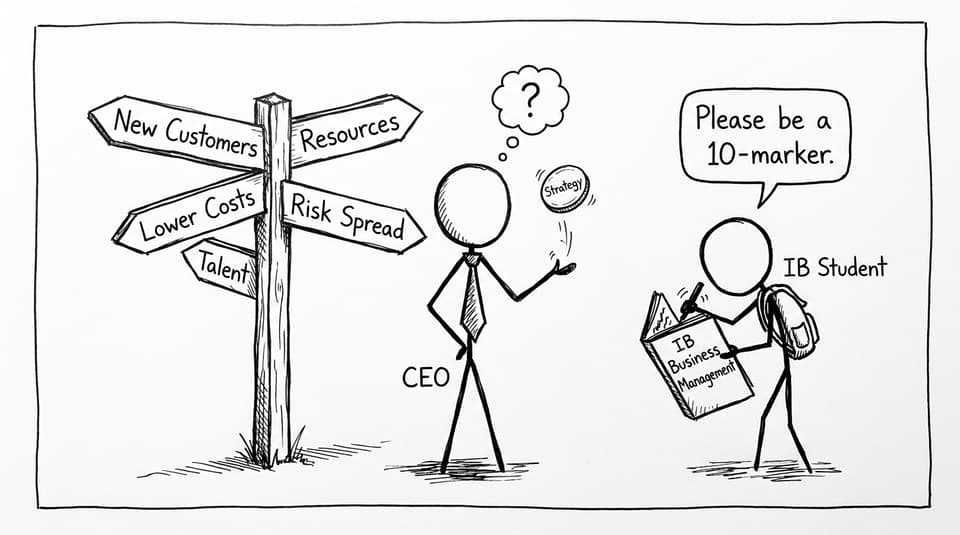
In IB Business Management, most “why become multinational?” answers can be built from five pillars:
-
Access larger markets (growth beyond domestic limits)
-
Reduce costs (labour, inputs, logistics, economies of scale)
-
Access talent (skills, knowledge clusters, innovation)
-
Secure resources and locations (raw materials, infrastructure, hubs)
-
Spread risk and build the brand (stability + credibility)
If you want the syllabus-aligned version, start with 1.6 Multinational Companies and the matching 1.6 Notes.
Access to larger markets: growth is the obvious reason
The cleanest motivation in IB Business Management is also the most human: businesses want more customers. Domestic demand can be small (think: small economies) or saturated (think: everyone already owns the product). Expanding internationally lets a firm scale revenue, increase market share, and reduce dependence on a single country.
For exam phrasing, link market growth to strategy tools: market development (Ansoff), market orientation, and long-term objectives. Then practise applying it under time using the 1.6 Questionbank.

Cost reduction: where efficiency becomes a location decision
In IB Business Management, cost reduction isn’t just “pay workers less.” Multinationals choose locations to lower total costs across the value chain: inputs, transport, energy, tax environments, and production efficiency. They can also gain economies of scale by producing for multiple markets, which may reduce average costs and widen profit margins.
In essays, balance this with evaluation: coordination costs rise too. Different regulations, supply chains, and quality standards can erase the savings if managed poorly.
Talent and knowledge clusters: hiring the world’s specialists
Some countries become magnets for specific skills: engineering, design, finance, advanced manufacturing. Multinationals go where the expertise lives, because talent is a competitive advantage that compounds over time.
For IB Business Management case study writing, connect talent access to innovation, productivity, and brand differentiation. If you need quick definitions you can reuse in answers, keep the IB Business Management Resources hub open while you revise.
Resources, logistics, and being close to the action
Multinationals often expand to get closer to:
-
Natural resources (inputs that are bulky or scarce)
-
Key suppliers and faster supply chains
-
Transport hubs and major trading routes
-
Customers (to reduce delivery time and increase responsiveness)
This is where application marks live: don’t say “resources” in general. Say which resource, where, and why it changes the firm’s costs or speed.
Risk diversification and global brand strength
Operating in multiple countries can stabilise overall performance. If one market faces an economic slowdown, currency shifts, or political change, revenue from other regions can soften the hit. That risk spread is a strategic motive in IB Business Management, but it is never risk-free; firms also face new political and legal risks abroad.
At the same time, multinational presence can strengthen a brand. Being “everywhere” signals credibility to customers, suppliers, and investors.
For a fuller discussion of benefits and downsides, see How do MNCs affect local economies positively and negatively.
A final exam tip: turn motives into application
In IB Business Management, “why become multinational?” is rarely a memory test. It’s a decision question. Use one motive as your main argument, apply it to the case facts, then evaluate the risks and feasibility.
To practise the same skill with feedback loops, use RevisionDojo’s Questionbank, Study Notes, and Flashcards, then tighten your judgment using AI Chat and the Grading tools. When you’re ready to simulate exam pressure, build timed practice with Predicted Papers and Mock Exams from the RevisionDojo Business Management hub.