RevisionDojo was developed independently of the IBO and as such is not endorsed by it in any way.
If you have ever stared at a DNA replication diagram in IB Biology and thought, “Surely the cell could just… begin,” you have met one of biology’s quiet constraints: enzymes are picky. They do not bend because you are in a hurry. And DNA polymerase, the star of replication, refuses to take the very first step.
That stubbornness is exactly why DNA replication needs RNA primers. A primer is not an optional accessory; it is the chemical starting handle that lets polymerase do its job. Once you see the logic, a lot of exam questions feel less like memorization and more like cause-and-effect.
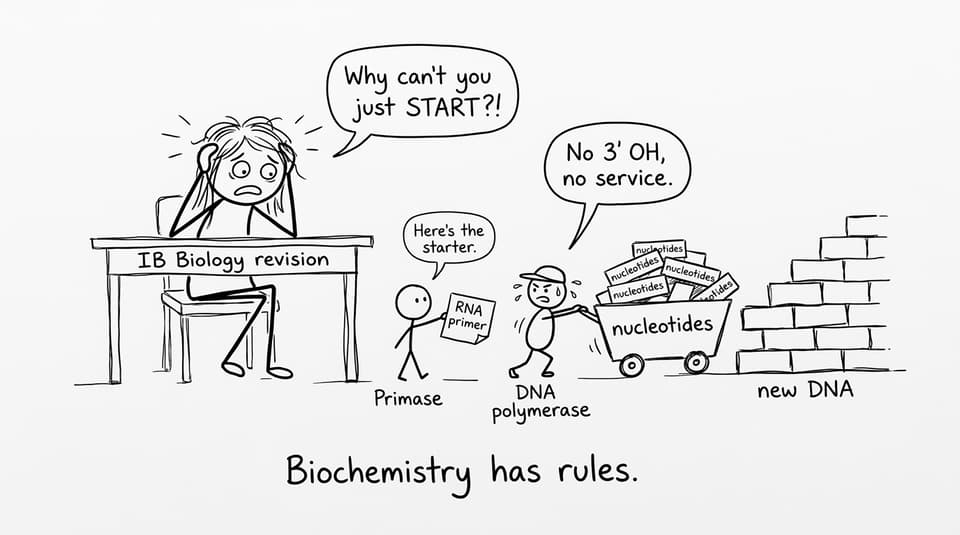
IB Biology student vs enzymes comic
The exam-ready checklist (RNA primers in one minute)
For IB Biology exam prep, keep this tight mental checklist:
DNA polymerase can only add nucleotides to an existing 3′ OH group.
Primase can start a new strand, so it builds a short RNA primer.
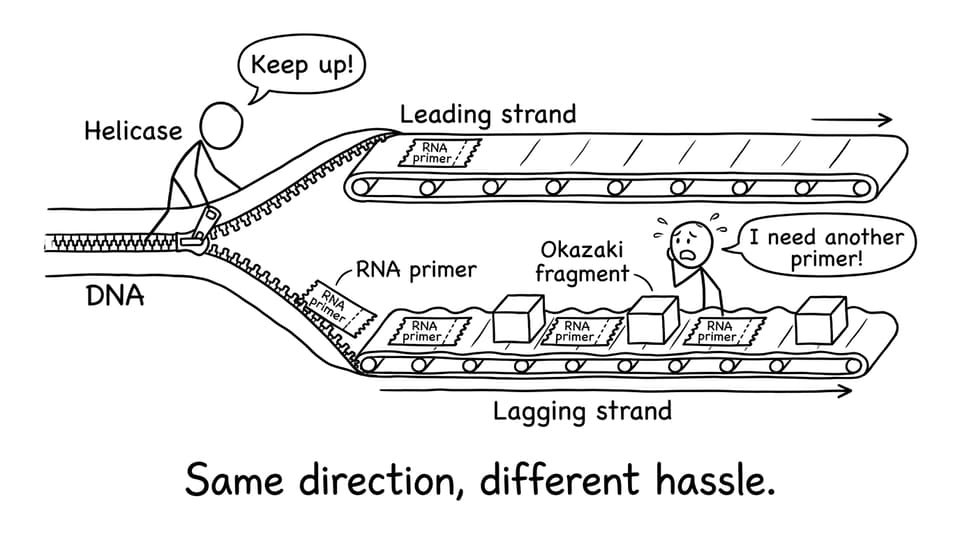
The leading strand usually needs one RNA primer.
The lagging strand needs many RNA primers for Okazaki fragments.
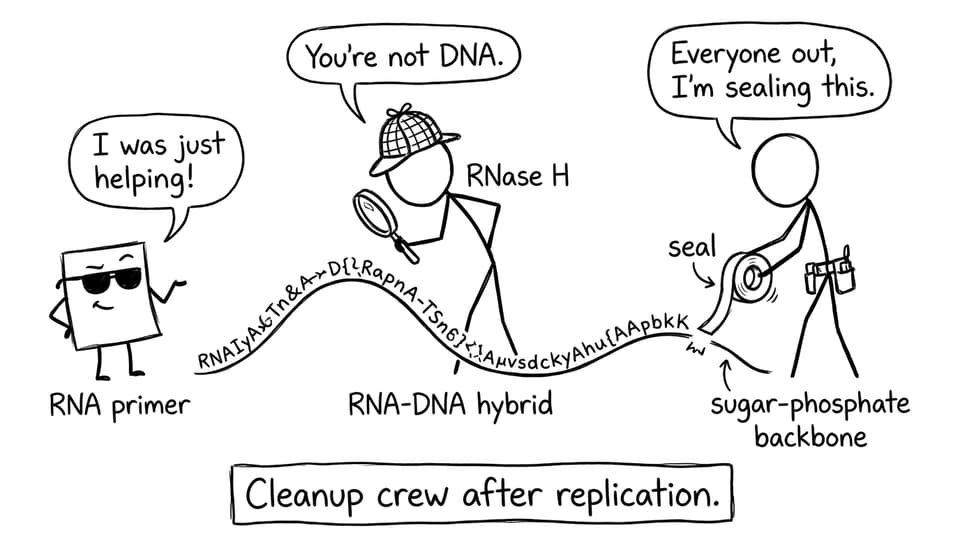
RNA primers are later removed, replaced with DNA, and sealed by ligase.
Here is the core idea IB Biology examiners love: DNA polymerase cannot initiate synthesis de novo. It is built to extend, not to begin.
Chemically, DNA polymerase forms a phosphodiester bond by attaching an incoming nucleotide to a free 3′ hydroxyl (3′ OH) on a pre-existing strand. No free 3′ OH, no first bond. So the cell solves the problem by providing a tiny starter segment: an RNA primer.
That primer is made by primase, an enzyme that can start a short nucleotide chain without needing an existing 3′ end. In many textbooks and markschemes you will see primer length given as roughly 5-10 nucleotides. It is short, temporary, and essential.
Leading vs lagging strand: where primers matter most
Students often remember “leading continuous, lagging discontinuous,” but IB Biology questions usually ask why primers appear differently on each.
On the leading strand, DNA polymerase can follow the replication fork and synthesize continuously in the 5′→3′ direction. So primase lays down one RNA primer near the origin, and polymerase extends from it.
On the lagging strand, the template orientation forces polymerase to work away from the fork in short bursts. The cell builds the new strand as Okazaki fragments, and each fragment needs its own RNA primer to provide that 3′ OH starting point.
This is a subtle but high-value IB Biology point: RNA primers are useful partly because they are temporary and recognizable.
Because the primer contains RNA, the cell can identify the RNA-DNA hybrid region and remove it using specialized enzymes (for example RNase H in eukaryotes, and DNA polymerase I in prokaryotes with exonuclease activity). After removal, a DNA polymerase fills the gap with DNA nucleotides, and DNA ligase seals the final nick in the sugar-phosphate backbone.
That “use RNA so it can be removed cleanly” logic is often what markschemes want, especially when comparing enzymes and roles at the replication fork.
When an IB Biology question asks about primers, aim for a crisp chain of reasoning:
DNA polymerase needs a 3′ OH to add nucleotides.
Primase synthesizes a short RNA primer to supply that 3′ OH.
One primer starts the leading strand; multiple primers start Okazaki fragments on the lagging strand.
RNA primers are removed, replaced with DNA, and fragments are joined by ligase.
Then test it under time pressure using RevisionDojo’s Questionbank and reinforce recall with Flashcards. If you are stuck on wording, the AI Chat can help you refine a markscheme-style explanation, and the Study Notes keep the definitions tight. When you want realism, build a mini set with Predicted Papers and Mock Exams, then use the Grading tools to check whether your phrasing is precise.
Closing: primers are small, but they unlock the whole process
In IB Biology, RNA primers are a perfect example of how a tiny constraint shapes an entire system. DNA polymerase is powerful, but it is not allowed to improvise; it needs a 3′ OH to begin. Primase provides that start, the lagging strand multiplies the problem into many starts, and the cell’s cleanup crew removes every RNA trace and seals the backbone.
If you want to turn this into dependable exam marks, start with the IB Biology resources hub, revise with RevisionDojo’s Study Notes and Flashcards, then lock it in with the Questionbank, AI Chat, and targeted Mock Exams. That is how details like “RNA primer provides a 3′ OH” stop being a fact you hope you remember and become a sentence you can write under pressure.