
Starting the Diploma Programme can feel like arriving halfway through a conversation. Your teacher mentions a new guide. A textbook says it covers the latest course. A video discusses an assessment component you have never heard of.
So, which IB syllabus am I on? The reliable answer comes from your final examination session, not simply the year you started DP1. For each subject, find the official guide that applies to that session and check its first-assessment year. Unless the IB has published a replacement that begins before your session, that is your syllabus.
For example, a typical May-session student beginning DP1 in August or September 2026 expects final assessment in May 2028. A guide marked “First assessment 2025” can still be correct in 2028. “First assessment” means the first session using that curriculum, not the only year in which it applies.
The quick syllabus check
Use this checklist before downloading notes, buying a textbook, or beginning assessment preparation:
- Confirm your expected final examination month and year with your IB coordinator.
- Write down the exact subject name, level, and language.
- Find the official IB subject guide or subject brief.
- Locate the words “first assessment” inside the document.
- Check whether the IB has announced a newer curriculum for your examination session.
- Compare the assessment outline with the one supplied by your teacher.
- Use revision resources labelled for the same curriculum version.
If those details align, you are probably looking at the right syllabus. If they do not, pause and ask your coordinator before reorganizing your study plan.
What a first-assessment year actually means
Every revised IB course follows a timeline. The curriculum is published, teachers begin teaching it, and students eventually complete the first assessments under that version.
For a conventional two-year course, the relationship often looks like this:
| Timeline label | What it tells you |
|---|---|
| First teaching | When schools normally begin teaching the revised course |
| First assessment | The first examination session assessed under that course |
| Last assessment | The final session for an outgoing course, when explicitly stated |
| Your examination session | The month and year that determine which version applies to you |
An older-looking date does not automatically indicate an outdated syllabus. Mathematics: Analysis and Approaches and Mathematics: Applications and Interpretation currently use courses introduced for first assessment in 2021 for students assessed before the revised mathematics courses reach first assessment in May 2029. RevisionDojo’s guide to the IB Mathematics syllabus changes for 2029 explains that transition in more detail.
Work backwards from your examination session
The safest method is simple: begin at the end.
Suppose you entered DP1 in August 2026 and expect to complete the Diploma in May 2028. Your working examination session is May 2028. Check every subject against the curriculum used in that session rather than searching for “2026 syllabus.”
Your subject list should record four details:
| Subject record | Example format |
|---|---|
| Exact course | Biology |
| Level | HL |
| Final session | May 2028 |
| Applicable guide | First assessment 2025 |
Repeat this for all six subjects.
Examples relevant to current DP1 students
Official IB material confirms that revised Biology, Chemistry, and Physics courses reached first assessment in 2025. In Biology, the curriculum uses four broad themes and levels of biological organization, alongside an internally assessed scientific investigation. Older resources may still explain the science well while using the wrong structure or assessment expectations.
Computer Science provides a different example. The IB identifies its revised course as first assessed in 2027. A student taking Computer Science in May 2028 would ordinarily use that version, subject to confirmation from the school and official guide.
Mathematics illustrates an approaching transition. The IB’s published curriculum-update schedule places revised Mathematics: Analysis and Approaches and Mathematics: Applications and Interpretation courses at first teaching in August or September 2027 and first assessment in May 2029. Consequently, a May 2028 candidate should not switch to a resource created specifically for first assessment 2029.
You can monitor transitions through RevisionDojo’s IB syllabus changes tracker. For broader context, see the guide to how the IB structures its subject syllabuses.
How IB syllabus changes affect your work
A syllabus change can alter four things that matter immediately to a DP1 student.
Content boundaries
Topics can be introduced, removed, renamed, or reorganized. An older textbook may remain scientifically accurate while omitting central content or covering material you do not need.
Assessment structure
The number, duration, weighting, and purpose of components can change. Use the assessment outline in your applicable official guide and confirm it with your teacher.
Command terms and criteria
Familiar knowledge may require a different kind of response. Internal assessment criteria, mark allocations, and instructions can change, so coursework built around superseded criteria may miss what current examiners reward.
Vocabulary and course organization
A revised guide may place familiar ideas under new themes. This affects lesson sequences and how RevisionDojo Study Notes, Flashcards, and Questionbank practice should be filtered.
RevisionDojo explains individual transitions through resources such as the new Language B syllabus timeline and the Language ab initio changes for 2029. These show how to read a curriculum transition without confusing first teaching with first assessment.
How to verify a document before trusting it
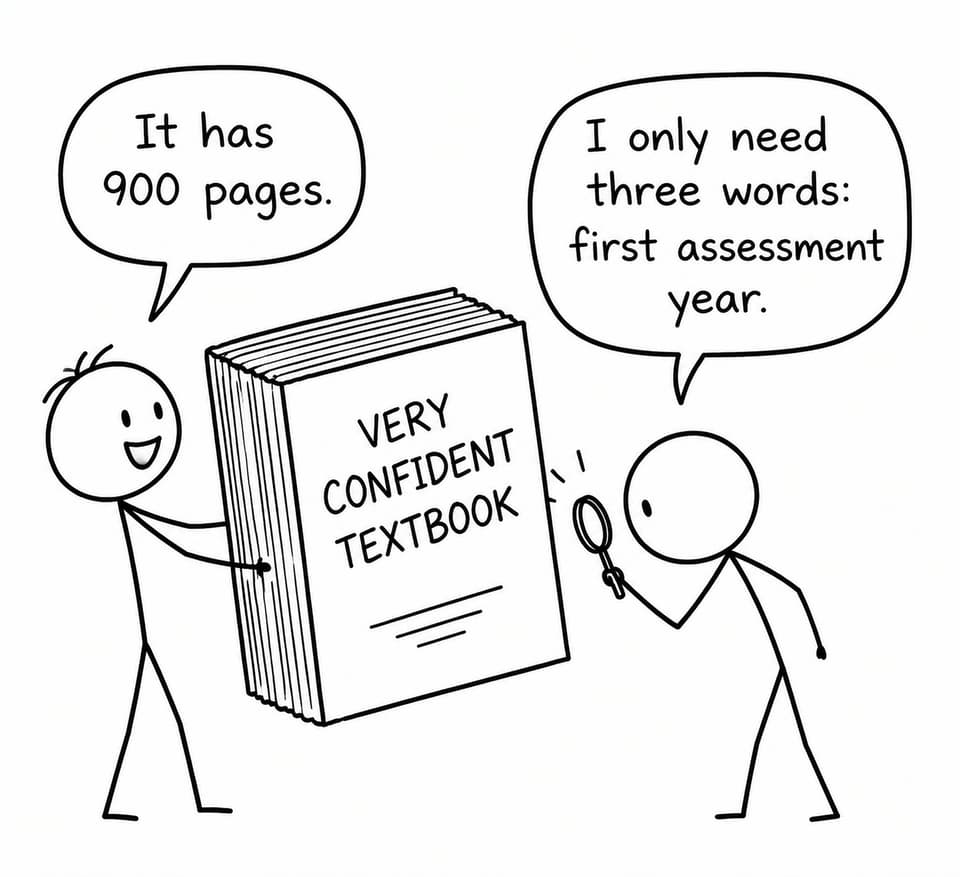
A confident title is not evidence that a resource matches your course. Open the document and inspect it.
First, look for the subject’s complete official name. “IB Maths” is not specific enough because the Diploma Programme offers two mathematics courses at SL and HL.
Next, search the guide for “first assessment.” Then compare its assessment outline with the one your teacher provided. Check component names, durations, weightings, permitted materials, and internal assessment requirements directly against the guide.
A resource can be recently uploaded while explaining an older course. Upload date and syllabus date answer different questions.
If you find a mismatch, do not average the versions together. Show both documents to your teacher or coordinator and ask which one governs your registered session.
Common mistakes that create avoidable confusion
The first mistake is searching by calendar year alone. “IB Biology 2026” might describe a resource published in 2026, a student beginning in 2026, or an examination held in 2026. None of those labels necessarily identifies the guide version.
The second is trusting a textbook cover without checking its contents. Publishers may use phrases such as “new syllabus” long after a newer review has been announced.
The third is assuming every subject changes together. IB curriculum reviews occur on subject-specific schedules. In one six-subject programme, a student can legitimately use guides with several different first-assessment years.
The fourth is confusing announcements with immediate changes. A future curriculum may already appear on the IB website while your cohort remains on the preceding version. RevisionDojo’s explanation of how its IB resources are updated can help you distinguish current materials from upcoming ones.
Build a syllabus-safe study system
Once you have confirmed the correct versions, save a one-page syllabus record. Include each subject, level, examination session, guide title, first-assessment year, and the date you last verified it. Store the official documents somewhere easy to revisit.
Then align every study tool with that record. RevisionDojo’s Questionbank, Study Notes, Flashcards, AI Chat, Grading tools, Predicted Papers, Mock Exams, Coursework Library, and Tutors are most useful when you select the course and version matching your cohort. If a label seems ambiguous, verify it rather than assuming.
Treat AI explanations the same way. Provide your exact subject, level, session, and first-assessment year, but confirm assessment rules against the official guide. AI can explain a rule; it should not create one.
Subject-expert review flag: students taking an anticipated subject, retaking an assessment, transferring schools, or following an unusual examination schedule may not fit the standard two-year timeline. These cases require individual confirmation from the school’s DP coordinator.
Your syllabus is a coordinate, not a date
The question is not merely, “What year did I start?” Your real coordinate combines subject, level, examination session, and guide version. Once those four pieces agree, the noise becomes manageable.
RevisionDojo brings syllabus-aligned learning into one place, from concise notes and targeted questions to coursework support and realistic mock practice. More importantly, it gives you a structure for revising the course you will actually be assessed on.
Curriculum dates are easy to miss when DP1 becomes busy. Sign up for RevisionDojo’s syllabus and deadline alerts by email when the option is available in your account. Timely notice of a guide update or approaching deadline can prevent weeks of preparation from drifting in the wrong direction.