

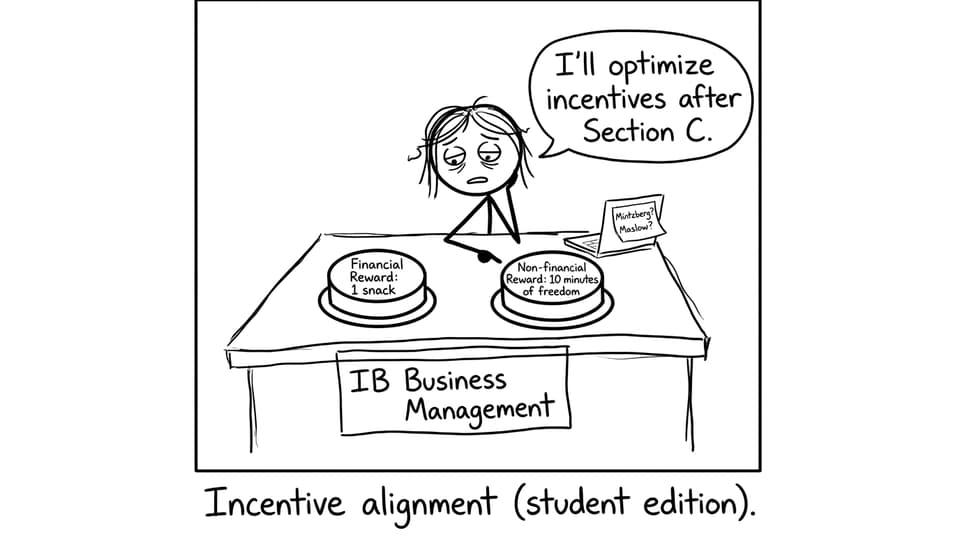
If you have ever told yourself, “If I finish this case study, I’ll buy bubble tea,” you have already run a tiny experiment in IB Business Management. You chose a financial reward because it feels immediate, measurable, and fair: effort in, benefit out.
Businesses think the same way. But the best managers don’t pick money because it’s “stronger.” They pick it because it fits the moment. In IB Business Management, that fit is what examiners want you to explain and evaluate.
Quick exam checklist (use this in IB Business Management answers)
Use financial rewards when the business needs:
-
Short-term performance you can measure fast
-
Fairness when pay is below market rate or living costs are high
-
Retention of top performers at risk of leaving
-
Recruitment in a tight labour market
-
Output in routine, repetitive roles
Then evaluate: financial rewards can raise costs, cause rivalry, or narrow focus to only rewarded tasks.
When financial rewards beat non-financial ones in IB Business Management
When short-term performance must move now
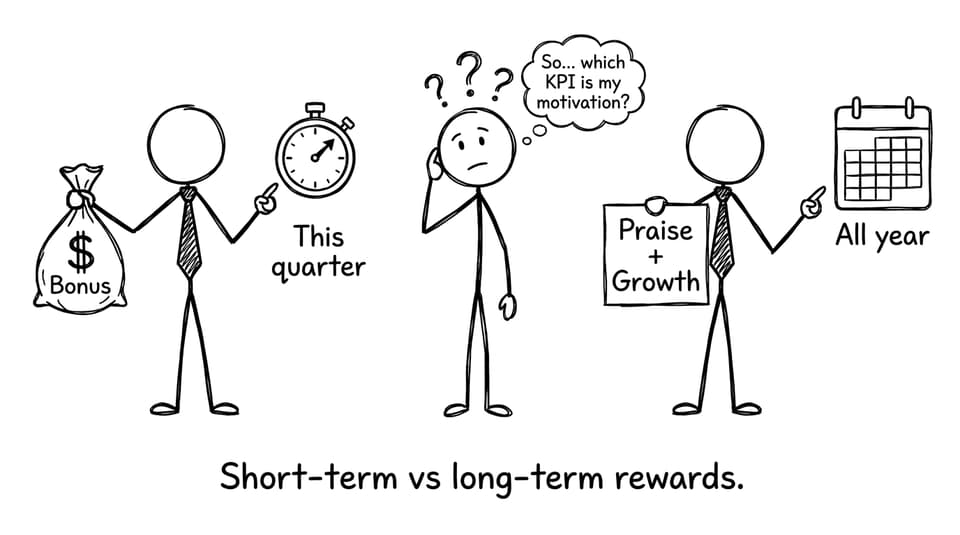
If a firm has a time-sensitive target (end-of-quarter sales, urgent production deadlines), financial incentives like bonuses or commission are direct levers. In IB Business Management, this works best when performance is clearly measurable and employees can see the line between action and reward.
A useful link for wording and examples is the syllabus-aligned page on 2.4 Motivation and Demotivation. For exam practice, pair it with the Topic 2.4 Questionbank to train application and evaluation.
When pay is a hygiene factor (and dissatisfaction is the real threat)
Sometimes motivation isn’t about “inspiring” people. It’s about removing a constant drain. If employees feel underpaid, non-financial rewards (praise, titles, staff socials) can feel like noise.
This is where Herzberg’s idea is useful in IB Business Management: salary often prevents dissatisfaction more than it creates true satisfaction. Use 2.4.1 Motivation Theories Notes to build clean theory paragraphs, then define key terms precisely with the IB Business Management glossary.
When exceptional performance needs a visible signal of fairness
A team member who delivers a difficult project, takes on extra responsibility, or exceeds KPIs often expects recognition that matches the scale of the contribution. Financial rewards communicate seriousness and can protect retention.
To write this well in IB Business Management, add evaluation: bonuses may motivate others, but they can also create resentment if criteria are unclear.
When the labour market is competitive
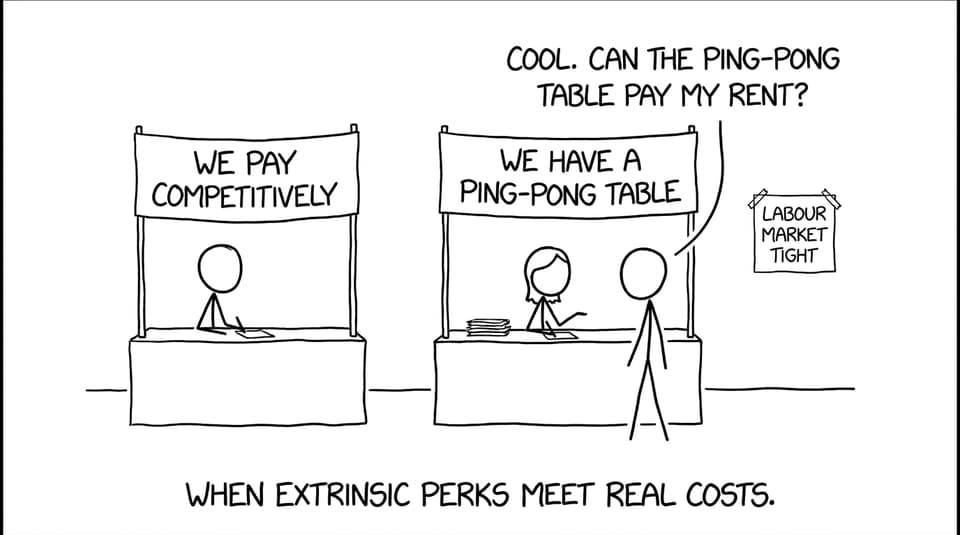
In industries where skilled employees have options, higher wages or signing bonuses can be necessary just to get candidates through the door. A ping-pong table cannot compete with rent.
Link your point back to HR strategy using Unit 2 HR Management overview and, if you want a broader exam approach, use How to Maximize Your Score in IB Business Management to shape analysis and judgement.
When work is routine and output-focused
If tasks are repetitive, tightly supervised, or standardized, financial incentives can sustain focus. This aligns with Taylor-style assumptions often discussed in IB Business Management.
For definitions and examples of wages, salaries, PRP, and commission, use the clear notes on 2.4.6 Financial Rewards. Then balance your essay by contrasting with 2.4.7 Non-Financial Rewards Notes.
Common pitfalls (evaluation marks in IB Business Management)
Financial rewards can backfire when they:
-
Encourage “reward chasing” over teamwork
-
Reduce intrinsic motivation in creative or purpose-driven roles
-
Increase costs and create expectations that are hard to maintain
-
Cause gaming of targets (hitting the metric, missing the real goal)
A strong evaluation line: the best HR approach is often a blend, chosen by context.
Conclusion: the IB Business Management takeaway
Financial rewards are best when a business needs measurable performance, fair compensation, talent attraction, or a clear signal that exceptional effort matters. Non-financial rewards are best when the goal is deeper engagement and long-term commitment.
To revise this topic efficiently, use RevisionDojo as your full loop: learn the theory with Study Notes, test it in the Questionbank, lock in definitions with Flashcards, and clarify weak spots with AI Chat. Then level up with Mock Exams, Predicted Papers, and grading tools to tighten exam technique, and use the Coursework Library and Tutors when you need targeted support. That’s how IB Business Management stops being a set of terms and becomes confident decision-making under exam pressure.