



Falling Behind in IB Design Technology? Do This Next
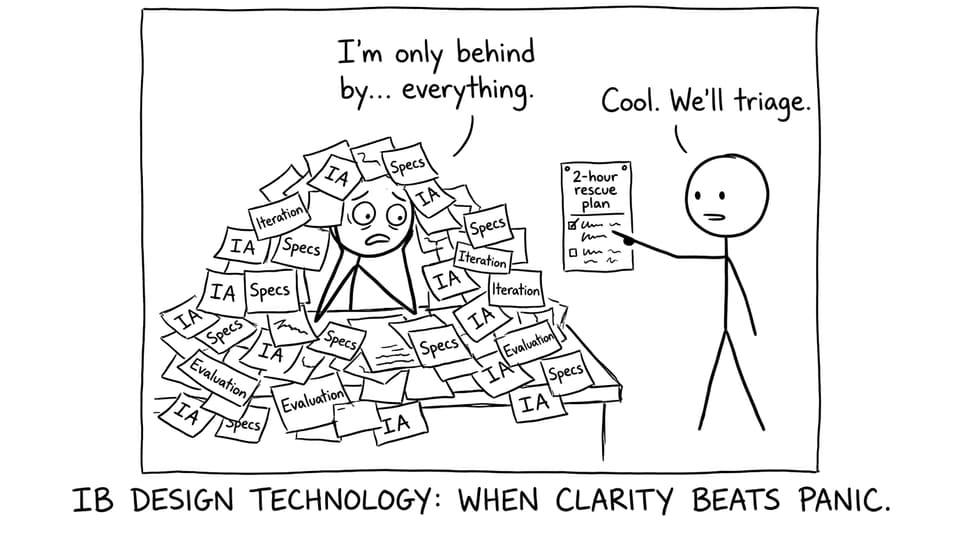
You don’t usually decide to fall behind in IB Design Technology. It happens quietly: a prototype that takes longer than expected, research notes that feel “good enough,” a week where other subjects shout louder. Then one day you open your folder and realize the project isn’t late in one dramatic way; it’s late in fifty small ones.
Here’s the reassuring truth: IB Design Technology is one of the most recoverable IB subjects when you respond with strategy, not panic. The fastest comebacks come from students who stop trying to do everything and start doing the few things that unlock marks across the whole assessment.
A quick recovery checklist (save this)
Use this checklist to reset your IB Design Technology direction in under 20 minutes:
-
Identify where you’re behind: missing work, unclear work, or low-scoring work.
-
Freeze new content for 48 hours.
-
Fix the highest-impact sections first (problem statement, requirements, iteration, evaluation).
-
Simplify the project so you can finish it with evidence.
-
Rebuild exam skill with targeted practice questions and feedback loops.
If you want one hub that keeps everything organized, start with IB Design Technology Resources and work outward.
Don’t panic: IB Design Technology rewards clarity, not early starts
In IB Design Technology, examiners can only award marks for what’s clearly shown. They don’t “sense” effort. They don’t fill gaps. That sounds harsh, but it’s also why catching up is possible: if you can improve clarity and justification, you can improve marks quickly.
The temptation when you’re behind is to sprint. But sprinting often creates messy documentation: extra pages, extra sketches, extra features, and still no clear reasoning. A calmer approach is faster.
Step one: diagnose what “behind” really means in IB Design Technology
Most students say they’re behind when one of these is true:
You’re missing core sections
That’s straightforward: certain deliverables simply aren’t there yet.
You have content, but it isn’t scoring
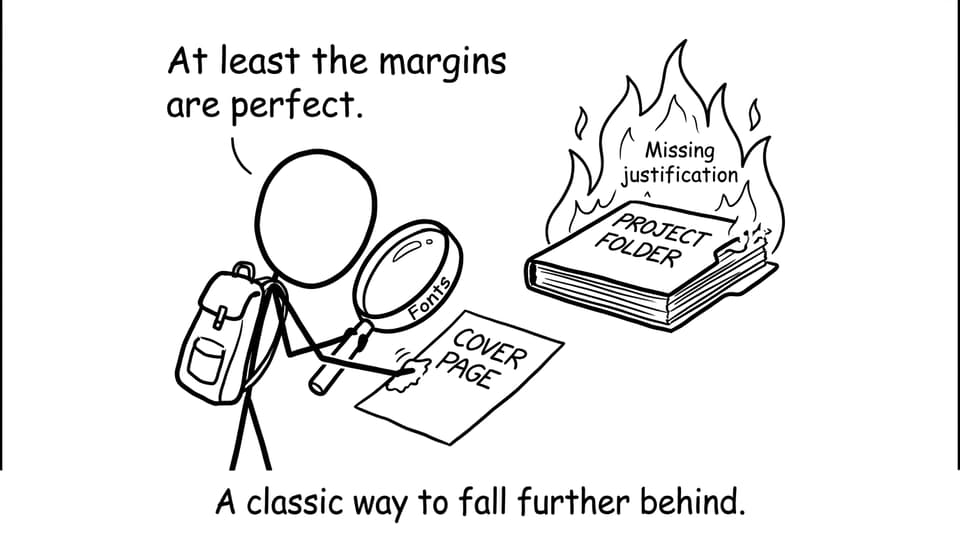
This is the sneaky version. You may have research, sketches, and a build log, but the writing doesn’t prove decision-making. In IB Design Technology, vague statements like “I chose acrylic because it’s strong” don’t carry much weight unless you tie them to user needs, testing, constraints, and trade-offs.
Your project scope has outgrown your timeline
Ambition is noble. But IB Design Technology rewards controlled design thinking. A smaller project with visible iteration and honest evaluation usually beats a complex project that’s unfinished.
For examples of what strong projects look like, compare your work to IB Design Technology IA Examples: What Top Projects Look Like.
Step two: stop adding new content (yes, really)
When you’re falling behind in IB Design Technology, adding more is often a way to avoid the uncomfortable work of explaining your thinking. For the next two days, pause:
-
new research sections
-
new concept directions
-
major redesigns
-
aesthetic upgrades
Instead, do the unglamorous fixes that raise marks:
-
rewrite unclear paragraphs
-
turn claims into evidence
-
add “because” statements that justify decisions
-
make the link between research and requirements obvious
If you need a steady weekly routine after the triage phase, use Best Study Strategies for IB Design Technology Students.
Step three: fix the highest-impact sections first
In IB Design Technology, some improvements echo through multiple criteria.
Make the problem statement specific and user-first
A strong problem statement names a real user in a real context, and shows evidence that the problem matters. If you want to pressure-test your framing, read How Does Design Thinking Work in IB Design Technology?.
Turn requirements into testable requirements
Weak requirements sound like wishes: “lightweight,” “durable,” “easy to use.” Strong requirements sound like tests: “mass under 500g,” “survives a 1m drop test,” “user completes task in under 30 seconds after one trial.”
Make iteration obvious (even if it’s small)
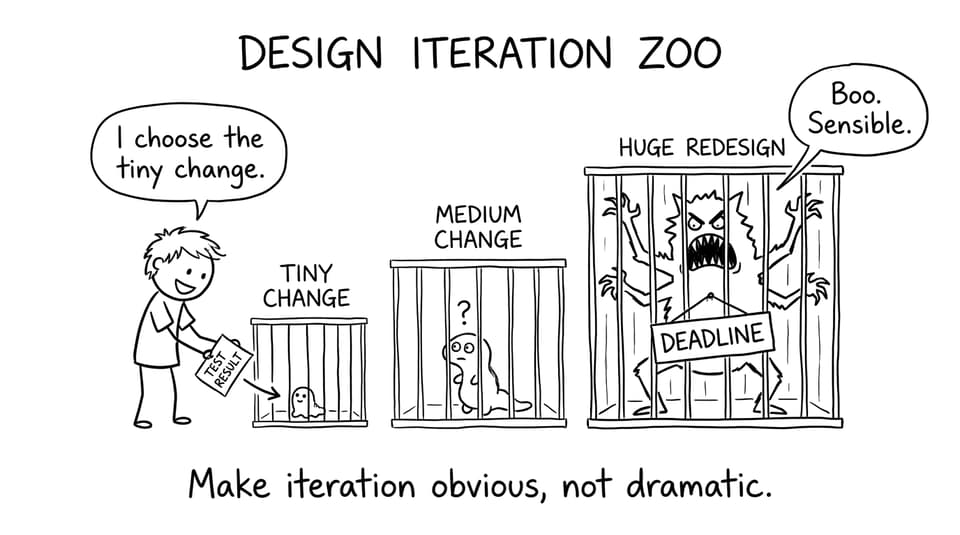
Iteration isn’t about dramatic reinvention. It’s about honest improvement.
Use this four-line formula:
-
What did I test?
-
What failed or underperformed?
-
What change did I make?
-
Why is the change better (evidence)?
Use evaluation to recover marks quickly
Evaluation is where late-stage students can claw back a surprising number of marks.
Strong evaluation in IB Design Technology:
-
judges performance against requirements
-
uses test data and user feedback as evidence
-
admits limitations without excuses
-
suggests realistic next improvements
When you’re close to submitting, follow a structured final check like Finalise and Submit Your IB Design Technology IA.
Step four: simplify the project ruthlessly (and feel good about it)
If your project is wobbling, simplify it until you can finish it well.
That might mean:
-
reducing features
-
narrowing the user group
-
cutting “nice-to-have” requirements
-
choosing processes you can document and repeat
Focused solutions are easier to justify, easier to test, and easier to evaluate. That’s not lowering standards, that’s aligning with how IB Design Technology is assessed.
To avoid accidentally crossing the line into copying while simplifying, use IB Design Technology: Can You Reuse Products or Ideas?.
Step five: rebuild exam confidence in parallel
Falling behind in IB Design Technology is often an IA problem and an exam confidence problem. The fix is short, frequent practice with feedback.
-
Use the IB Design Technology Questionbank to target weak topics.
-
When you’re ready for timed practice, simulate full papers with Design Technology Predicted Papers.
-
If you’re on the new syllabus pathway, start from IB Design Technology Resources (First Exam 2027).
On RevisionDojo, you can combine Study Notes and Flashcards for quick recall, then switch to Questionbank for exam-style application. AI Chat helps you rephrase explanations in markscheme-style language, and Grading tools help you judge whether your written justification would actually earn marks. If your IA needs a model, the IB Design Technology Exemplars and the Coursework Library shorten the guessing game. And when you need human accountability, Tutors can help you prioritize rather than panic.
The calm finish: a smarter way to catch up in IB Design Technology
Falling behind in IB Design Technology doesn’t mean you’re doomed. It means your next hours need to be high-leverage: clarify, justify, simplify, and evaluate with evidence. Do that, and your work starts compounding again.
If you want an all-in-one system to recover faster, use RevisionDojo’s Study Notes, Flashcards, Questionbank, Predicted Papers, Mock Exams, AI Chat, Grading tools, Coursework Library, and Tutors to turn stress into a plan. Start at the IB Design Technology Resources hub, and rebuild momentum one clean decision at a time.