



In the last week before a deadline, most students do the same thing: they look at their prototype, feel relieved it exists, and write a few lines that sound like closure.
But in IB Design Technology, an evaluation is not closure. It’s the moment you prove you were thinking the whole time.
If your evaluation reads like “it worked well,” you’re asking the examiner to trust your mood. The rubric doesn’t mark moods. It marks judgement backed by evidence. That’s why a strong evaluation is often where IB Design Technology IAs swing from “fine” to “high-scoring.”

A quick checklist for a high-scoring IB Design Technology evaluation
Before you write paragraphs, run this short check. A strong IB Design Technology evaluation usually has:
-
Design requirements (success criteria) that are specific and testable
-
A judgement for each key requirement (met / partly met / not met)
-
Testing data and user feedback used as evidence
-
Honest limitations, explained (not just listed)
-
Clear links to iteration (what changed, what improved, what stayed weak)
-
Realistic improvements that follow from evidence
If you’re unsure what examiners prioritise across the project, read What Do IB Design Technology Examiners Look For?
What “evaluation” really means in IB Design Technology
Evaluation in IB Design Technology is the disciplined habit of judging performance against the standards you set earlier.
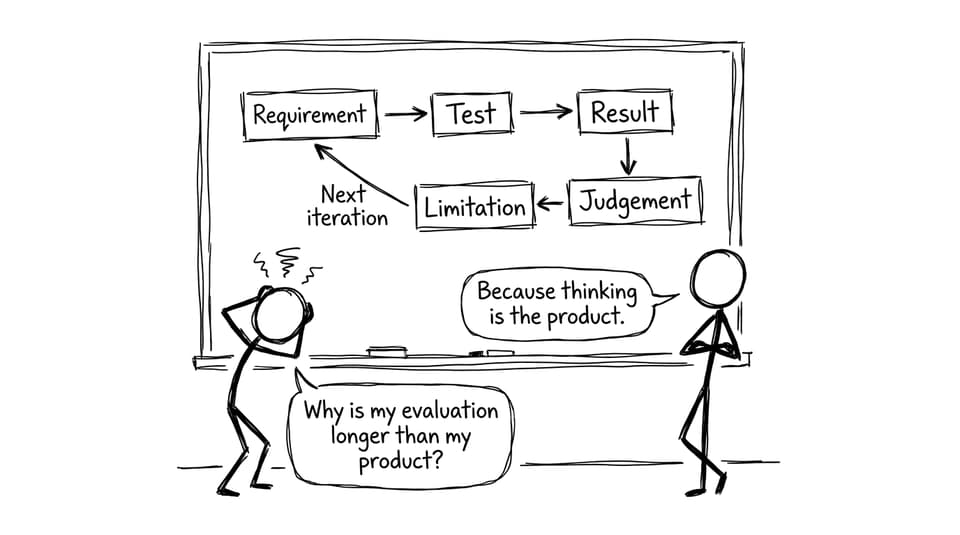
That means your evaluation is not a recap of what you built. It’s an argument:
-
Here is the requirement.
-
Here is the evidence from testing and users.
-
Here is my judgement.
-
Here is the limitation and why it exists.
-
Here is what iteration already improved.
If you want a deeper IA-specific breakdown of success judgement, see How Do You Evaluate Success in the IB Design Technology IA?
The mistake that quietly caps marks
The most common weak pattern in IB Design Technology evaluation is opinion disguised as confidence.
Examples that sound positive but score low:
-
“The product was successful.”
-
“The user liked it.”
-
“The design met the needs.”
These lines don’t fail because they’re wrong. They fail because they’re unprovable.
Examiners can only award marks for claims that are supported. Your goal is to make every judgement traceable to evidence.

Build your evaluation around design requirements (not paragraphs)
A reliable structure for IB Design Technology evaluation is requirement-by-requirement.
For each key requirement, write 4 tight moves:
-
Restate the requirement (keep the exact measurable language).
-
State a judgement (met / partly met / not met).
-
Prove it with evidence (test results, observations, user quotes).
-
Add nuance (limitations, trade-offs, context).
This is also the easiest format for teachers to mark and moderate consistently. If you want to understand that process, read How Do Teachers Mark IB Design Technology Internal Assessments
Use testing as evidence, not decoration
Testing is not there to make your pages look “scientific.” In IB Design Technology, testing is the backbone that allows evaluation to exist.
Strong evaluation uses tests like a lawyer uses exhibits:
-
Pull the specific measurement that answers the requirement.
-
Compare expected vs actual performance.
-
Explain what the result means for the user.
If your testing stage is thin, fix that first. This guide helps: How Do You Test Your Product in IB Design Technology?
And if you want syllabus-aligned support for the evaluation skill itself, the topic hub C3.1 Product analysis and evaluation is a useful anchor.
Be honest about limitations (and explain why they happened)
A surprising truth about IB Design Technology: admitting weakness often raises your mark.
Why? Because honest limitation analysis signals control.
Don’t just write:
- “The prototype is slightly unstable.”
Write:
-
Why instability occurred (material choice, joint method, tolerance, manufacturing constraints).
-
Whether iteration reduced it.
-
Whether solving it is realistic within time, tools, and cost.
That final step matters. Unrealistic redesign fantasies weaken credibility.
Link your evaluation back to iteration
Iteration is the story of your thinking. Evaluation is where you show what that story taught you.
A strong IB Design Technology evaluation will reference earlier versions and say, in concrete terms:
-
What the test revealed in version 1
-
What changed in version 2
-
What improved (with evidence)
-
What still didn’t meet the requirement, and why
If you’re noticing patterns in your own work (like describing instead of evaluating), this exam-focused post is worth reading: What Are the Most Common IB Design Technology Exam Mistakes?
Bring it all together with RevisionDojo
A strong evaluation in IB Design Technology isn’t about sounding impressed with your own work. It’s about sounding certain because you can point to proof.
If you want that structure to feel automatic, build your workflow inside RevisionDojo: practise evaluation-style thinking in the Questionbank, refine terminology with Study Notes and Flashcards, and use AI Chat to convert messy testing notes into clear requirement-linked judgements. When you’re ready to check your draft against criteria, the built-in Grading tools (including the IA rubric graders), Mock Exams, and Predicted Papers keep your writing aligned with what examiners reward. And if you need a human second set of eyes, RevisionDojo Tutors can help you pressure-test whether your evaluation is truly evidence-based.
For a full course hub to support your revision alongside the IA, start here: IB Design Technology Resources