



You open your IB Design Technology notes and suddenly see words that feel like they belong in Physics or Chemistry: stress, strain, conductivity, efficiency. For a moment, it’s easy to panic. Did I accidentally sign up for a full Group 4 science?
Here’s the calmer truth: IB Design Technology does require science knowledge, but it rewards useful science. The kind that helps you justify a material, explain why a mechanism fails, or argue that a redesign is safer. Not the kind that asks you to memorise every formula you’ve ever seen.
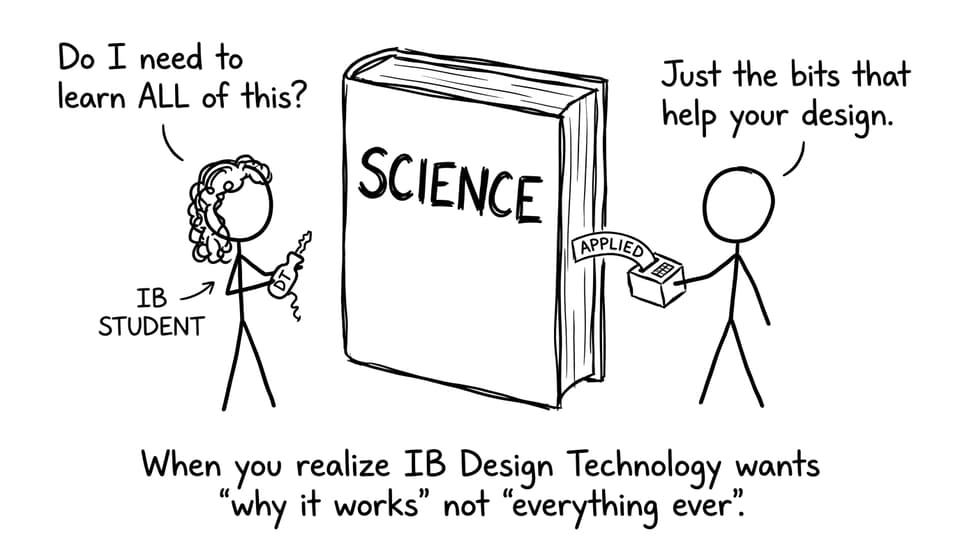
The short answer: science in IB Design Technology is a tool
In IB Design Technology, science shows up when it improves a design decision. Examiners aren’t looking for abstract theory; they’re looking for cause and effect.
If you can explain:
-
why one material outperforms another in a specific context
-
why a structure bends, snaps, heats up, or wears down
-
how a system improves performance, safety, or sustainability
…then you’re using the right level of science for IB Design Technology.
A good way to frame it is: science is your evidence. Design is the claim.
For syllabus-aligned practice, start from the IB Design Technology hub and treat it like your home base.
A quick checklist of the science you actually need
Before you dive back into revision, use this quick checklist to spot gaps.
You’re in a good place if you can…
-
connect material properties to product performance (not just list properties)
-
explain forces and failure using clear diagrams and simple reasoning
-
discuss energy, efficiency, and sustainability in real products
-
apply ergonomics and basic human factors to user-centred design
-
back up IA decisions with testing data and a scientific explanation
If you want a structured way to build these skills, RevisionDojo’s Study Notes and Flashcards help you learn the language fast, while the Questionbank forces you to apply it under exam conditions.
Where science shows up most in IB Design Technology
Materials science (the big one)
If there’s one scientific area that consistently pays off in IB Design Technology, it’s materials.
You don’t need chemical formulas. You do need to explain things like:
-
why a polymer might be better than a metal for weight, corrosion resistance, or manufacturing
-
how toughness vs hardness changes suitability in an impact-heavy product
-
why thermal conductivity matters for handles, casings, or electronics
-
how environmental conditions change performance (UV, moisture, fatigue)
This is also where sustainability becomes real: material choice connects directly to recycling, life cycle thinking, and responsible design.
To practise this the exam way, use topic-based questions like Material classification and properties Questionbank.
Basic physics (but explained, not worshipped)
Physics in IB Design Technology is usually about simple models and clear communication:
-
forces on beams and frames
-
moments and stability
-
stress concentrations
-
mechanical advantage and motion
-
energy transfers, losses, and efficiency
The exam rarely rewards “look how advanced my maths is.” It rewards “I can explain why this design behaves that way.”
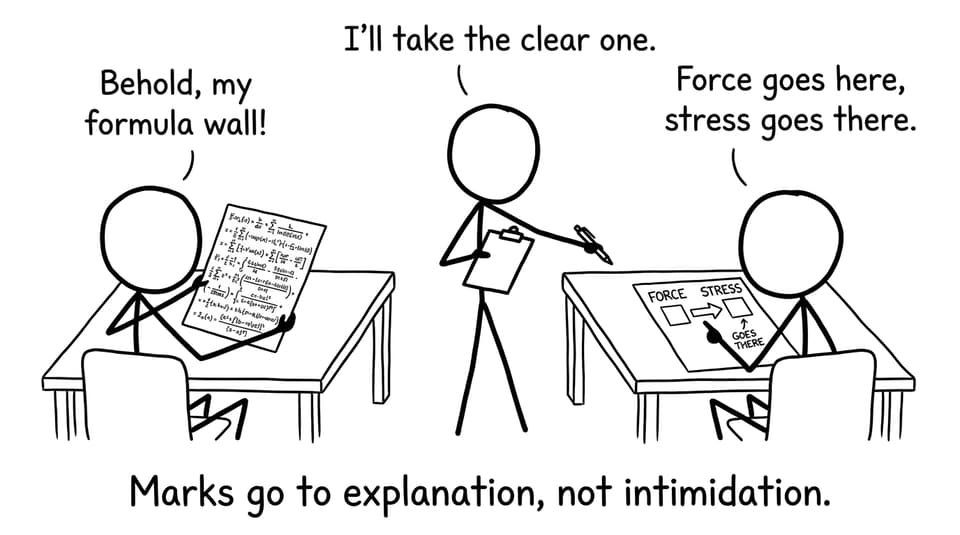
If you’re losing marks, it’s often because your answer stays descriptive. This is why learning command terms matters. Keep Command terms in IB Design Technology exams bookmarked and revisit it before timed practice.
Human sciences (ergonomics sneaks in everywhere)
A lot of students forget this counts as “science,” but it matters constantly in IB Design Technology:
-
anthropometrics (fit, reach, clearance)
-
comfort and posture
-
repetitive strain and safety
-
perception, intuitive use, user error
When you justify a handle shape, interface layout, or safety feature, you’re often using biology and human factors, just in a practical, user-centred way.
How IB Design Technology exams reward science knowledge
In IB Design Technology, science is assessed mainly through application. That means your marks come from linking a concept to the scenario in front of you.
A strong exam response usually does three things:
-
States the relevant concept (briefly)
-
Applies it to the product or context (specifically)
-
Explains the impact on performance, safety, sustainability, or usability
To build that habit, use RevisionDojo’s Questionbank and then check your wording against examiner-style expectations. If you get stuck, AI Chat can help you convert messy thinking into clear “because… therefore…” explanations.
You can also raise your exam readiness with Design Technology Predicted Papers and build stamina with the Mock Exams and Exam builder inside the platform.
Science in the IA: where it becomes visible (and easy to score)
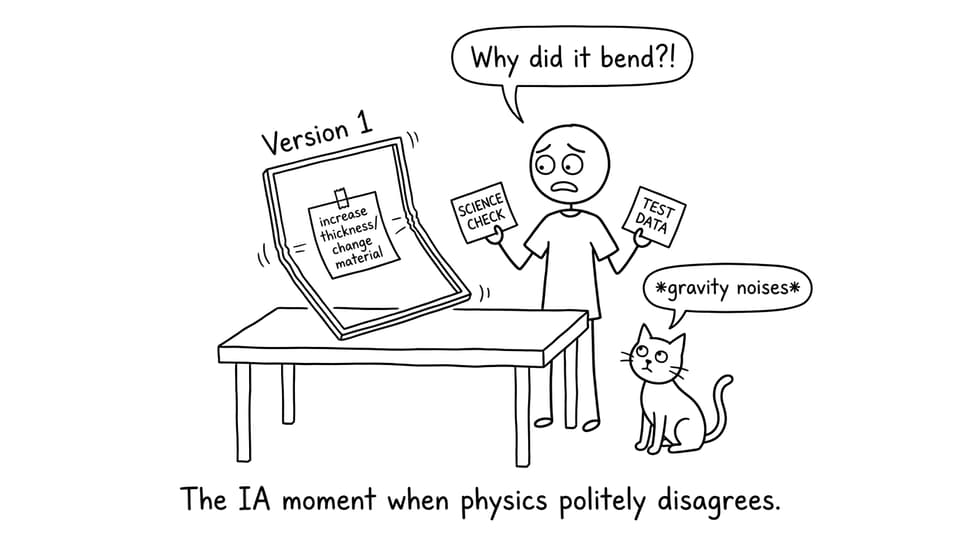
The IA is where IB Design Technology science feels most natural. You’re testing. You’re iterating. You’re learning what fails.
The simplest way to think about it: science is what turns “I changed it” into “I improved it.”
Use science in the IA to:
-
justify why your chosen material suits the user and context
-
interpret test results (and explain unexpected outcomes)
-
explain why prototypes fail and what mechanism caused it
-
evaluate trade-offs with evidence, not opinions
For more strategic guidance on scoring, read How can you score a 7 in IB Design Technology? and keep your weekly routine tight with Best study strategies for IB Design Technology students.
SL vs HL: do you need “more science”?
Both SL and HL students use similar scientific ideas in IB Design Technology. The difference is usually:
-
how often you apply them
-
how confidently you connect systems together
-
how deep your evaluation goes
HL tends to demand stronger links across topics and more frequent justification. But even at HL, the goal is still applied reasoning, not advanced theory for its own sake.
Common science mistakes (and the simple fixes)
In IB Design Technology, students often drop marks by:
-
avoiding science completely (answers become vague)
-
using scientific terms without explaining them
-
overcomplicating explanations that should be clear and visual
-
dumping facts without linking them to a design decision
The fix is almost always the same: make the science serve the design.
If you want your foundations organized in one place, How to create effective IB Design Technology revision notes pairs well with RevisionDojo’s Key Definitions, Flashcards, and targeted Study Notes.
Conclusion: learn the science that buys you marks
The best way to think about IB Design Technology is that science is the quiet partner in every strong answer. It’s what turns a preference into a justification, and a prototype failure into an improvement.
If you want to revise efficiently, use RevisionDojo to keep everything connected: Study Notes for clarity, Flashcards for recall, Questionbank for application, AI Chat for explanations, and Predicted Papers plus Mock Exams for exam confidence. Start in the IB Design Technology hub, and build your science knowledge the way DT rewards it: practical, specific, and tied to better design decisions.