


In IB Biology, there’s a moment in cell respiration that feels almost unfair: you can memorize “glycolysis, Krebs cycle, ETC” and still lose marks because you didn’t explain how energy actually moves.
That’s where NADH and FADH2 quietly do the heavy lifting. They’re small, easy to overlook, and absolutely central to energy transfer. If glucose is the story, NADH and FADH2 are the messengers carrying the plot forward.
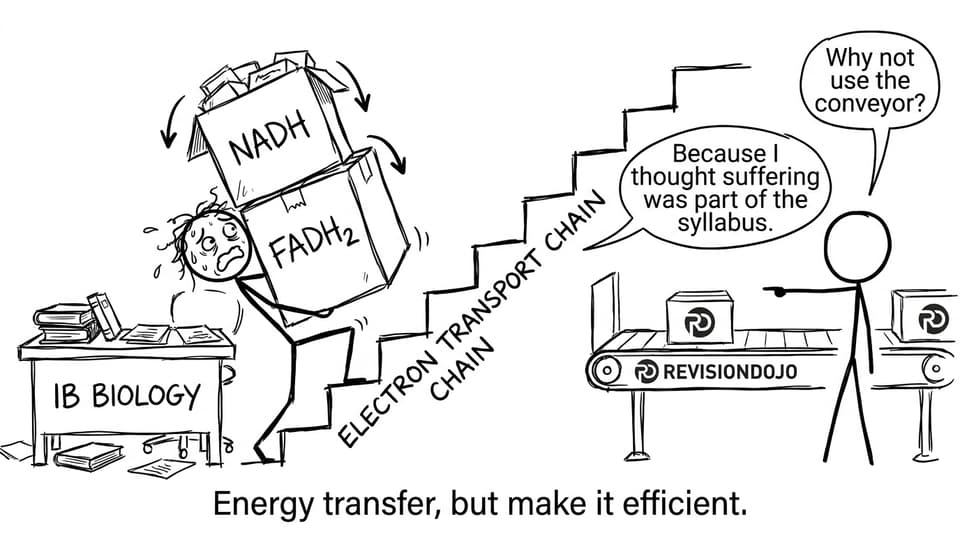
IB Biology quick checklist: what to remember
-
NADH and FADH2 are reduced electron carriers.
-
They’re made during glycolysis, the link reaction, and the Krebs cycle.
-
They deliver electrons to the electron transport chain (ETC) in the inner mitochondrial membrane.
-
Electron flow powers proton pumping and builds a proton gradient.
-
The proton gradient drives ATP synthase (chemiosmosis).
-
NADH usually leads to more ATP than FADH2 because it enters earlier.
For the full pathway context, anchor yourself in RevisionDojo’s 2.8 Cell respiration notes and the topic hub for C1.2 Cell respiration.
How NADH and FADH2 capture energy in IB Biology
In IB Biology, you’ll often see the phrase “hydrogen atoms are removed.” What that really means is: high-energy electrons are stripped from molecules step-by-step instead of being released all at once as heat.
-
NAD+ accepts electrons (and associated H+) and becomes NADH.
-
FAD accepts electrons (and associated H+) and becomes FADH2.
You can track this directly in the syllabus-aligned explanation of NAD as a hydrogen carrier (HL) and how the Krebs cycle generates multiple reduced carriers in oxidation and decarboxylation of acetyl groups.
Why carriers matter more than the glucose itself
A useful mental model: early respiration stages are “charging” NADH and FADH2. The real ATP payoff comes later, when those carriers “spend” their electrons in the ETC.
IB Biology: where NADH and FADH2 go in the electron transport chain
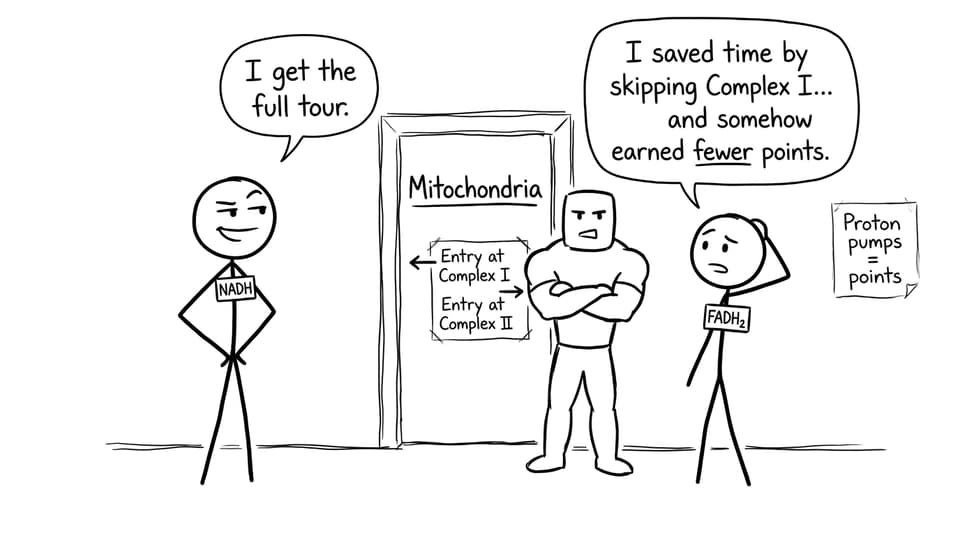
Both carriers deliver electrons to the ETC, but they enter at different points:
-
NADH donates electrons at Complex I.
-
FADH2 donates electrons at Complex II.
Because NADH enters earlier, its electrons travel through more energy-releasing steps. That usually means more proton pumping and a higher ATP yield.
If you want the clearest markscheme-friendly wording, use RevisionDojo’s breakdown of transfer of energy by reduced NAD (HL) and the step-by-step logic in generation of a proton gradient (HL).
The exam line that earns marks
In IB Biology, don’t just say “they make ATP.” Say:
NADH and FADH2 donate electrons to the electron transport chain, and the energy released during electron transfers is used to pump protons across the inner mitochondrial membrane, creating a proton gradient that powers ATP synthase.
That sentence contains the mechanism markers examiners look for.
Regeneration: the quiet reason respiration doesn’t stall
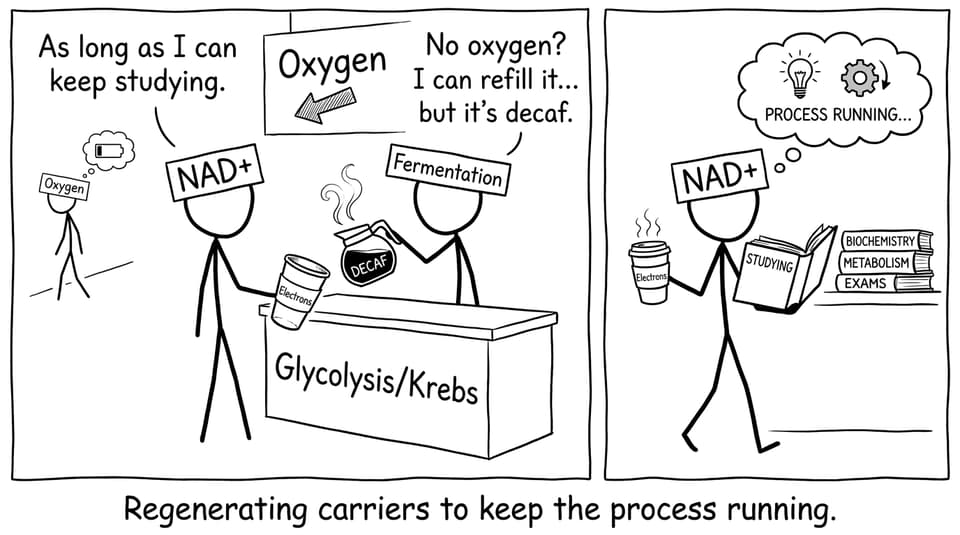
NADH and FADH2 are only useful if they can be turned back into NAD+ and FAD. This regeneration is essential because NAD+ and FAD are needed as electron acceptors in glycolysis and the Krebs cycle. No acceptors, no continued oxidation, no steady ATP supply.
Under anaerobic conditions, cells can regenerate NAD+ through fermentation pathways. It’s not efficient, but it keeps glycolysis running long enough to matter.
For targeted practice that exposes common traps, use the 8.2 Cell respiration Questionbank and the broader 8.2 Cell respiration topic page.
Bring it together with RevisionDojo
If NADH and FADH2 feel like “extra details,” remember this: they are the bridge between breaking molecules apart and actually making usable ATP. In IB Biology, explaining that bridge is often the difference between a vague answer and a top-mark one.
On RevisionDojo, you can lock this down fast by pairing syllabus-precise notes with active practice: use the Study Notes for clarity, Flashcards for recall, the Questionbank for exam-style accuracy, and AI Chat when your confusion is specific but hard to word. When exams get close, Predicted Papers, Mock Exams, and Grading tools help you practise under pressure without guessing what matters.
If you want one place to consolidate everything you need for IB Biology respiration, start at the IB Biology tag page and build outward from there.


